Black Mirror #81: what’s inside the Kometa, the Gerbera with a warhead, a combat video database for AI training and other Russian miltech updates
Overview of Russian defence-industrial complex developments for the second week of October
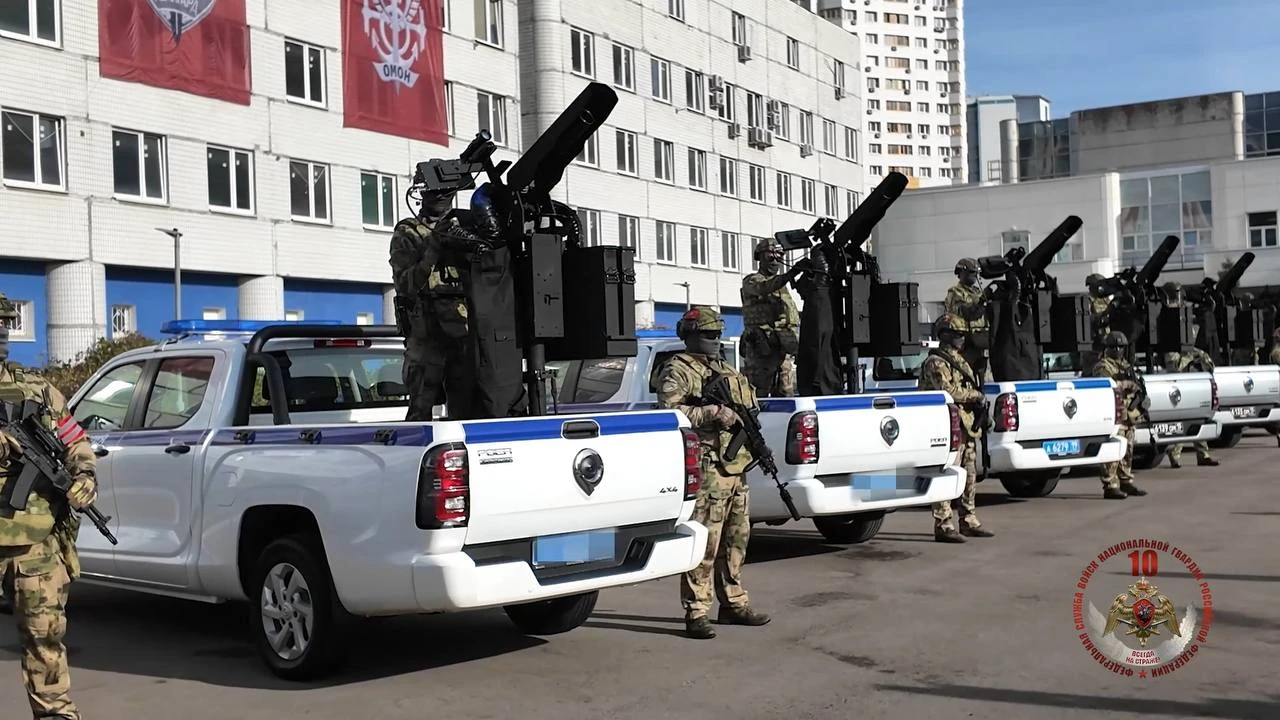
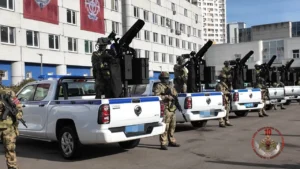
Moscow’s mobile fire group equipment
Last week, Russia reported refurbishing and modernising production facilities for Tu-160M2 strategic bombers and announced plans to train AI on combat footage. Other developments included an upgraded version of the Gerbera-2, now capable of carrying a warhead, and the reported deployment to the front lines of a circular-wing drone known as Knyaz Vladimir Svyatoslavovich. Read about these and other developments in Russia’s military-industrial complex in Defender Media’s weekly Black Mirror.
Foreign components and the production of Russia’s Kometa navigation systems
Ukraine’s Main Directorate of Intelligence (DIU) has published information on producing Russia’s Kometa anti-jamming navigation modules on its War&Sanctions portal.
According to the DIU, Russia is already using Kometa modules with 16 patch antennas at scale and is working to establish serial production of 20-element antenna arrays. The use of CRPA systems manufactured in China and Russia’s Alabuga special economic zone, featuring 32 antennas, has also been confirmed.
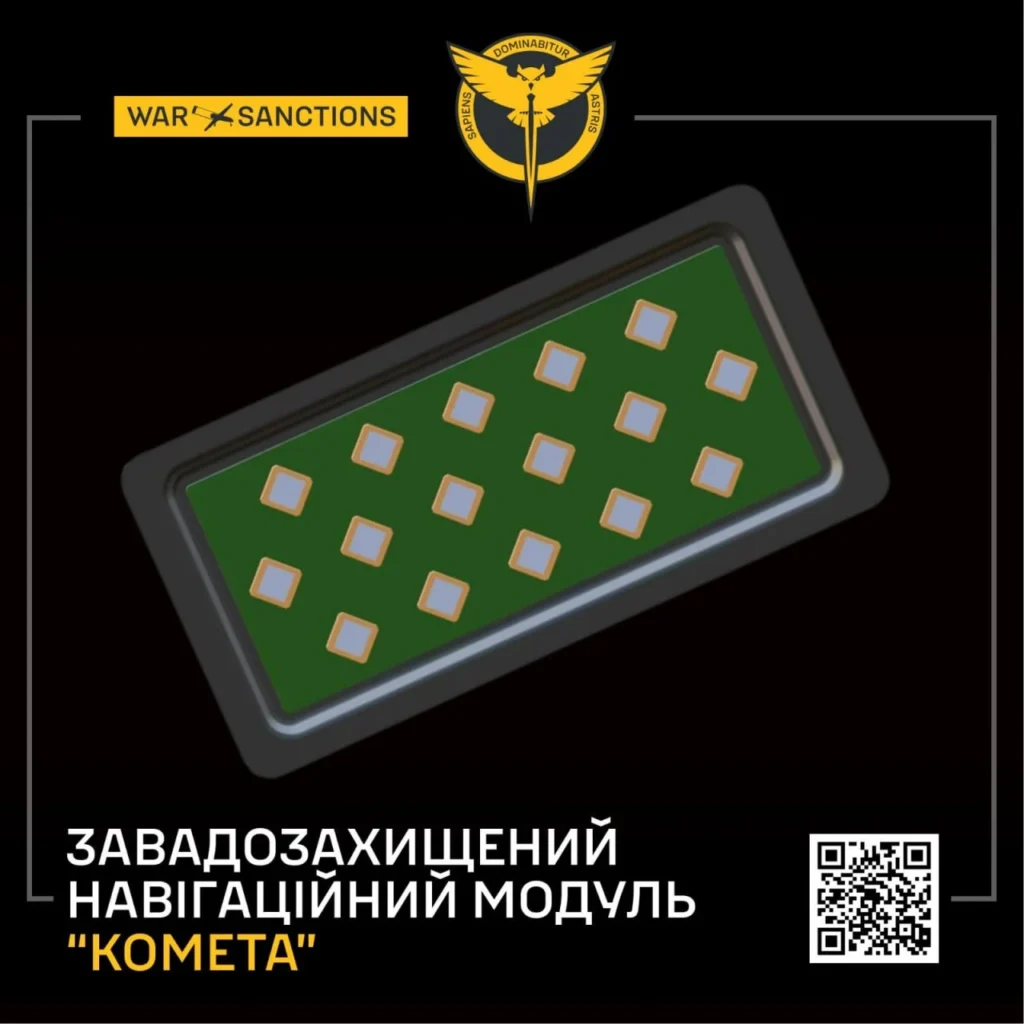
The standard Kometa design includes an antenna array with patch antennas and a signal-processing module built around an Altera Cyclone field-programmable gate array (FPGA), an Intel subsidiary. The DIU identified 37 foreign-made electronic components in Russian unmanned aerial vehicles. The DIU has also published details on 28 companies involved in manufacturing Kometa modules and supplying their electronic components, as well as 13 items of foreign-made industrial equipment used in their production.
Kometa navigation modules are used in Russian missiles, drones, and guided aerial bombs. They rely on controlled reception pattern antennas (CRPAs), which reduce the impact of electronic warfare interference by adjusting the antenna’s reception pattern and employing signal-processing algorithms.
The system’s resistance to interference depends on the number and arrangement of patch antennas, as well as the signal-processing algorithms used. The antenna array enables the system to determine the spatial characteristics of incoming signals and compensate for interference.
Gerbera-2 receives a 10kg high-explosive fragmentation-incendiary warhead
The Russian Gerbera-2 drone has received a 10kg high-explosive fragmentation-incendiary warhead in a new variant, according to Russian military commentators.
In this new configuration, the drone carries a more powerful warhead containing fragmentation, high-explosive, and incendiary elements. The incendiary mixture is housed in a separate flexible plastic tank behind the main warhead. This configuration combines blast and fragmentation effects with an additional incendiary capability.
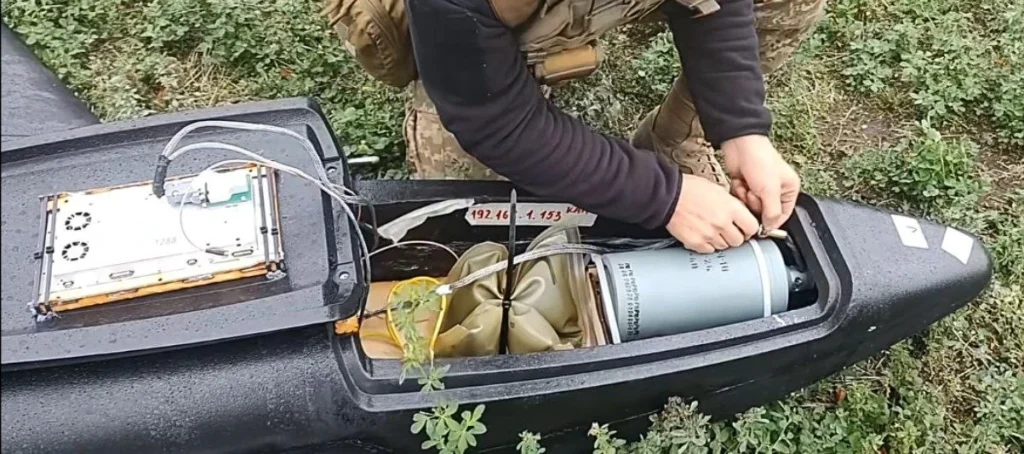
Previously, drones of this type either carried no warhead or carried lighter OFBCh-2 and OFBCh-3 variants, primarily intended for self-destruction or to endanger anyone attempting to inspect them.
The drone retains the basic model’s distinctive layout: a swept wing, a central vertical stabiliser, and a pusher propeller at the rear. One of the main changes is a more powerful piston engine. According to published information, the drone now has an engine displacement of around 275cc, half that of the engine used in the Shahed/Geran-2 strike drone.
Preliminary reports indicate that the Izhevsk Motorcycle Plant has set up production of these engines for Russian drones.
Jet-powered Geran-4 drones reach Lviv and Lutsk from Crimea
Over the past week, Russian forces launched several dozen jet-powered drones from Crimea toward Ukraine’s western regions. According to military analyst Serhii Beskrestnov, the drones flew through the Odesa region along the border with Moldova, covering 820–880km from their launch point.
Available information indicates that the Geran-4 drones flew at an altitude of 5–6km, maintaining an average speed of 320–380km/h.
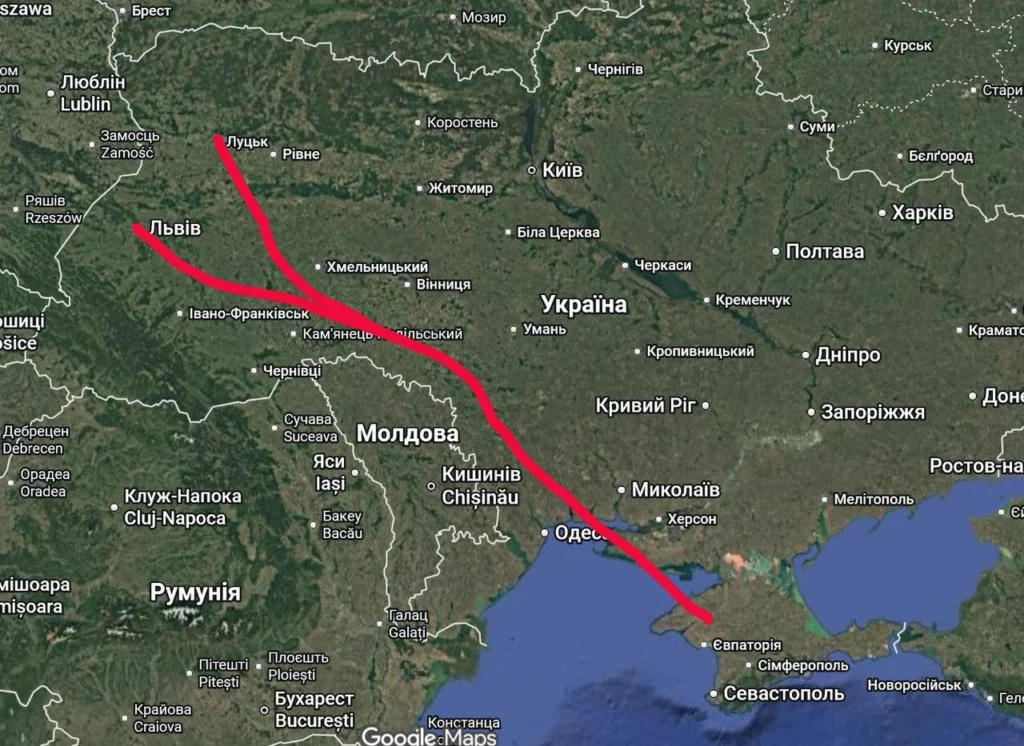
Beskrestnov notes that these flights indicate Russian forces are testing attack routes to western Ukraine from different directions. He also suggests that the Russian military may have reduced the drones’ warhead weight to extend their range.
Production of Tu-160M strategic bombers resumes
Russian aircraft manufacturer Tupolev has restructured its supply chains and modernised its production facilities to resume manufacturing Tu-160M strategic bombers, according to the company’s chief executive, Yuri Abrosimov.
The company has upgraded equipment in its production workshops and modernised its flight-test facilities. It has also commissioned electron-beam welding systems and vacuum annealing equipment for titanium components.
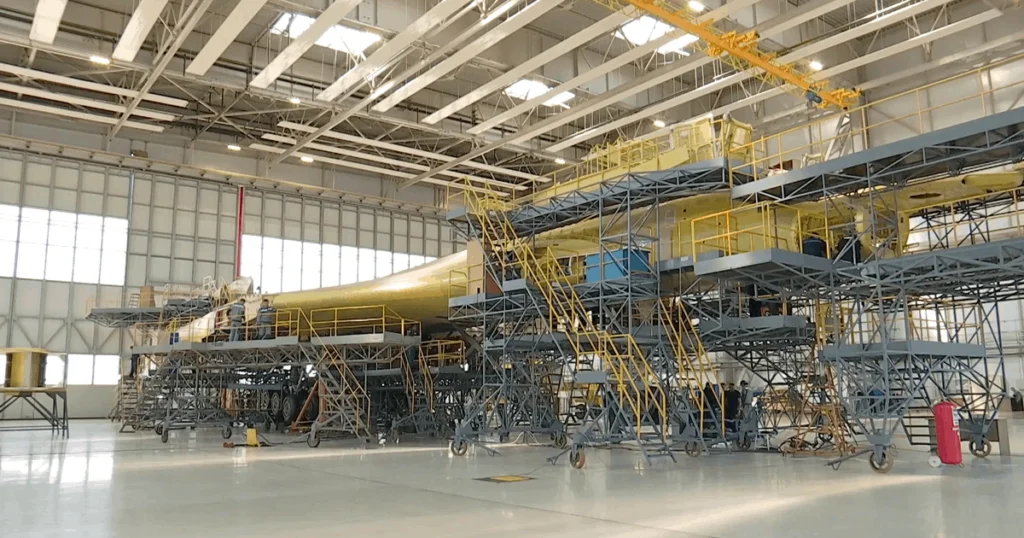
According to the manufacturer, 80% of the bomber’s systems and equipment have been modernised. The manufacturer says it replaced the bomber’s onboard electronic systems, flight and weapons controls, and navigation systems, and upgraded its engines.
Between 2016 and 2024, Russia modernised around 10 manufacturing facilities to prepare them for the serial production of key components. Under a contract spanning 2018–2027, the Russian military was scheduled to receive 10 newly built Tu-160M bombers. The first aircraft produced under this order made its maiden flight in 2022.
Russian Defence Ministry to train AI using footage of combat drone operations
Russia’s Defence Ministry has created a service containing a database of video footage showing drones in combat. The material is intended to train neural networks being developed for military applications.
The ministry states that drone developers will be granted access to the repository. It has also created a unified classification system for labelling and recognising data used to train artificial intelligence systems. More than 40 organisations have already joined the platform.
The system is designed to allow data to flow both ways: developers will upload their own material to the Defence Ministry’s service, where it will train and refine neural networks. The unified classifier is also intended to establish common standards for labelling and recognising objects.
Functionally, the Russian service resembles Ukraine’s Avengers Labs and Brave1 Dataroom platforms, which also use drone footage recorded for operational assessment to train AI models.
16 shelters for strategic bombers at Engels-2 airbase
Russia is building 16 large aircraft shelters at the Engels-2 airbase in the Saratov region. According to United24 Media, citing satellite imagery from Airbus Defence and Space, construction began in early September 2026.
Imagery dated 12 October shows the steel frames of the first three structures. Concrete foundations have been prepared, and taxiways have been laid to serve them.
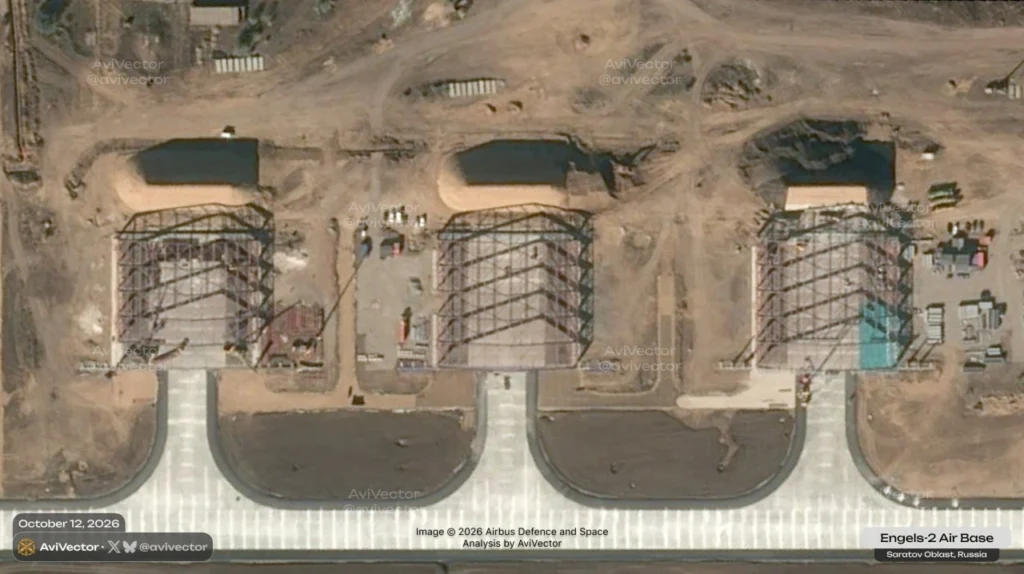
According to estimates by OSINT analysts at AviVector, each shelter has a footprint of approximately 63 × 63 metres, with walls around 7 metres high and a maximum height of 17 metres. These dimensions would allow the shelters to accommodate Tu-160 and Tu-95MS strategic bombers.
They have also constructed earth berms behind the shelters. They may be intended to deflect exhaust gases during engine startups inside the structures, potentially allowing bombers to start their engines before taxiing out onto the airfield.
New drone launch site
Western satellites have detected the construction of a new drone launch site near the town of Millerovo in Russia’s Rostov region. Available information suggests that the facility was built in approximately six weeks.
The new site follows the design of a facility in the village of Tsymbulovo in the Oryol region and is intended for launching Geran-5 jet-powered drones.
Another strike-drone launch site, located within Millerovo airbase, is designed for internal combustion-engine drones. The two launch facilities are located approximately 4km apart.
Molniya-2 fitted with unidentified equipment
Russian Molniya-2 strike drones may have been used for the first time with terminals for the new Rassvet satellite communications system, according to several Russian military correspondents. However, the logo found on the equipment only partially matches Rassvet’s branding: it features two semicircles and a star, whereas terminals made by Bureau 1440 feature two semicircles and a solid black dot.
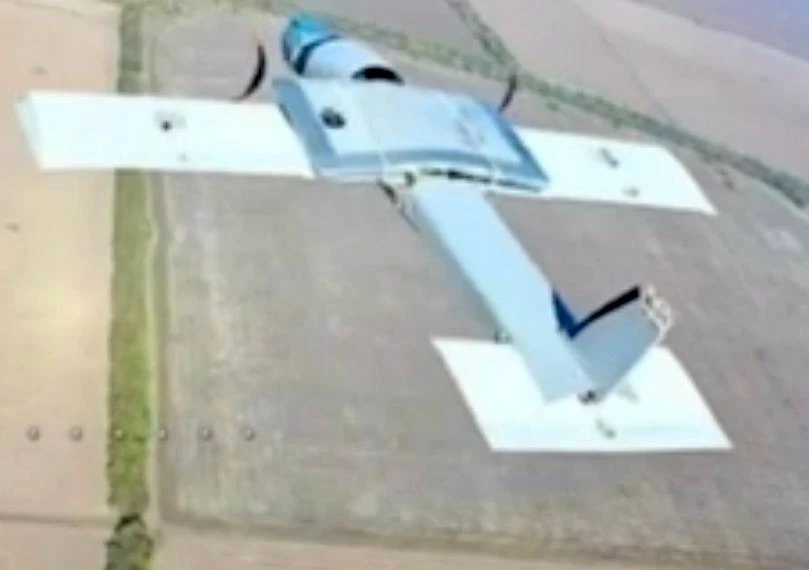
However, according to Serhii Beskrestnov, the unidentified object attached to the drone does not appear to be a satellite communications antenna, judging by both its shape and mounting method. Beskrestnov suggests it could instead be a modified version incorporating AI components that operates without control antennas.
Mi-8AMTSh-VN helicopters fitted with launchers for Dan-T cruise missiles
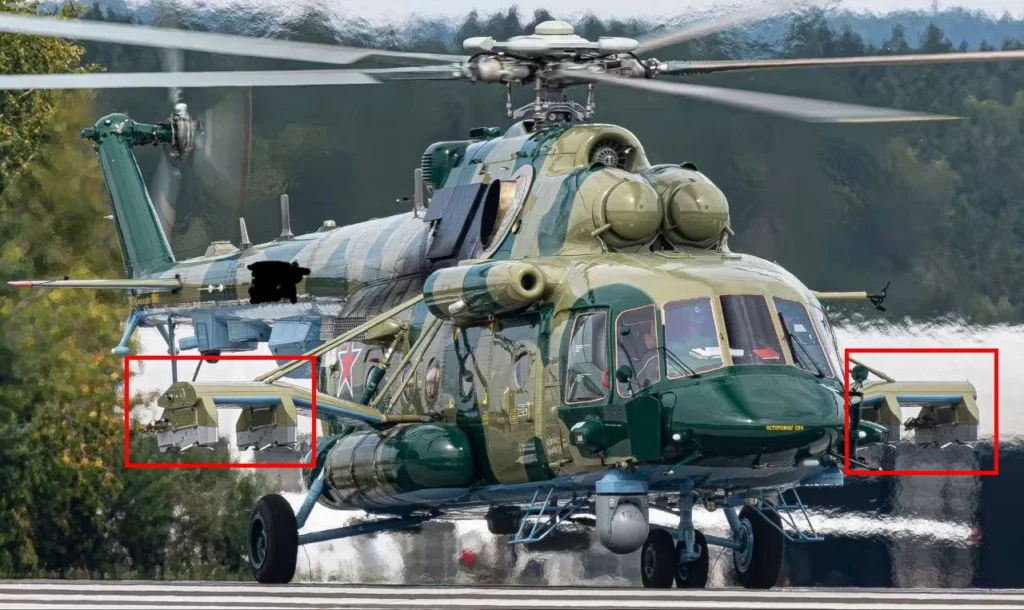
Photographs have emerged of a Russian Mi-8AMTSh-VN helicopter fitted with launchers for Dan-T cruise missiles, also known as Banderol.
The launchers resemble those previously used on Mi-8 helicopters to fire Dan-M jet-powered aerial targets.
Rosgvardia showcases Moscow’s mobile fire group equipment
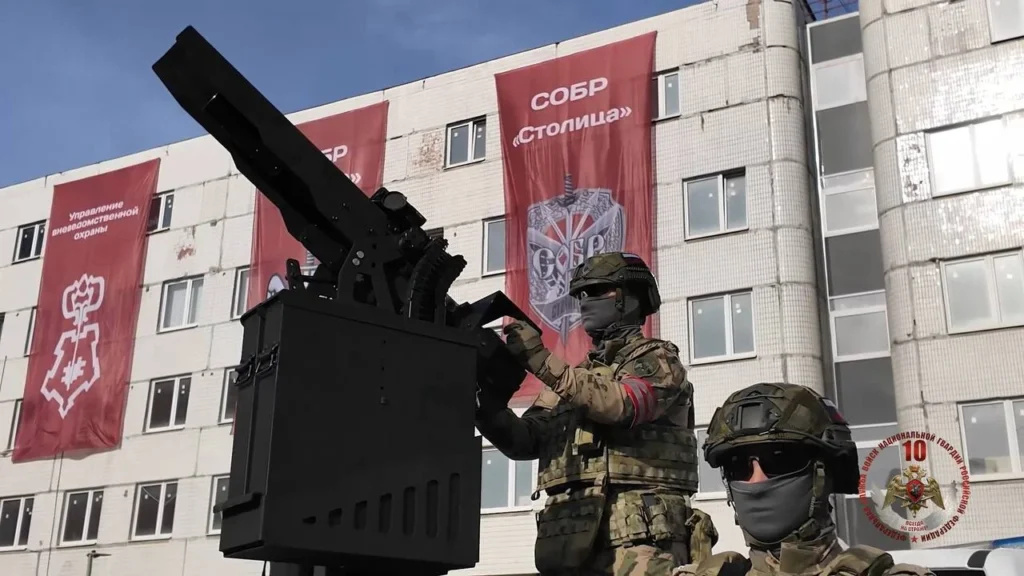
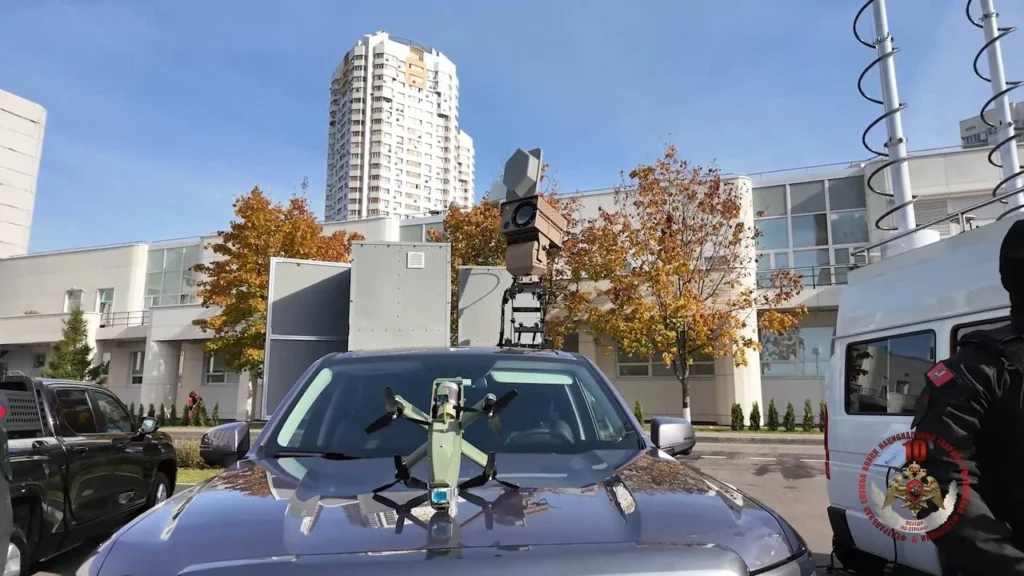
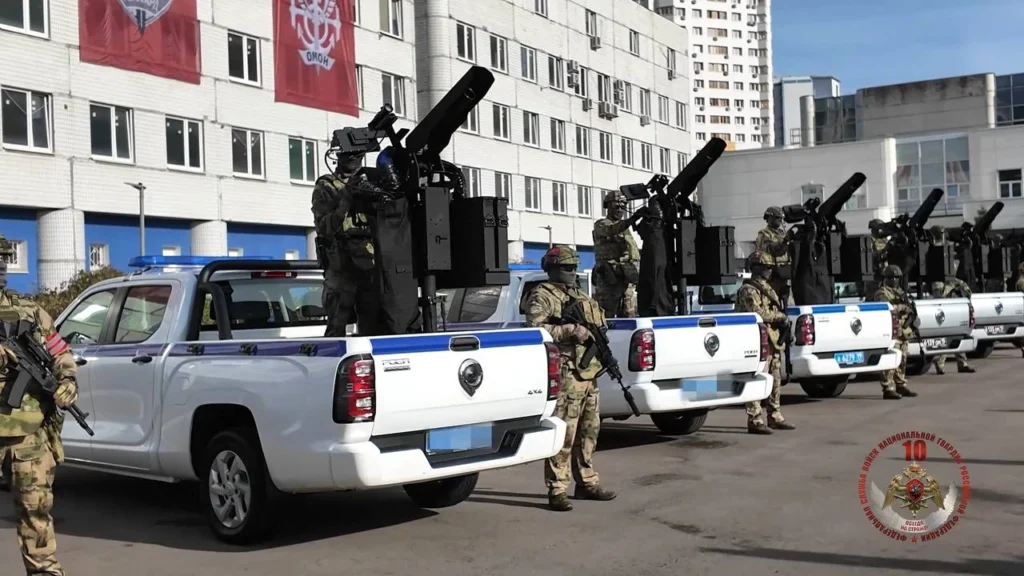
In early October, Russia’s National Guard (Rosgvardia) held a demonstration of air defence equipment used, among other purposes, to protect Moscow against Ukrainian drones. The mobile fire groups’ pickup trucks carry various gun mounts, including the 7.62mm Kalashnikov tank machine gun and a high-rate-of-fire, four-barrel 7.62mm aircraft machine gun. The groups also carry mobile radar systems, thermal imaging sights, and interceptor drones.
Knyaz Vladimir Svyatoslavovich loitering munition enters frontline service
Russian forces have begun receiving the Knyaz Vladimir Svyatoslavovich (KVS) loitering munition, developed by the Ushkuynik Research and Production Centre in Novgorod. Its stated engagement range is up to 50km.
The KVS’s primary design feature is an oval wing that encircles the fuselage and propeller assembly. After taking off vertically, the drone transitions to horizontal flight, using its wing to increase speed and range.

The protective shroud around the propellers is intended to make it harder for anti-drone nets and interceptor drones to disrupt the propeller assembly. The manufacturer claims the system can automatically lock onto a target and keep operating autonomously if it loses the radio signal.
Russian satellite Kosmos-2612 makes dangerously close approach to ICEYE-X36
The Russian military satellite Kosmos-2612 approached the commercial radar-imaging satellite ICEYE-X36 to within 26 metres, according to data from the satellite tracking service satellitemap.space.
ICEYE-X36 belongs to the Finnish company ICEYE, which partners with Ukraine to provide satellite imagery for intelligence purposes. According to tracking data, at 02:06 UTC on 19 October, Kosmos-2612 was approximately 640 metres behind ICEYE-X36 and 2km above it. By 16:07 UTC, the distance between the two spacecraft had closed to just 26 metres. During this close approach, both satellites were orbiting at an altitude of around 541km.
According to the Center for Strategic and International Studies (CSIS), Kosmos-2612 began a series of orbital manoeuvres in late September 2026, allowing it to return to the same orbital plane as ICEYE-X36 and match its altitude.
On 12 October, the Russian spacecraft carried out a manoeuvre that changed its velocity by about 27.9 m/s, adjusting its orbit to an altitude of around 555km. Such manoeuvres consume fuel, especially when orbital parameters must change. Once a spacecraft has entered the same orbital plane as another satellite, further close approaches require less fuel for trajectory corrections.
An approach at such close proximity could enable detailed observation of another spacecraft and the inspection of its design. Another possible explanation for these manoeuvres is preparation for the potential use of anti-satellite weapons.
Reading now
1

260+ vacancies in Ukrainian defence technology at BlueBird Tech, Sine Engineering, Buntar Aerospace and more
2
Forbes: Airlogix plans to raise $100m at a $2bn valuation
3

6,000 lives saved by replacing people with robots. “Makar” on the ground strike drone unit NC13 and its role in Operation Vivaldi
4
US Buys 1,320 more FPV drones from Ukraine’s F-Drones for $6.5M
5
Black Mirror #79: What’s inside Geran-4, unmanned tanks, balloon barrages and more of a new russian miltech
By submitting this form, you give Defender Media consent to the processing of personal data.
Надсилаючи цю форму, ви надаєте Defender Media згоду на обробку персональних даних.

Latest news
1
Black Mirror #81: what’s inside the Kometa, the Gerbera with a warhead, a combat video database for AI training and other Russian miltech updates
2
TENCORE buys manufacturers of TOR UGV and MAT1LDA amphibious vehicle
3
BlueBird Tech presents Chuyka 4.5.0 drone detector with expanded frequency range
4
Tencore unveils MAT1LDA amphibious platform at AUSA 2026
5