Black Mirror #79: What’s inside Geran-4, unmanned tanks, balloon barrages and more of a new russian miltech
Overview of Russian defence-industrial complex developments for the fourth week of September
Last week, Russian president Putin visited the Tsentr-2026 military trials, where he inspected the latest developments from Russia’s military-industrial complex. In addition, Russian officials outlined plans to deploy tethered balloons to protect critical infrastructure, demonstrated the air-dropping of UGV/UGVs from helicopters, and Ukrainian intelligence analysed components — including European-made electronics — found in the Geran-4 strike UAV. Read about the latest developments in Russia’s defence industry in Defender Media’s weekly Black Mirror review.
DIU reports on a new variant of the Russian Geran-4 jet-powered UAV
The Main Directorate of Intelligence of the Ministry of Defence of Ukraine has released details on a new variant of the Russian Geran-4 jet-powered unmanned aerial vehicle, operational since autumn.
According to HUR, the updated Geran-4 is equipped with a MOKh module built around a high-precision magnetic-induction sensor — the PNI5GA magnetometer manufactured by the US-based PNI Sensor. Operating alongside the SADRA inertial navigation system (INS), it mitigates gyroscope drift and enhances autonomous navigation accuracy.
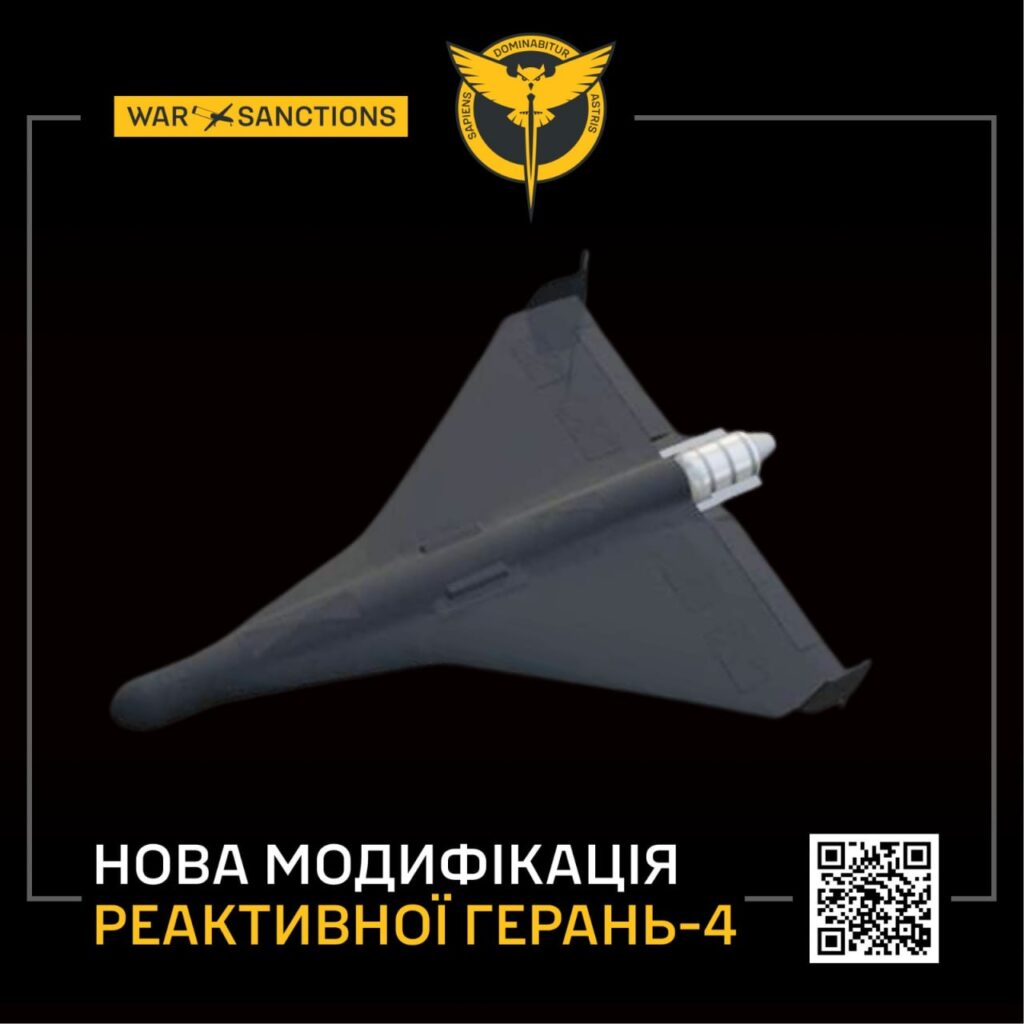
The UAV is also fitted with the Susanin autonomous optoelectronic correlation system. It compares real-time optical images with reference satellite imagery stored in the onboard computer memory to navigate along its flight path from launch to target. DIU notes that a similar system is integrated into the newer Geran-5 K5.
Furthermore, the Geran-4 features a KRSN shaped-charge warhead designed to destroy bridges and power grid pylons. Its Chinese-made Telefly turbojet engine has been replaced with a localised Russian equivalent produced in Alabuga.
Gerans can now be launched from KamAZ trucks
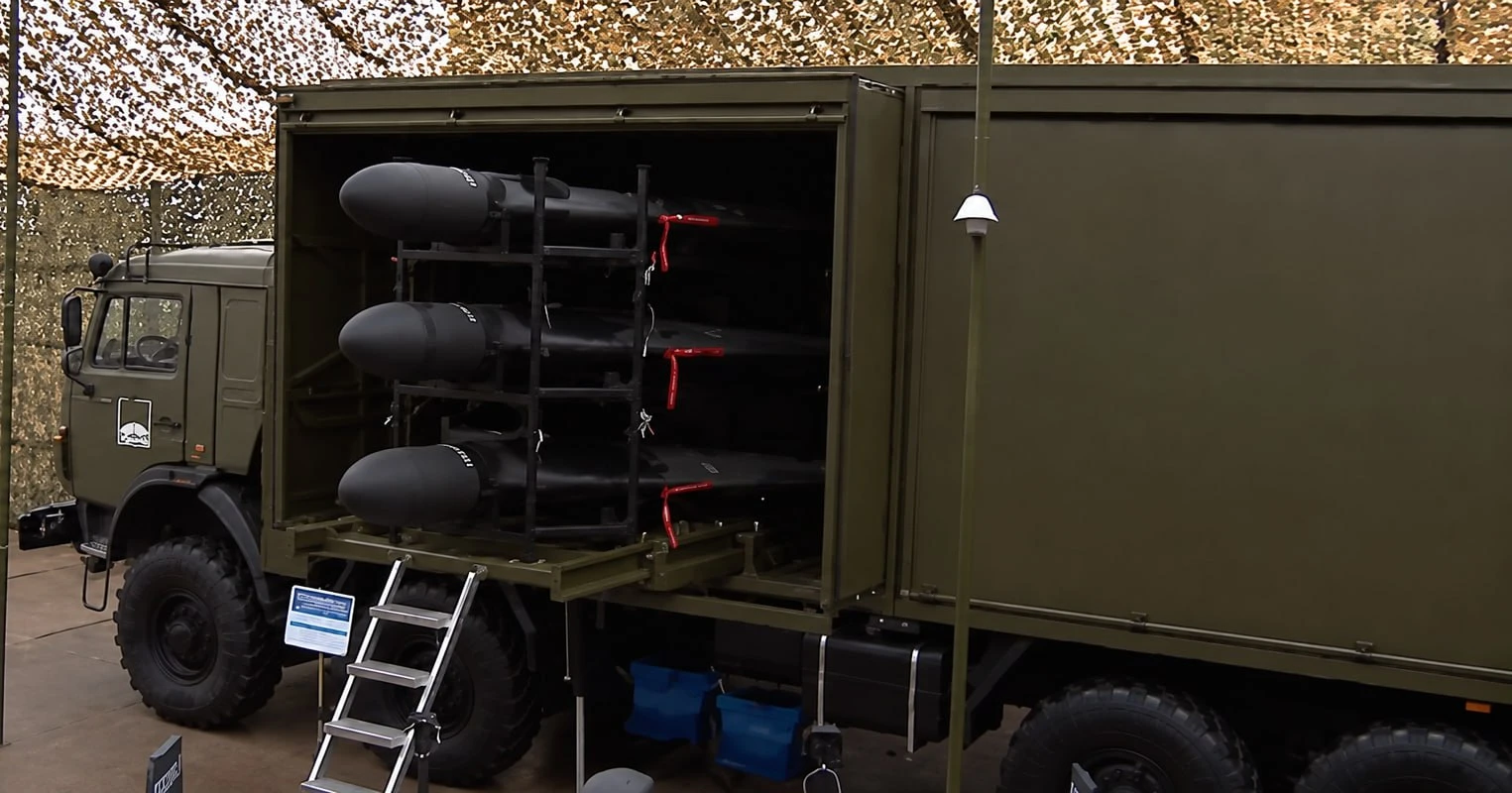
During the Tsentr-2026 exercises, Russian forces demonstrated a mobile launch system for the Geran UAV family.
Mounted on a four-axle KamAZ chassis, the launcher can carry up to six aircraft. Multiple UAVs are accommodated on a single mobile platform, eliminating the need for individual launch vehicles per drone.
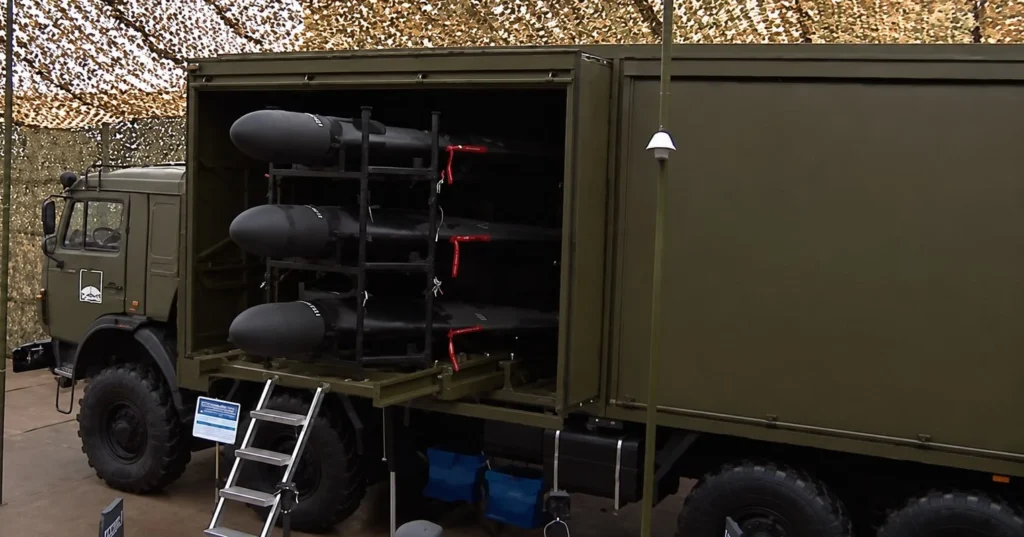
A similar multi-canister launch concept was previously utilised for the Shahed-136.
Official technical specifications and the list of verified compatible UAV variants remain classified. The system is presumably capable of launching newer jet-powered Geran variants as well, though no official confirmation has been provided.
Local relays suspected of guiding precision strikes on Kyiv
Up to three radio relay units may be operating within Kyiv to facilitate real-time control of Russian strike Gerans. This was reported by presidential adviser Serhii “Flash” Beskrestnov.
Beskrestnov attributes precise strikes on bridge infrastructure to stable, continuous online telemetry up to the moment of impact. According to him, these relays are difficult to detect, making signal suppression via electronic warfare (EW) exceptionally challenging.
He also noted that inspections of recovered drone debris revealed no evidence of alternative covert communication channels, such as LTE, Rassvet, or other rumoured systems.
Equipment demonstrated to Putin at the Chebarkulsky training ground
- The Kozerog launcher firing 122mm rockets featuring an integrated guidance system. Previously showcased with unguided munitions, the upgraded variant reportedly fires rockets equipped with homing seekers.

- Coordinated FPV drone strikes against ground targets and counter-drone aerial interceptions. The Russian Ministry of Defence claimed to have practised swarming tactics with synchronised multi-drone operations. The swarm was managed via coordinated operator crews, radar units, and a command post.
- The Shturm heavy UGV — essentially an uncrewed tank. It features a roof-mounted camera array delivering a 360-degree panoramic view to an internal operator station.
- The Spiridon unmanned tank is equipped with twin 30mm autocannons and secondary armament. The platform can be fitted with a bulldozer blade to clear obstacles and rubble or breach field fortifications.
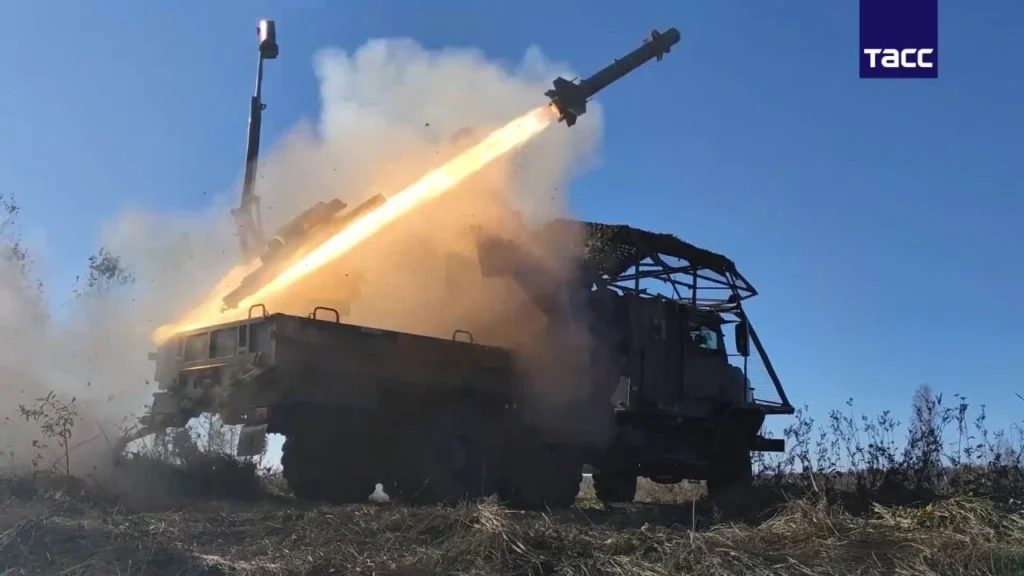
- Deployment of the Izdelie 347 ground-based missile system firing the modified Izdelie 305 LMUR (Light Multipurpose Guided Missile). According to defence officials, the system engaged artillery positions identified by aerial reconnaissance assets. Mounted on a truck chassis, it boasts a claimed operational range of up to 20 km against high-value fixed and moving targets and features terminal-phase operator guidance.
Vogan-15 FPV drones equipped with Tropa systems for mine clearance
During the Tsentr-2026 exercises, Russian combat engineering units deployed Vogan-15 FPV drones carrying ZRP-2 “Tropa” line-charge systems to clear minefields and breach obstacles ahead of simulated enemy lines.
The military tested the Vohan-15 as a carrier for engineering equipment. During the tests, the carrier was equipped with the Depesha UGV, which directly delivered, dropped or detonated munitions.
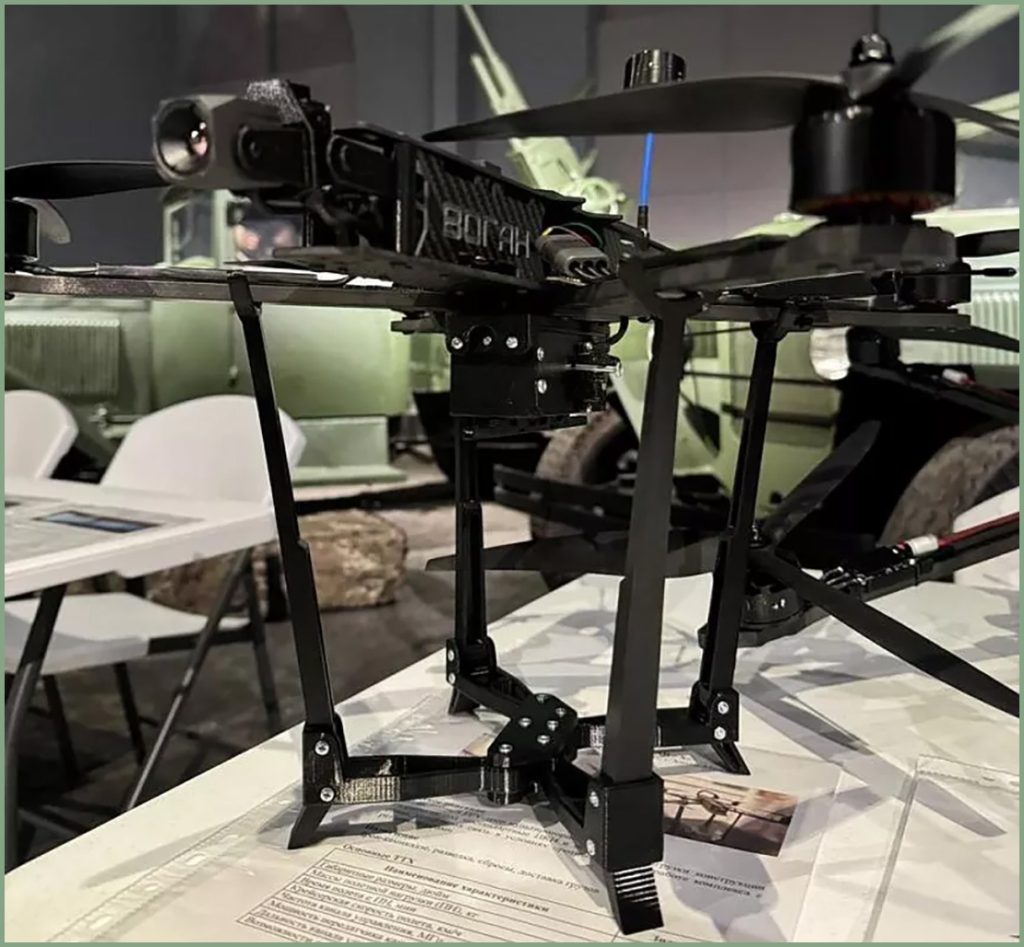
The Tropa mine-clearing charges are designed to create narrow passages through minefields. During the exercise, Tropa was used with an unmanned carrier for the first time, while the charge type itself remained unchanged.
Airborne forces air-drop ground robotic systems from an Il-76
Russian Airborne Troops (VDV) conducted air-drop operations of unmanned ground vehicles from an Il-76 transport aircraft during the Tsentr-2026 manoeuvres.
According to official reports, drone operators parachuted first, followed by UGVs dropped from about 600 meters on parachute platforms. Tested systems included the Omich-2, a combat-module-equipped Kurier, and the Bogomol-7V. Operators reportedly achieved operational readiness within 3–5 minutes after landing.
Mobile perimeter security system with a detection range of up to 10 km
Russia unveiled the Signal 2.0 mobile perimeter security system, engineered for rapid deployment of intrusion detection lines across unfortified terrain and temporary sites. Rather than relying on EW mechanisms, the non-radiating system employs passive infrared sensors to detect trespassers via thermal contrast.
The baseline detection range is up to 2 km, extending to 10 km from the monitored zone when utilising an auxiliary antenna array. Sensors can be mounted on various surfaces, allowing full perimeter setup within minutes.
Alert mechanisms include audible, visual, and haptic (vibration) notifications.
Deployment of the Kirm-10 minelaying kit
Elements of the Tsentr force grouping have begun deploying the Kirm-10 engineering reconnaissance and minelaying kit for remote mining along enemy supply routes. The system comprises a payload UAV, a drop mechanism, and an onboard camera to monitor minelaying accuracy.
The drone can carry up to 8 kg of payload for precision drops, with a claimed service life of at least 30 combat sorties without maintenance.
Testing counter-drone balloon barriers with Kevlar tethers
Russia has begun testing counter-UAV barrier systems made of tethered balloons, steel cables, and suspended Kevlar threads. Rossiya 1, a state TV channel, broadcast a feature on the system.
The grid structure utilises multiple balloons linked by cables with hanging Kevlar threads. According to the designers, the threads entangle a drone’s propellers, forcing a loss of control and a crash. Protecting a single large facility requires at least 10 tethered balloons.
Kalashnikov showcases models of three naval surface developments
At the ADEX 2026 defence exhibition in Baku, the Kalashnikov Concern displayed scale models of three surface vessels: the BK-10E high-speed assault boat, the BK-16E landing craft, and the Haska sidewall hovercraft (flexible-skeg air-cushion vessel). No full-scale prototypes or live trials were reported.
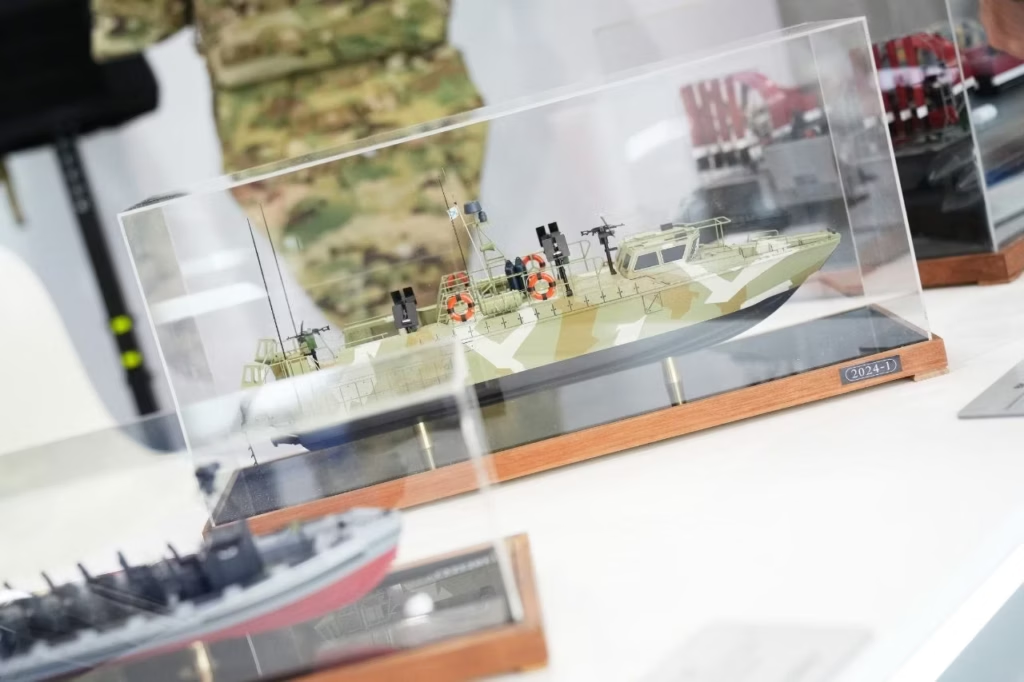
The BK-16E is an 18-meter armoured landing craft designed for troop transport, unequipped beach landings, and direct fire support. It reaches a maximum speed of 45 knots and has an operational range of 400 nautical miles.
The BK-10E serves as a lighter, more agile troop insertion vessel. Featuring a draft of 0.6 meters, it reaches speeds of up to 40 knots.
The Haska is a flexible-skeg air-cushion vessel that can transport up to 20 metric tons of cargo, personnel, or light armour. Fully loaded, it maintains speeds up to 40 knots, operates in shallow waters, and seamlessly transitions onto unequipped shorelines. Measuring 23.7 meters in length, it can negotiate vertical obstacles up to 1.2 meters high.
Reading now
1
SkyFall officially unveils Thor Hammer mid-strike and announces 1,000+ km version
2
Pentagon to hold Drone Dominance trials for bomber drones, with UFORCE, Gurzuf Defence, Grim Tech and others taking part
3

Terra Drone acquires 50% of Ukrainian Kurin Technologies for $3.5 million
4

British-Ukrainian Occam Industries raises €3.8m. The funds will go towards scaling drone autonomy software
5

Frontline Robotics CBDO Mykyta Rozhkov: Ukraine and Norway are working on an autonomous system to protect maritime infrastructure
By submitting this form, you give Defender Media consent to the processing of personal data.
Надсилаючи цю форму, ви надаєте Defender Media згоду на обробку персональних даних.

Latest news
1

Nataliia Mykolska to become VP of Growth and Affairs at Sine Engineering
2
Black Mirror #79: What’s inside Geran-4, unmanned tanks, balloon barrages and more of a new russian miltech
3

6,000 lives saved by replacing people with robots. “Makar” on the ground strike drone unit NC13 and its role in Operation Vivaldi
4

M-Fly and Dwarf Engineering announce partnership: what it involves
5