6,000 lives saved by replacing people with robots. “Makar” on the ground strike drone unit NC13 and its role in Operation Vivaldi
In-depth interview with Third Army Corps officer Mykola Zinkevych
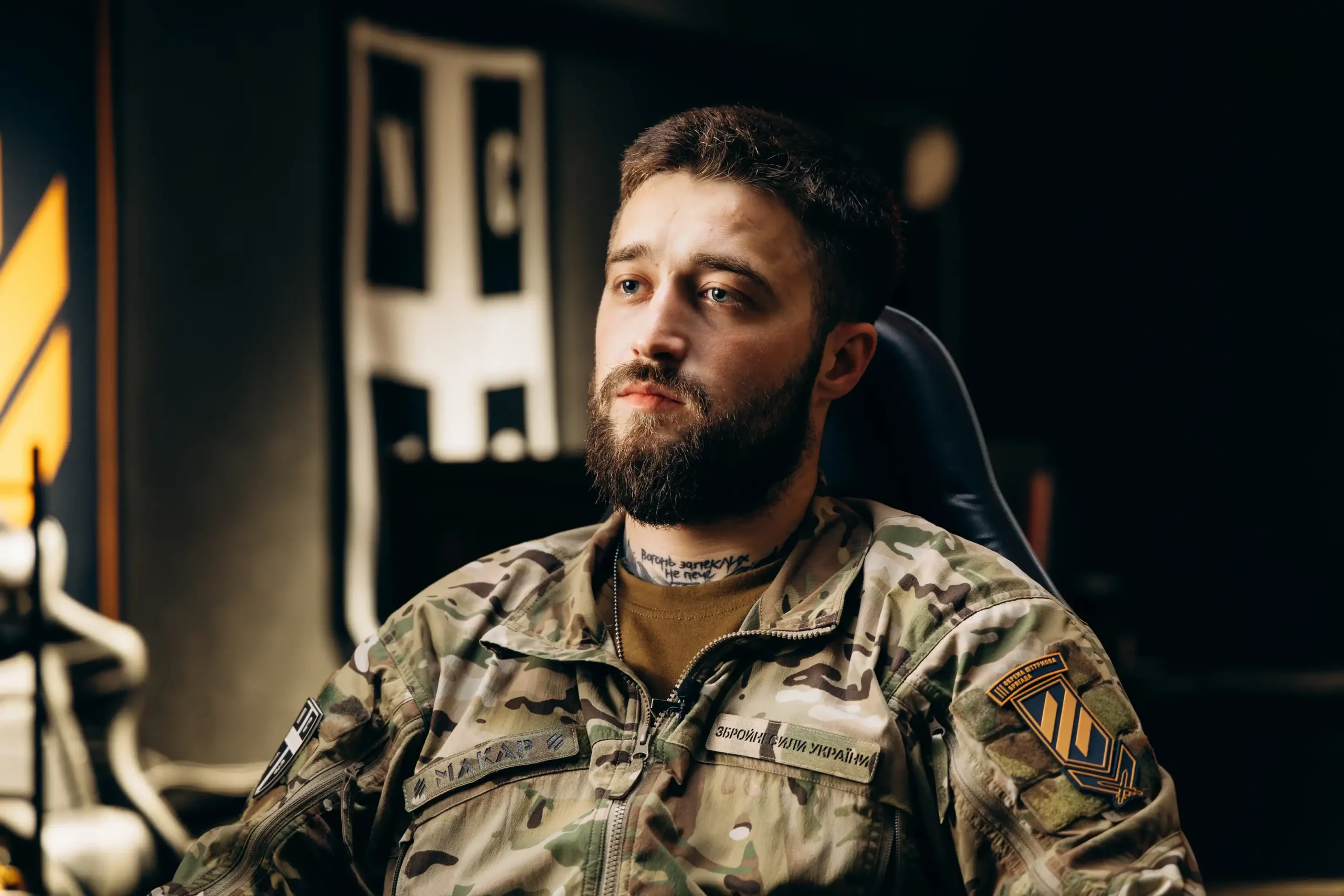
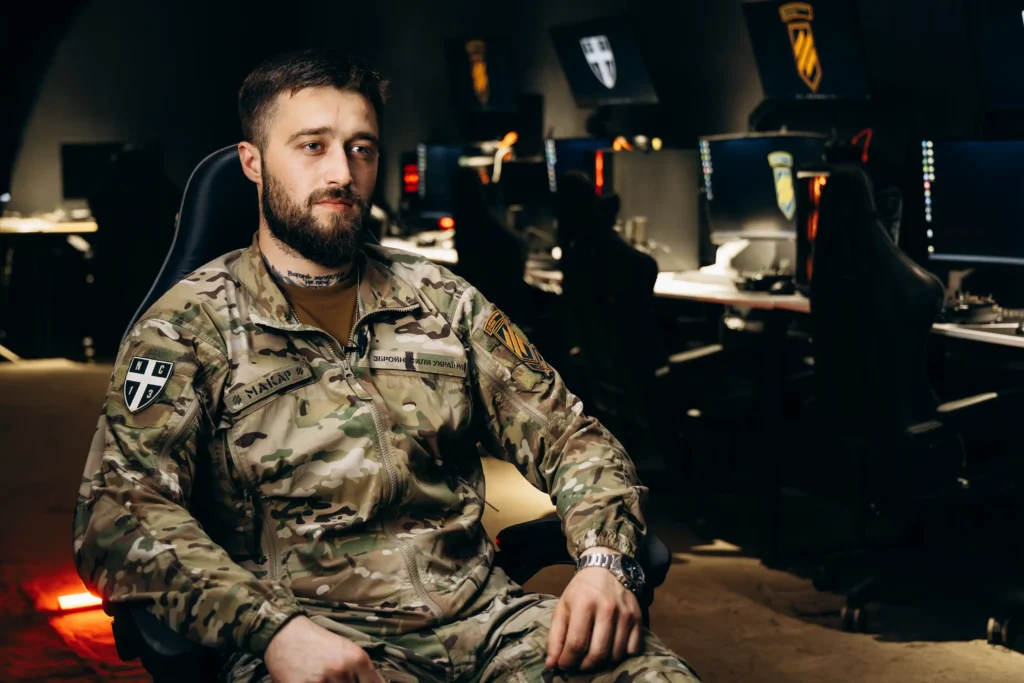
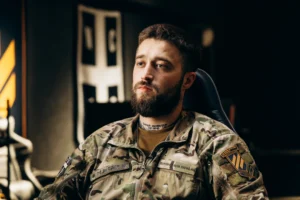
Mykola "Makar" Zinkevych (Photo: NC13)
Operation Vivaldi, which the Third Army Corps is conducting this autumn, has become one of the most high-profile and successful Armed Forces’ campaigns in 2026. Since the start of offensive actions, troops have recaptured 176 km² of territory and taken at least 250 Russian soldiers prisoner.
One of the newest tactics in this offensive is air-dropping kamikaze UGVs from bomber drones. NC13, the Corps’ strike UGV unit commanded by Mykola “Makar” Zinkevych, used it.
NC13 methodically uses robots to liberate territory and eliminate Russian troops. In 2025, the unit held a position for a month and a half using a UGV armed with a machine gun.
Defender Media spoke to Zinkevych about the tactics of using UGVs, the future of robots on the battlefield and the importance of a workshop to the unit’s operations.
The unit’s history and first results
– How did you end up in the military and move into the UGV field?
– In the first days of the full-scale invasion, I joined the units from which the 3rd Separate Assault Brigade was later formed. At the time, it was Azov Kyiv Territorial Defence, which was later transformed into an Azov Special Operations Forces detachment and then into the Third Assault Brigade.
At first, I was a driver-medic and evacuated the wounded from the front line. Later, I fought as an assault trooper and an assault group commander. I took part in battles near Bakhmut, in Avdiivka and then on the Kharkiv axis, among other places.
Around May 2024, on the battalion commander’s order, I switched from assault work to developing ground robotic systems.
Until summer 2025, we developed the logistics and evacuation line and shared this experience with the entire brigade. Then we moved on to purely strike missions.
We started with two large-scale operations. In the first, we held a position for 45 days with a single robot armed with a machine gun. In the second, we carried out a full-fledged robotic assault, captured enemy troops using UGVs and liberated territory.
These operations led us to scale up from a UGV platoon in an assault battalion to a separate strike UGV unit within the Third Assault Brigade. This happened on the order of Brigadier General Andriy Biletsky, who is genuinely very interested in the subject of UGVs.
In 9 months of work, NC13 has conducted more than 60 assault and special operations using robots and, in addition, 103 sabotage missions in which UGVs went into the enemy’s rear. The unit says it has carried out more than 400 strikes using drones.
– Your statistics mention 6,000 lives saved with the help of UGVs. Are you still involved in evacuation and logistics?
– Our unit performs strike missions exclusively: sabotage, assault and defensive operations. Meanwhile, the 3rd Separate Assault Brigade has a unit called NOVA, which handles logistics and evacuation across the whole brigade and helps the corps with this.
6,000 lives saved means 6,000 people whom we replaced while carrying out strike missions. That is, to destroy a dugout and eliminate the infantry, we need to deploy up to eight people. Instead, we sent two kamikaze ground drones.
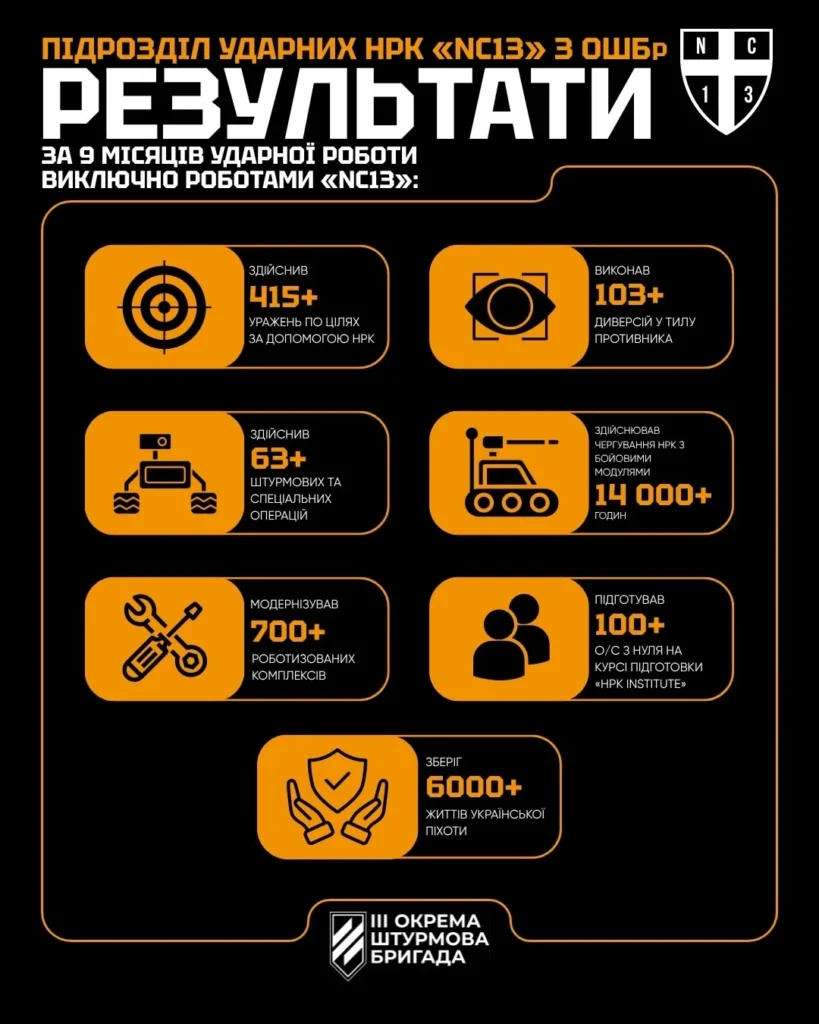
Scale of UGV use
– How often do you carry out strike missions with UGVs, and how are they funded?
– Every strike mission is actually unique: it is planned and prepared separately, and we study the enemy for it. These operations require a lot of resources, but not so much money.
As for the money, we find it in different ways: in some cases the guys chip in, in others we borrow funds, find sponsors, and the brigade helps.
State support is not as large-scale as we would like. It goes mostly to logistics and evacuation UGVs, because the strike segment is not as developed.
At the same time, we carry out strike missions almost every day. We systematically destroy enemy dugouts and shelters using ground kamikaze drones that carry 30-50 kg of explosives each.
We are given a certain number of targets per week, and we hit them – this is already routine, as is the use of UGVs with machine guns and grenade launchers. We send such drones to specific sectors where the enemy is active. They support the infantry in positional defence or in offensive actions.
– What role did UGVs play during Vivaldi?
– UGVs became one of the key factors in the success of the Vivaldi offensive operation, planned by Brigadier General Andriy Biletsky. In the initial stage, ground drones distracted the enemy and forced it to reveal its surveillance and fire assets, drawing all focus onto itself.
While the enemy was hunting the robots, assault groups entered its battle formations unimpeded.
Afterwards, kamikaze UGVs and drones with combat modules kept up constant fire on command posts, UAV operator positions and areas where personnel were concentrated. This disrupted Russian logistics, disorganised command and control and undermined the enemy’s morale. Prisoners even said that the appearance of UGVs on the battlefield forced them to abandon their positions.
Thanks to striking UGVs in Vivaldi, about 2,500 lives were saved. The robotic systems carried out more than 200 strikes and performed 94 assault and sabotage operations without risk to Ukrainian troops.
The targets hit included shelters, fortified defensive structures, depots, command posts, enemy UAV accumulation and launch points, and enemy command personnel.
Sabotage operations and air-dropping UGVs from bomber drones
– As for sabotage operations, how long have you been conducting such missions?
– We have been using this tactic for about 10 months, and the effectiveness is very high. To our credit, we have destroyed command posts, UAV launch points and FPV pilot positions, including those of Rubikon.
Sabotage missions include all operations that we carry out at a depth of more than 8 km into enemy territory. We can set up ambushes, conduct free hunting, and find positions unreachable by aerial reconnaissance.
A separate reconnaissance platoon in our unit carries them out.
– The 93rd Brigade showed a UGV air-drop mission alongside you. Was it an exchange of experience, or did your thinking simply coincide?
– In fact, several brigades have tried to implement air-dropping UGVs from UAVs. I spoke with “Electrician”, the commander of the UGV battalion in the 93rd Brigade, and our vision of such a mission really did coincide.
Our methods differ slightly, though – we modernised an existing UGV, while 93rd Brigade created its own system. But both systems are already in regular use and have proven effective.
Everything here depends on imagination – the potential of the UGV field remains entirely unrealised. And it can be developed as far as the imagination allows.
Meanwhile, the brigades that use strike UGVs can be counted on one hand. And I think only we have reached the global level of systematic use, where 10-15 missions a day are carried out with such drones.
The main things here are desire, motivation and support within the brigade. If commanders have people who want to develop ground-based robotic systems, they should encourage them. After all, we have proven many times that robots preserve the lives of Ukrainian infantry.
The present and future of UGVs at the front
– What equipment do you use for strike operations?
– I would rather not name specific systems, but we work with many manufacturers of strike UGVs. At the same time, in my view, there are not enough systems on the market.
But there were also few logistics UGVs at first, and only a handful were effective. Over time, this field developed, and strike UGVs are scaling up in the same way.
It is known that for one of its missions, the unit used Targan drones, with the help of which Russian troops were captured. To hold a position in 2025, NC13 also used the Droid TW 12.7, armed with a 12.7 mm M2 Browning machine gun.
– How do you choose a drone for a mission?
– We assess its reliability and suitability for battlefield conditions. We look at range, payload capacity, size, off-road capability, how well it adapts to the types of communication we use, and how easy it is for operators to control.
We also consider the manufacturer’s technical support. While a kamikaze drone is a one-off, drones with combat modules carry out their tasks and return from the battlefield. So we need quick help from the manufacturer with repairs, the spare parts supply and so on.
In general, we require maximum interaction with the unit from the manufacturer so it can quickly change and adapt its systems to conditions. To that end, we give feedback, and sometimes a company brings its engineering teams to us to learn our requirements.
Several products on the market were built from scratch jointly by us and the manufacturer. And they are now at the top among strike UGVs. In particular, we created kamikaze drones jointly this way.
– Do you use foreign products as well?
– We have exclusively Ukrainian drones in service. We tested foreign UGVs, but they are far behind domestic ones – the problem is precisely the lack of interaction with the battlefield.
Because of this, the manufacturers cannot keep up with changes in the war. That is why several foreign UGVs sit with us as exhibits.
But I can say that even drones from Ukrainian manufacturers that come to us are always refined. No UGV goes on a mission straight out of the box. At the same time, we spend two to three hours on some robots and two to three days on others.
– What is the limit to which the use of strike UGVs can be scaled?
– I cannot imagine a stopping point, because at one time even air-dropping UGVs from bomber drones was a joke – we sat and laughed about it. Then we turned it into a tactic that became a major problem for the enemy and brought many results.
Of course, we will not replace infantry completely. The hardest and most important work lies with them – holding territory. Because only territory where a Ukrainian soldier stands can be considered ours.
But we can take up to 80% of processes off the infantryman and transfer them to UGVs or UAVs. I say this with confidence because the unit’s entire command consists of former infantrymen and assault troopers. So we know well where these systems can be used on the battlefield.
– What tasks will then remain for the infantry?
– Andriy Biletsky once answered this question: the infantryman should become the elite component of the front. UGVs will clear the battlefield, but troops will consolidate and make key decisions. For example, whether to stop here or move on.
UGV modification and trooper training
– What does your workshop look like, and what tasks does it perform in general?
– We started with a small number of people, but now we have a large staff of engineers, mechanics, welders, programmers and so on. At the same time, the unit is constantly growing, so we are looking for new people.
Among the tasks is modernisation for a specific purpose. For example, for air-dropping from bombers, we took a UGV that we could not use because of its size and specs. So we used it for this mission: we made it lighter, changed the communications, and refined the mounts, among other things.
We also usually unify communications, control and electronics. We created our own box so we can remove the native electronics from a drone, install ours, and have a configured UGV. We also developed our own control software, so we do not depend on manufacturers’ software.
There is a ‘zoo’ of different models, but each product has its own strengths and weaknesses, and the market needs wheeled, tracked and amphibious UGVs alike. At the same time, connectors and batteries need to be unified.
On request, the workshop can also create entirely new UGVs if no drone exists for the task. But it is easier for us to work with an interested and motivated manufacturer and help it.
And, of course, its tasks include exchanging experience with engineers from different manufacturers and training other units.
In my view, the workshop is the unit’s most important part. It has the greatest impact and handles the most crucial work. After all, you can’t fix a poorly assembled or repaired drone during a combat mission, and it would be a real shame to drive 20 km to the target only to realise, a few metres out, that the drone can’t detonate or something like that.
– As for training your own troopers and other units, how does it work?
– The unit runs the UGV Institute – in effect, it is a basic training course. It was created so that everyone who joins the unit is brought up to the same level of knowledge.
People come to us from other units, from AWOL status and from civilian life, and their levels of knowledge differ. This course gives a basic understanding of ground robotic systems, their types, their interaction with UAVs and so on.
It also serves as a distribution centre. Every two days, troopers are tested, and at the end there is a general exam. Based on their scores in different topics, we can see what a person is more inclined toward and which role they will be most effective in.
We also bring troopers from other units onto this course if they need it. In general, we share our experience with anyone ready to adopt it properly. We help in every area: the workshop, control, planning, passing on operator knowledge and so on.
Reading now
1
SkyFall officially unveils Thor Hammer mid-strike and announces 1,000+ km version
2
Pentagon to hold Drone Dominance trials for bomber drones, with UFORCE, Gurzuf Defence, Grim Tech and others taking part
3
Terra Drone acquires 50% of Ukrainian Kurin Technologies for $3.5 million
4
British-Ukrainian Occam Industries raises €3.8m. The funds will go towards scaling drone autonomy software
5
Frontline Robotics CBDO Mykyta Rozhkov: Ukraine and Norway are working on an autonomous system to protect maritime infrastructure
By submitting this form, you give Defender Media consent to the processing of personal data.
Надсилаючи цю форму, ви надаєте Defender Media згоду на обробку персональних даних.

Latest news
1
6,000 lives saved by replacing people with robots. “Makar” on the ground strike drone unit NC13 and its role in Operation Vivaldi
2
M-Fly and Dwarf Engineering announce partnership: what it involves
3
Quantum Frontline Industries signs new contract with Ukraine’s National Guard to supply Linza and Zoom drones in 2027
4
SHOT-L1 drone detects sources of radio emissions and automatically homes in on target
5