Black Mirror #69: Dangerous manoeuvres near ICEYE, a 500-tonne USV, and the latest in Russian miltech
Review of Russian defence industry developments during the fourth week of July
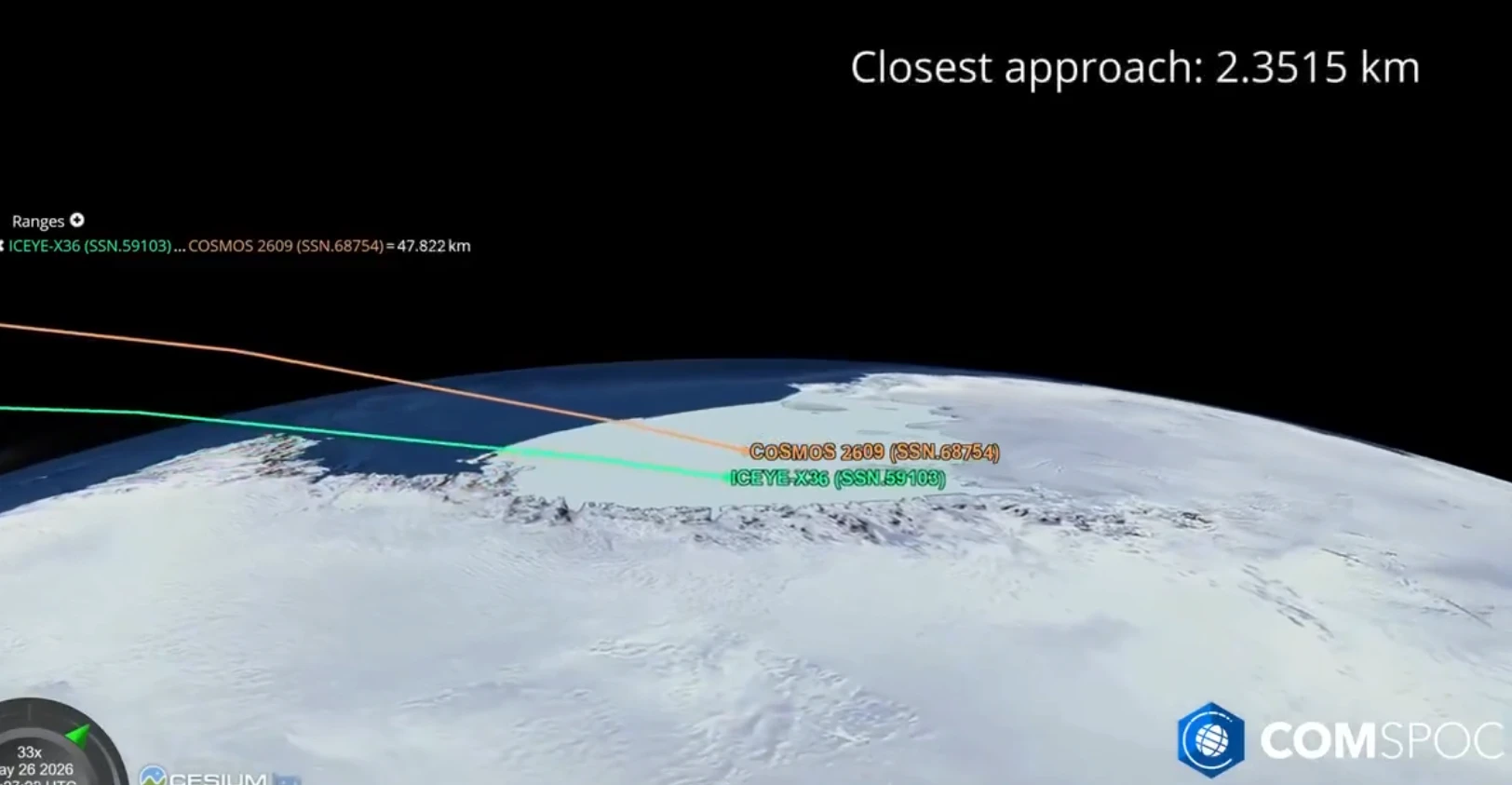
Dangerous proximity to ICEYE satellite. Video screenshot
Last week, Russian sources reported the first case of controlling Molniya drones via a Gerbera relay platform, claimed that Kosmos satellites had performed hazardous approaches to ICEYE spacecraft, and announced new capabilities of the Kalinka and Volna Kupol Garant EW systems to counter the Starlink satellite communications network. In addition, the military community discussed the expansion of European Union sanctions against manufacturers of Russian strike drones and their component suppliers. These and other developments in the Russian defence industry are covered in Defender Media’s weekly Black Mirror review.
Delayed-action timed munitions on Shahed drones
Russian Shahed drones can carry up to 22 submunitions equipped with a timer and detonator. Adviser to the President of Ukraine Serhii Beskrestnov reported a case involving the operational use of such munitions.
Before launch, the timer of each munition is manually set for a delay ranging from 24 hours to five days. After being released from a Shahed, the munitions may detonate at any moment. Ukraine’s State Emergency Service uses specialised robots to clear and collect them.
Controlling Molniya drones via Gerbera
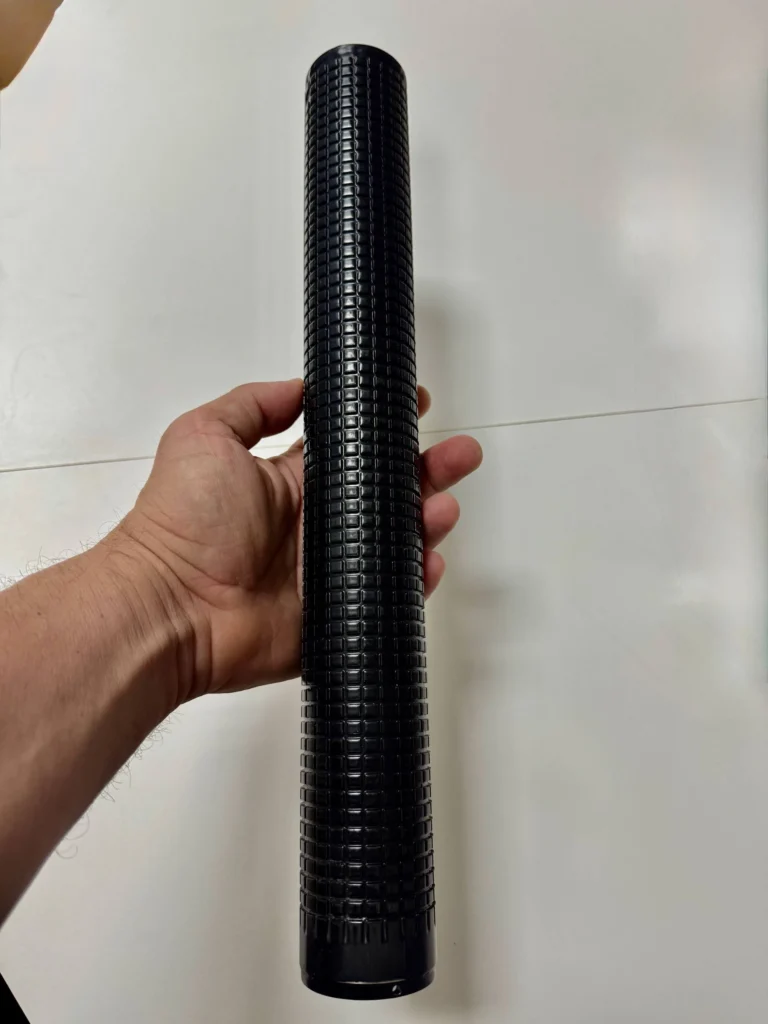
According to Beskrestnov, Russian forces have adapted the MESH modems installed on Molniya and Gerbera drones so that a Gerbera operator can directly control strike Molniya drones. Previously, these modems were incompatible due to licensing restrictions, despite operating within the same frequency band.
Updated Bumerang
Russian developers have upgraded the Bumerang FPV drone. The platform now utilises diversity signal reception, supports rapid frequency hopping across its antennas, and operates on a video link above the 6 GHz frequency band.
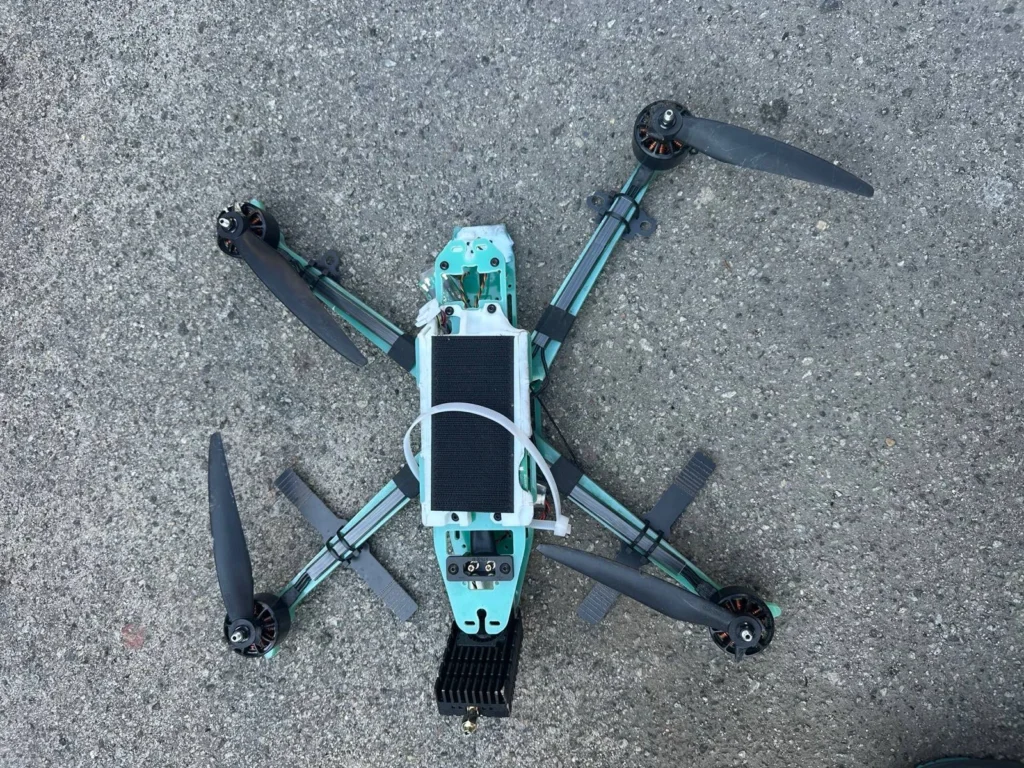
The Bumerang is produced serially. One of its earliest variants reached speeds of around 200 km/h and featured a declared flight ceiling of up to 1 km. Later configurations have been deployed not only as kamikaze drones but also for munition delivery, remote mining, and tactical logistics.
Russia developing 500-tonne uncrewed surface vessel
Russia is developing an uncrewed surface vessel with a displacement of 500 tonnes, Commander-in-Chief of the Russian Navy Admiral Aleksandr Moiseyev has announced. According to him, the project has already been incorporated into the current State Armament Programme and has entered the practical implementation phase. The vessel will be designed to detect and track submarines and other underwater targets.
Moiseyev also said that the Russian Navy has already established regiments of unmanned systems within its structure. One such unit, he noted, has been formed as part of the Northern Fleet.
Russian satellites conducted hazardous manoeuvres near ICEYE
A group of Russian satellites — Kosmos-2609 through Kosmos-2614 — executed a series of orbital manoeuvres and entered the same orbital plane as satellites operated by the Finnish company ICEYE. According to various estimates, the distance between the spacecraft was reduced to less than 13 km, with some reports indicating a separation of as little as 500 metres.
The report notes that ICEYE satellites utilise synthetic aperture radar (SAR), enabling them to capture high-resolution imagery of the Earth’s surface down to 16–25 cm regardless of weather conditions or time of day.
In the second half of May, the independent analytical firm Integrity ISR reported that at least four Russian military satellites of the Kosmos series (Kosmos-2610 to Kosmos-2613) had performed orbital inclination manoeuvres, bringing them into an almost identical orbital plane with the ICEYE-X36 radar observation satellite. The analysis was published on 22 May and was based on publicly available orbital tracking data.
The Kosmos-2609 through Kosmos-2614 satellites were launched on 17 April 2026. Their official mission profile has not been disclosed; however, independent analysts highlight their capacity for active manoeuvring and classify them as Russian military inspector satellites designed to practise rendezvous and proximity operations (RPO) with other spacecraft.
The Russian Ministry of Defence, Roscosmos, ICEYE, and Finnish authorities have not publicly commented on reports concerning these orbital manoeuvres.
EU expands sanctions against manufacturers of russian strike drones
The European Union has expanded its sanctions package to include dozens of companies involved in the manufacturing and supply chain of Russian strike drones, along with their executive leadership. The new restrictions aim to disrupt supply chains for critical components used in Russian strike platforms, including engines and microelectronics.
The updated sanctions target two drone families: the Garpiya-A1 and the Bekas line of FPV drones.
EU documentation identifies the Izhevsk Electromechanical Plant Kupol as the primary manufacturer of the Garpiya-A1. Because the plant itself is already under sanction, the new measures focus on its subcontractor network, listing NTT Vostok, Tekhnosvyaz, Orbita, and Severnaya Zarya.
According to published records, the Garpiya-A1 has been produced at the Kupol facility since 2023. The drone utilises a tailless delta-wing design, is powered by a piston engine with a pusher propeller, reaches speeds of up to 185 km/h, features an operational range of 1,500–2,000 km, and carries a warhead weighing up to 150 kg.
The Bekas family comprises tactical FPV drones deployed for frontline strikes.
Omich 3.0 robotic platform
During proving-ground trials in Russia, the updated version of the Omich 3.0 robotic platform reached a maximum speed of 60 km/h. The UGV is powered by an asynchronous electric motor and offers an operational range of approximately 30 km on a single charge.
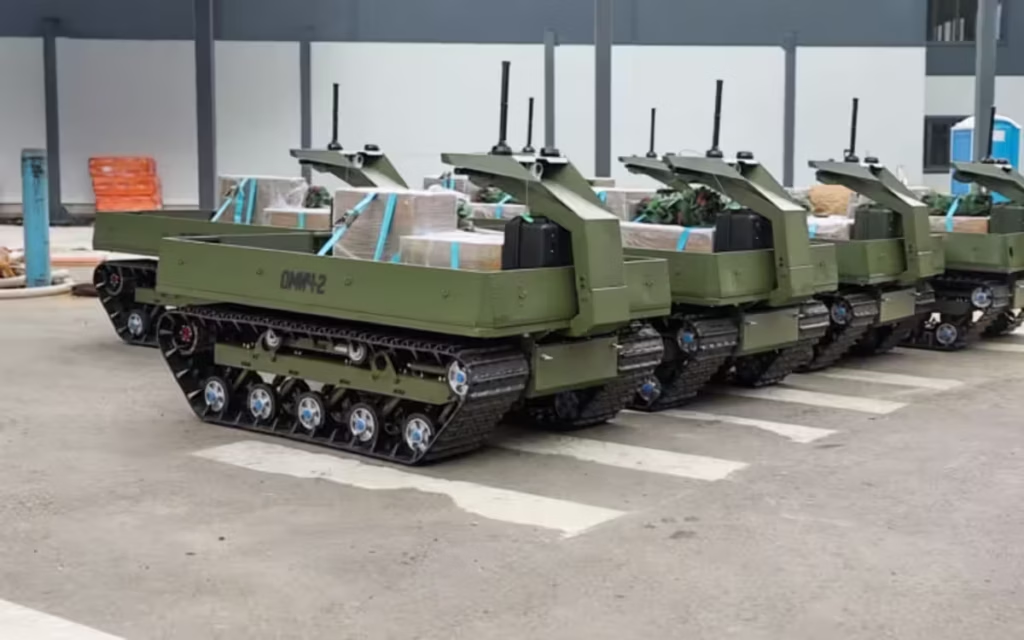
With a kerb weight of around 650 kg, the platform can carry a payload exceeding 500 kg on its own chassis and tow over one tonne via trailer. It is also capable of towing light vehicles stuck in challenging terrain.
The developers demonstrated modular adaptability, including the integration of remotely operated weapon stations (ROWS).
Ten’ drone detector gains ability to detect Hornet UAV signatures
Russian developers announced updated detection algorithms for the Ten’ drone detector, claiming it can now identify and intercept the RF signatures of Hornet UAVs.
According to the developers, while monitoring the radio spectrum, the system can distinguish telemetry protocols and analyse signal propagation velocity. In the case of the Hornet, Russian sources claim the drone uses non-standard communication protocols, which previously prevented the Ten’ detector and other EW support systems from recognising its signature.
Russia unveils the Plot-47 surface platform
A prototype of the Plot-47 floating platform was demonstrated on water for the first time in Vyborg, Russia. The system is designed to protect naval bases, port infrastructure, and fuel and energy facilities.
According to Leningrad Region Governor Aleksandr Drozdenko, construction of the prototype is complete, and the project has received preliminary approval from a naval research institute.
The platform is also reportedly being evaluated as a counter-uncrewed surface vessel (C-USV) asset. Its detailed technical specifications have not been disclosed. Published imagery shows the Plot-47 as a small pontoon-style floating platform equipped with a tall mast carrying electro-optical sensors, communications antennas, and a distinct bow module.
New capabilities of Kalinka and Volna Kupol Garant EW systems against Starlink
Russian electronic warfare systems Kalinka and Volna Kupol Garant have reportedly been upgraded to counter the Starlink satellite communications network.
According to published reports, Kalinka was developed to jam satellite communication links and analyse the operation of orbital constellations. The Volna Kupol Garant system is engineered to generate directional interference within specific frequency bands used by satellite data links.
The reported concept of operations relies not on kinetic or physical damage to satellites, but on degrading ground terminal connectivity through electronic attack.
The Kalinka EW system was first showcased in late 2024 as a platform for monitoring and jamming Starlink satellite links. According to its developers, it can detect, geolocate, and analyse both static and mobile Starlink terminals while jamming their downlink/uplink channels.
Currently, there is no independent open-source confirmation of the combat deployment or claimed effectiveness of either system.
Russia patents tethered unmanned system with carrier drone for 6 reconnaissance UAVs
The Novosibirsk Higher Military Command School has developed and patented an unmanned system where a single heavy carrier drone transports and deploys up to six micro-reconnaissance UAVs.
According to patent documentation, the carrier drone launches while receiving continuous power and data from the operator via a master tether. It is equipped with a flight controller, gyroscopes, an optical camera system, and propeller guards. Between two and six small reconnaissance drones are mounted to the carrier platform.
Upon reaching operational altitude, the smaller drones are deployed on command while remaining connected to the primary carrier via secondary power and data tethers. Published data claims this tethered architecture provides immunity to electronic warfare, continuous power supply, and uncompressed video transmission.
Upon mission completion, all sub-drones automatically dock back to their landing positions, the tethers reel in, and the carrier returns to the operator.
The patent notes that this design expands the tactical observation radius and sensor coverage.
Flight trials of the Heavy Motylyok UAV
Factory flight trials have commenced in Russia for the new “Motylyok” heavy multirotor UAV, developed by “Sovelmash”. According to official specifications, the drone can carry a payload of up to 300 kg, reach speeds of up to 100 km/h, and offers a maximum operational range of 60 km at full payload capacity.
The Motylyok heavy multirotor project has been under development since at least 2023. In previous years, the developers showcased individual components and reported bench testing of its propulsion systems, asserting that the platform is manufactured entirely from domestic Russian components.
According to the developers, the drone’s primary feature is its use of 60 kW asynchronous electric motors utilizing “Slavyanka” technology. Despite manufacturer claims, there is currently no operational evidence that the drone has been deployed in combat.
Reading now
1
Ukrainian Skyeton secures $10.6M US army contract
2
Canadian General Dynamics signs agreements with Ukrainian GreenTech
3
The Pentagon has announced the results of Drone Dominance Gauntlet II – announced Ukrainian companies did not make the top 5
4
Korven Systems project: How Teletactica co-founder is building an autopilot for interceptor drones
5

Ukrainian SkyFall again among winners of US Drone Dominance Program
By submitting this form, you give Defender Media consent to the processing of personal data.
Надсилаючи цю форму, ви надаєте Defender Media згоду на обробку персональних даних.

Latest news
1
12 British defence companies to gain access to Ukrainian AI platform Avengers Labs
2

Defence tech startup Zmiyar takes second place at IT Arena Startup Competition 2026
3

Mykhailo Fedorov launches ‘Army of Robots’ project to bring together venture fund, own companies and R&D for frontline robotics
4

Pentagon uses Ukrainian Unwave’s EW to test UAVs in Drone Dominance programme: details of cooperation
5