How the world’s first AI assistant for military vehicle repair NeoLens is developing
“We wanted to invest time in interesting features. But again and again we heard from users that they needed more equipment,” the NeoLens co-founder Ostap Korkuna explained

Startup co-founders Ostap Korkuna and James Leo (Photo: NeoLens)
The NeoLens startup announced the launch of the world’s first AI assistant for military vehicle repair in November 2025. At that time, the application covered only three vehicle models: the Humvee, the MaxxPro and the M113 armoured personnel carriers.
The chatbot developed by Ostap Korkuna and James Leo now supports repair guidance for 10 types of equipment and is used by approximately 1,700 Ukrainian military personnel. Although the primary focus has been on content, the list of features has also expanded.
The startup is now in discussions about potential contracts abroad as it moves towards generating revenue. Defender Media spoke with Ostap Korkuna about which areas are of interest and how the application continues to operate in Ukraine.
What’s under the bonnet of NeoLens
NeoLens is a web application that uses artificial intelligence to analyse official manuals and other relevant documents, providing step-by-step diagnostic and repair instructions for military vehicles via a chat interface. The startup was founded by Ostap Korkuna, an American of Ukrainian descent, and James Leo, an American of Taiwanese descent.
“After hundreds of interviews with Ukrainian and American military personnel, it became clear that the frontline critically needs an autonomous repair tool,” Korkuna said earlier in a comment to Defender Media.
In the summer of 2025, they built an MVP, tested it, and officially launched the application in November, subsequently bringing on developers. The team consists of six people: four AI specialists and two full-stack developers.
Under the bonnet of the web application is a proprietary document processing system capable of handling technical documents of any complexity, combined with commercial AI models accessed via API. To generate responses, the AI uses a RAG – Retrieval-Augmented Generation – approach, whereby the model first retrieves relevant documents from a database and then generates a response based on them. This makes responses more accurate and helps avoid hallucinations.

UAV and UGV manufacturer partnerships are in progress
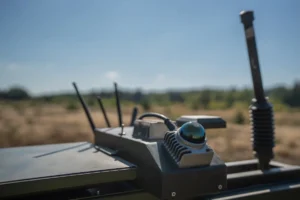
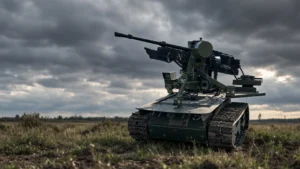
At launch, NeoLens worked exclusively with manuals for the Humvee, the MaxxPro and the M113 armoured personnel carriers. The list has since expanded to 10 types of equipment. Additions include Ford F-550-based vehicles – the truck itself, the Kozak-5, and the Roshel Senator – the M109A6 Paladin self-propelled howitzer, the Ural-4320, and two Saber combat modules by Roboneers.
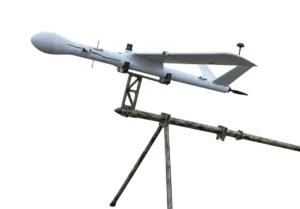
Manuals for the equipment are sourced in various ways – found in the public domain, provided by manufacturers or the military. NeoLens is currently working on several unannounced integrations with UAV and UGV manufacturers, disclosing only that the products are from Ukrainian companies or joint ventures with Western firms.
Manuals for foreign-made small arms have also been added to the content library, ranging from machine guns to anti-tank systems. “This doesn’t cover everything, but it covers a large share of the foreign weaponry used by the Armed Forces of Ukraine,” the co-founder said.
In five months of operation, NeoLens has also expanded beyond equipment, adding a survival assistant and a first aid assistant.
What else has the application learned
Korkuna says the time since launch has been largely devoted to improving the document processing system and expanding content rather than developing new features.
“We wanted to invest time in interesting features: diagnostics from a photo or engine audio recording. But again and again we heard from users that they needed more equipment,” the NeoLens co-founder explained. This approach has brought the web application around 1,700 users.
At the same time, NeoLens did add voice input – mechanics fed back that it was inconvenient to type messages into the bot continuously. The process of adding assistants has also been optimised. Where adding an assistant previously could take a month, it can now be launched within a day.
The startup is currently preparing a smartphone application, which will be released within a few months at most. It will function offline and will launch first on iOS, then on Android. In parallel, the company is experimenting with new features – for example, real-time models in which interaction with the assistant takes place via voice.

Monetisation plans
Ostap Korkuna says their application addresses the customer support challenge faced by weapons manufacturers. NeoLens means they no longer need to hire large numbers of specialists for a support department to handle requests from military personnel. In addition, it accelerates repairs – some faults are simpler to fix on the spot than to send equipment to the manufacturer for diagnosis.
“We are now trying to work out how to build the right marketing strategy for working with manufacturers,” the co-founder said. At the same time, the application will remain free for military personnel.
The company does not view Ukraine as its primary market. For example, the startup is negotiating a partnership with a foreign company that sells spare parts for military equipment and holds contracts with the US Department of Defence.
The company is also preparing to port the technology into civilian sectors involving equipment that is difficult to maintain and located in remote areas. This could include field repair of telecommunications equipment, oil extraction installations, or trucks transporting perishable goods.
NeoLens is currently financed by angel investors and venture capital funds. Among the company’s earliest investors are the owners of what Korkuna describes as “the world’s largest bakery.” Dnipro VC has also invested in NeoLens. The startup has not disclosed the total amount raised, adding only that all investment comes from abroad.
Reading now
1
SkyFall officially unveils Thor Hammer mid-strike and announces 1,000+ km version
2
Pentagon to hold Drone Dominance trials for bomber drones, with UFORCE, Gurzuf Defence, Grim Tech and others taking part
3
Terra Drone acquires 50% of Ukrainian Kurin Technologies for $3.5 million
4
British-Ukrainian Occam Industries raises €3.8m. The funds will go towards scaling drone autonomy software
5
Frontline Robotics CBDO Mykyta Rozhkov: Ukraine and Norway are working on an autonomous system to protect maritime infrastructure
By submitting this form, you give Defender Media consent to the processing of personal data.
Надсилаючи цю форму, ви надаєте Defender Media згоду на обробку персональних даних.

Latest news
1
Nataliia Mykolska to become VP of Growth and Affairs at Sine Engineering
2
Black Mirror #79: What’s inside Geran-4, unmanned tanks, balloon barrages and more of a new russian miltech
3
6,000 lives saved by replacing people with robots. “Makar” on the ground strike drone unit NC13 and its role in Operation Vivaldi
4
M-Fly and Dwarf Engineering announce partnership: what it involves
5