


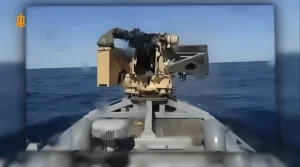
DoD Solution enters the drone guidance market. How will the startup compete with its existing players
DoD Solution’s core product is the AURA autonomy module for various types of drones. €300,000 has been invested in production

Roman Hapachylo, CEO of DoD Solution (Photo: University of Lviv)
Ukrainian startup DoD Solution is preparing to mass-produce terminal guidance modules for various types of drones. The solution for FPV is already ready, while systems for fixed-wing drones and interceptors are still in development.
The company’s ultimate mission is to deliver full autonomy, enabling a single operator to send multiple drones into a strike zone, newly appointed CEO Roman Hapachylo has shared.
Among DoD Solutions’ clients, however, are not only drone manufacturers but also companies that develop terminal guidance software. The startup is preparing to sell them computers of its own design. How did DoD arrive at this decision?
How a volunteer initiative became a stable team
The DoD Solution core team has a volunteer backstory that began in 2022. At that time, Roman Hapachylo and Nazar Kravchuk launched the Banderomobil initiative. Ivan Oleksii joined them later.
They collected donations, purchased pickup trucks for the military, armoured them, and fitted turrets. The first funds came from the audience of Hapachylo’s YouTube channel, which has more than 400,000 subscribers.
The initiative was launched under a different brand for international audiences – Car for Ukraine. This brand currently generates the majority of donations. Through it, more than 840 pickup trucks have been delivered to the military.

In 2023, the core team of Hapachylo, Kravchuk, and Oleksii entered the FPV drone sector. “We brought together key donors from the Banderomobil and Car for Ukraine projects who wanted to contribute further, along with AI experts, military personnel, and drone manufacturers,” the interlocutor recalls.
This led to the founding of Banderodron LLC, whose team assembled 100 UAVs: “We were writing terminal guidance elements for them, but in practice it was a conventional drone.” The company received several grants from the Ukrainian Startup Fund and Lviv City Council, but ultimately decided against continuing and scaling production.
The IT team became more interested in working on the technology itself. The LLC was therefore kept active to complete work on the grants received, and in 2025, DoD Solution was registered. Roman Hapachylo served as a consultant, Nazar Kravchuk as CEO, and Ivan Oleksii as Head of Business Development. In March 2026, Hapachylo moved into the CEO role, with Kravchuk transitioning to CPO.
What stage of development is DoD Solution at
DoD Solution’s core product is the AURA autonomy module for various types of drones. €300,000 has been invested in production – funds from an angel investor based in Germany. The money was spent on components, drones for testing, and visits to military units. The company also use grants, including from Brave1.
“We are currently focused on several priority integrations, which we are bringing to codification to then scale the application of the technology,” the CEO shares.
The investment was also used to hire a team. There are currently 20 full-time staff and a further five on contract. Five vacancies are also open, so Hapachylo expects to have 30 people at the company by mid-April. A CTO will also be joining the team on a full-time basis within a month.
The company’s structure includes a hardware team developing the AURA computer itself, as well as software teams, each working on terminal guidance and autonomy for individual products: FPV, fixed-wing, and interceptor. In addition, DoD Solution has received a request from the military to develop autonomy for “waiting” drones.
The company’s strategy is to select a drone manufacturer partner for each area and develop autonomy for its UAV. If the technology performs successfully, it can then be scaled to other drones of the same type.
The autonomy for FPV is complete, and the module is currently undergoing codification. This technology has already been tested with six units of the Armed Forces of Ukraine. The interceptor module is planned for completion in six to seven months, the “waiting” drone module in five, and the fixed-wing module in two to three months.
How to compete with Ukrainian and Western companies
DoD Solution identifies its proprietary AURA single-board computers as its differentiator from competitors. Assembled in-house, they offer developers greater flexibility. “This allows us to better understand how to optimise the software for this hardware. We can also modify it easily,” says Hapachylo.
To build the computer, a hardware engineer designs the board, after which the required components are mounted onto it, and the software is written. The board itself is manufactured in Europe. The components mounted onto it depend on the client’s requirements – they may be European or Chinese, the latter for cost reasons.
Beyond drone manufacturers, DoD Solution sees companies that develop terminal guidance and full drone autonomy software as potential clients, and plans to offer them its computers. The startup intends to compete with Nvidia computers on price. The AURA Mini module for FPV and its accompanying software cost $150. AURA for fixed-wing drones costs $200–250. Aura Pro for interceptors will be priced at $450–550. Processor performance plays the primary role in pricing. The Nvidia Jetson Orin Nano starts from $300.
Competing on price with Raspberry will be difficult, Hapachylo acknowledges. The Raspberry Pi 5 starts from $70, depending on RAM capacity. However, the company wants to offer greater computing power, so that software development companies will need to spend less effort optimising their software.
What potential clients think
Software autonomy developers surveyed by Defender Media are potentially open to considering computers from a Ukrainian company.
Danish Robotto currently uses Raspberry Pi 5 and Raspberry Pi Compute Module 5 mini-computers, says co-founder Kenneth Richard Geipel. They would consider hardware from a Ukrainian company, but said it depends on several factors:
- reliability of the supply chain;
- the price-to-performance ratio compared to what they already use;
- and whether there would be any issues with exporting from Ukraine.
Robotto is looking for computers that contain no Chinese components, as it sells its product to Nato countries.
NORDA Dynamics also uses the Raspberry ecosystem and has “some proprietary developments compatible with Raspberry,” says co-founder and CEO Nazar Bihun. They are likewise open to considering a Ukrainian alternative, provided it works without requiring further modification. Price and performance are similarly important factors, as is the absence of Chinese components.
Three funds are currently considering investment
The company’s plans for this year include launching the AURA and AURA Pro computers into mass production and raising investment for them. Hapachylo says they are currently actively pitching their concept to venture funds.
The startup has already been selected for a US acceleration programme to participate in a Demo Day. Three venture funds are currently making decisions on investing in DoD, and one further angel investor recently contributed a small sum to the company.
The company’s ultimate mission is to deliver full autonomy, enabling a single operator to send multiple drones into a strike zone. This is not about swarm control, but about pre-configuring the mission and the actions the drones are to carry out. The company is also potentially preparing to enter the development of missile guidance systems, though no concrete plans exist at this stage.
Reading now
1
400+ jobs in Ukrainian defence tech from BlueBird, Vyriy, The Fourth Law, Odd Systems and other sector leaders
2

70+ vacancies in Ukrainian defence tech at Ukrspecsystems, Strix Air, DoD Solution and other industry leaders
3
20 Ukrainian companies are working on jet-powered interceptor drones. Firebolt Engineering is among them
4
Swarmer acquires Ukrainian UGV and UAV manufacturer Ratel Robotics for $224m – and this is just the beginning
5

Swarmer co-founder Serhii Kupriienko steps down as CEO, Alex Fink takes over
By submitting this form, you give Defender Media consent to the processing of personal data.
Надсилаючи цю форму, ви надаєте Defender Media згоду на обробку персональних даних.

Latest news
1

EU-Ukraine Drone Alliance holds first meeting to define priority areas of work
2

Farsight Vision and Celebra Tech to represent Ukrainian defence tech at TechCrunch Disrupt in the US
3
Canadian General Dynamics signs agreements with Ukrainian GreenTech
4
Defence Ministry confirms payment delays under ePoints and explains the reasons
5

