Black Mirror #51: the Cheburashka antenna, a drone detector, an official photo of Geran-5 and other Russian miltech updates
Overview of new developments in Russia’s military-industrial complex in the third week of March

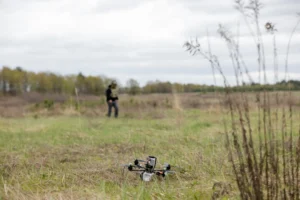
Heavy multicopter Geksa-kran
Russian developers have released the inaugural image of a jet-powered Geran, announced the commencement of operational deployment for the Zubr mobile air defence system equipped with machine guns, and unveiled the Cheburashka antenna for ground-based drone control stations. These and other updates from Russia’s defence sector are covered in Defender Media’s weekly Black Mirror roundup.
DIU releases data on components used in Russian UAVs Lancet and Scalpel
Ukraine’s Defence Intelligence (HUR) has published detailed intelligence on the Russian loitering munitions Lancet and Scalpel via the War&Sanctions portal. The “Components in weapons” section features interactive 3D models of the systems, their internal architecture, electronic components, and data on the entities involved in their manufacture.
Lancet (product-51), manufactured by Zala Aero Group, remains one of the most widely deployed Russian strike UAVs. It is employed to engage vehicles, hardware and positions at both tactical and operational depths.

The second system, Scalpel, developed by the Vostok design bureau, features an X-wing configuration and is positioned as a more compact analogue to the Lancet. Both UAVs are operated in real time, although attempts to introduce autonomous targeting elements in the Lancet have been observed, including the integration of artificial intelligence modules.
In total, 62 electronic components have been identified across the two UAVs, the majority of which are of foreign origin — primarily from the United States, as well as Switzerland and China. Among them are modules capable of supporting AI-based algorithms, including those built on Nvidia Jetson platforms.
Russians enlarge the OFSP-2 munition body for UAV use
The Russian volunteer group ‘Tekhnofront Rusvesny’ has developed a new aerial munition casing, the OFSP-2, designed for deployment from drones. The system weighs approximately 2 kg and occupies a niche between earlier “mini-FAB” designs and the OFSP 1.7 model. The updated design features increased internal volume to accommodate additional fragmentation elements or a thermobaric payload.

The casing has a diameter of 70 mm and a length of 250 mm, with a total volume of approximately 700 cm³, of which 350 cm³ is allocated for the payload. It includes standardised threaded fittings compatible with UDZ- and UZRG-type fuzes and is produced by 3D printing, followed by filling with plastic explosive.
Russia reveals jet-powered Geran-5 in first official imagery
An official image of the Russian jet-powered strike UAV Geran-5 has appeared in open sources for the first time. Unlike earlier Geran variants, the new model features a conventional fuselage and straight-wing design rather than a flying-wing configuration.

Available data suggest the UAV is approximately 6 metres long and has a wingspan of up to 5.5 metres. It is equipped with a turbojet engine and can achieve speeds of up to 600 km/h. The reported range is up to 1,000 km, with a warhead weighing around 90 kg, and guidance potentially provided via satellite systems or mobile networks.
Heavy multicopter Geksa-kran continues testing
Russian developers are continuing trials of the heavy multicopter Geksa-kran. The UAV is reported to be capable of transporting and deploying TM-62 anti-tank mines. Its payload capacity is stated at up to 20 kg.
The system was first reported in operational use in spring 2025. Since then, the developers, ‘Polden 21 vek’, have introduced several upgrades, including the integration of a thermal imaging camera, support for satellite communications, and the ability to function as a signal relay for other drones.

“Cheburashka-Ts” antenna system unveiled
A new antenna system, Cheburashka-Ts, has been introduced for UAV ground control stations. The system utilises two receiving antennas to determine signal direction and automatically aligns the transmitting antenna with the UAV.
According to the developers, this approach doubles the communication range compared to baseline solutions and facilitates a stable link at distances of up to 20 km from the operator’s console.

Heavy strike drone Vorobey-15 enters serial production
Serial production of the heavy UAV Vorobey-15, developed by the Spektr design bureau, has been launched in Novosibirsk. Current production capacity allows for the manufacture of up to 1,000 units per month. The drone can carry up to 15 kg of payload and is intended for strike missions.

Portable drone detector Alissum-8 delivered to Russian units
Russian units have begun receiving Alissum-8 portable drone detectors, developed by the company Kvadro kod. The device operates within the 300–8000 MHz range, with an option to extend coverage to 12,000 MHz via software updates.

The detector can classify signals by type — including digital UAVs, FPV systems and Wi-Fi — and determine whether a target is approaching or receding. A full scan cycle takes approximately five seconds. The device supports smartphone connectivity via Bluetooth or USB, maintains logs for up to 40 hours, and includes protection against signal overload when operating in proximity to electronic warfare systems.
FPV drones Skvorets equipped with fibre-optic control
Developers of the Skvorets FPV drone family have introduced a variant featuring fibre-optic control. The cable spool provides a stated range of up to 25 km, while the base flight speed is approximately 150 km/h, and the payload capacity reaches up to 3.5 kg. The family also includes versions adapted for maritime operations and for the interception of aerial targets.

Short-range air defence system Zubr enters operational use
Russia has commenced the operational deployment of the Zubr automated short-range air defence system, designed to protect facilities from small, low-flying targets, including drones. Development reportedly spanned approximately eighteen months, with initial trials conducted in 2024 at the Kapustin Yar test range.

The system features a modular architecture, incorporating a combat module, control system and detection assets such as radar. Zubr can be deployed either on a single platform — such as a vehicle, trailer or container — or as distributed components. In its combat configuration, it can automatically detect and track targets, relaying data to an operator for engagement decisions.
The system is armed with PKT machine guns or GShG-7.62 aviation machine guns. According to available information, it is designed to operate in various weather conditions and engage small aerial targets within the close-in defence zone. Detailed technical specifications have not been disclosed.
Reading now
1
SkyFall officially unveils Thor Hammer mid-strike and announces 1,000+ km version
2
Pentagon to hold Drone Dominance trials for bomber drones, with UFORCE, Gurzuf Defence, Grim Tech and others taking part
3

Terra Drone acquires 50% of Ukrainian Kurin Technologies for $3.5 million
4
British-Ukrainian Occam Industries raises €3.8m. The funds will go towards scaling drone autonomy software
5

Frontline Robotics CBDO Mykyta Rozhkov: Ukraine and Norway are working on an autonomous system to protect maritime infrastructure
By submitting this form, you give Defender Media consent to the processing of personal data.
Надсилаючи цю форму, ви надаєте Defender Media згоду на обробку персональних даних.

Latest news
1

Nataliia Mykolska to become VP of Growth and Affairs at Sine Engineering
2
Black Mirror #79: What’s inside Geran-4, unmanned tanks, balloon barrages and more of a new russian miltech
3

6,000 lives saved by replacing people with robots. “Makar” on the ground strike drone unit NC13 and its role in Operation Vivaldi
4

M-Fly and Dwarf Engineering announce partnership: what it involves
5