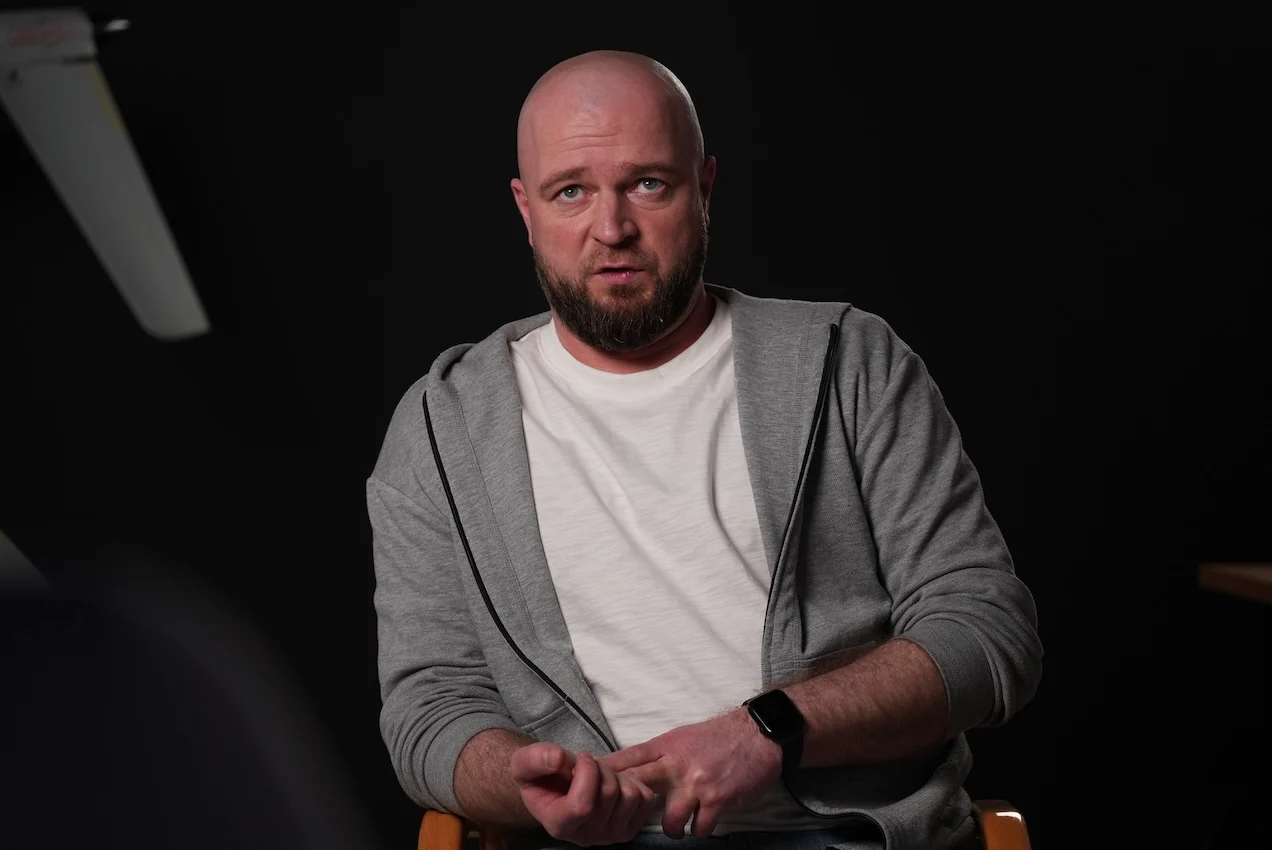
Frontline drones quickly become obsolete. How the Sternenko Community’s ReDrone project gives them a second life
ReDrone workshop revives up to 2,000 drones a month. How does it work?

“We’ve got a truckload of drones that won’t fly. What should we do?” — calls like these from the military marked the beginning of the ReDrone workshop, created by the Sternenko Community charitable foundation.
Within the Ukrainian Armed Forces, there can be thousands of drones at any given time that are not performing any combat missions. They are not broken — they simply no longer function effectively in the conditions where they are deployed.
ReDrone head Oleksandr Syniook and the project’s Executive Director Oleksandr Skarlat told Defender Media how they became an intermediary between military units and manufacturers, giving a second life to drones that had lost their operational relevance.
The ReDrone workshop emerged as a spontaneous response to urgent frontline needs. In its early stages, it functioned as a horizontal mutual-assistance network, where the primary supply mechanism was a form of “technical barter” between military units.
Any drones available to crews must be in ready-to-fly condition — soldiers should be able to arrive at a position, unpack the equipment, and launch immediately, without wasting time on modifications. In practice, however, many drones must pass through the hands of ReDrone technicians before their first combat sortie. The reason lies less in the build quality of the drones than in how rapidly the battlefield’s electronic environment evolves.
Why do drones stop flying
Why do flight-ready drones sometimes fail to operate? The problem lies in supply chain issues and the technical characteristics of the UAVs.
The state procures equipment in massive batches — 10,000, 20,000, or more units at a time. Manufacturing and delivering such volumes takes months. While these contracts are being fulfilled, the situation on the battlefield changes significantly. By the time the drones reach frontline units, they often arrive with components that are already obsolete — most notably their operating frequencies.
“Once the enemy identifies a working frequency and begins jamming it, the pilot loses the video feed, and the drone effectively ‘goes blind’. To restore operation, the frequency must be shifted, which requires replacing the transmitter. Over time, the adversary adapts to the new solution, and the cycle repeats”, ReDrone explains.

In 2023, a newly adopted frequency could remain effective for up to six months. Today, its “lifespan” is typically around three months, and in some high-intensity sectors, even less. Meanwhile, actual manufacturing defects occur far less often: in most cases, the drone is technically functional but no longer compatible with the current electronic warfare environment.
What happens on the ground
Every combat crew includes a technical specialist who experiments daily — selecting antennas, modifying firmware, and hunting for workable frequency bands. At the battalion level, separate workshops exist where drones are adjusted and repaired. Yet, this system is neither unified nor formally recognised in official staffing structures; it has emerged organically from the bottom up through horizontal connections.
Solutions to these problems include pooling personal funds, attracting private donors, or obtaining components directly from manufacturers. Others do nothing at all and simply attempt to fly what they have, often with zero results.
The situation is further complicated by a total lack of standardisation. While the underlying technology is similar, each manufacturer produces proprietary media converters that are often incompatible with those of others. In practice, an operator in a dugout during combat may have to cycle a drone through several different ground stations to find a compatible match — losing precious time while a target escapes.
Horizontal exchange
To mitigate these issues, soldiers began organising their own redistributions. Initially, this took place in military chat groups. A unit holding a batch of drones configured to a “jammed” frequency would swap them with a unit in another sector where those frequencies were still viable.
“Over time, this process became more complex. Some units ended up with hundreds of drones sitting in storage — sometimes as many as 800 at once. They were ready to hand them over to those in need, but in return, they asked for scarce components, such as up-to-date video transmitters,” Skarlat explains.

What began as informal agreements between crews gradually evolved into a structured system. As requests multiplied, the Sternenko Foundation established a full-scale laboratory. Experience showed that rather than letting obsolete equipment accumulate, it was far more effective to provide engineering support — turning “dead stock” into operational tools through professional technical upgrades.
Today, more than a thousand drones pass through the workshop every month, rising to two thousand during peak periods.
A “second life” for drones
When units receive drones that are “unflyable” straight out of the box, they are often repurposed as “donors” — dismantled for high-quality parts used to build more reliable systems.
ReDrone cites models built on low-quality aluminium frames as a primary example. These frames can generate excessive vibration and resonance. “At high speeds, such a drone loses stability and cannot stay on target. However, these machines often contain excellent ‘donor organs’ — high-quality digital video transmitters and communication systems,” Syniook says.
A similar situation exists with fibre-optic drones. If the spool is defective or the winding is poor, it cannot be fixed in the field. The drone then becomes a donor — its motors, controllers, and other intact components are harvested to revive other machines.
“This approach allows us to save significant resources. Instead of buying expensive new components, we utilise what is already in storage, turning ‘dead weight’ into effective weapons through deep technical reworking,” Oleksandr notes.
This raises a logical question: why should volunteer initiatives like ReDrone invest in antennas or transmitters when manufacturers could do so themselves? The problem often lies in a total breakdown of communication.
“In large government contracts, manufacturers effectively lose sight of who is using their drones and under what conditions. Conversely, with decentralised procurement — where a unit buys equipment directly — the feedback loop is instantaneous,” Skarlat observes.
However, the foundation is seeing positive shifts: some manufacturers are now taking the initiative, agreeing to take back their drones for upgrades or replacement.
“This is becoming a prerequisite for cooperation: if a product has flaws, the manufacturer must either replace the batch or fix the problem at their own expense. The Serhii Sternenko Foundation, as one of the largest non-state suppliers, builds these requirements into its partnerships from the start,” says Skarlat.
How a good drone is created
ReDrone’s experience proves that producing drones that actually work in combat requires a “whole-ecosystem” approach — from prototype development to frontline feedback.
The best drones emerge from sustained iteration rather than a single moment of inspiration. In the Foundation’s model, the process begins with funding an initial prototype, which is immediately sent for combat testing to several units in different sectors. The feedback is analysed, external experts are consulted, and a new version is developed. The cycle then repeats.
“At the same time, we improve not just the hardware, but the operator’s software. Manufacturers and the foundation receive real-world data and can quickly adapt, avoiding unsuitable components,” ReDrone representatives state.
The opposite strategy — simply copying and scaling an existing product — fails to produce sustainable results. “Formal tests at training grounds usually amount to little more than a certificate stating the drone took off. The real test only happens in combat,” Skarlat says.
For many manufacturers, state contracts and frontline feedback are matters of survival. Large contracts provide working capital but, due to long lead times, often result in the mass production of equipment that is already obsolete. Smaller orders allow for better products but lack the capital for scaling.
“In this hybrid economy, the winners are those willing to take responsibility for their product even after it leaves the factory. The state must enforce this as rigorously as private foundations do, ensuring every non-functional drone returns to the manufacturer for improvement rather than sitting as ‘dead weight’ in a warehouse,” Skarlat concludes.
What needs to change
The problem with large state contracts is not just the delivery time. Communication between the state and the manufacturer typically ends once the contract is signed. Manufacturers may never know who ends up with their drones, and units have no way to provide feedback to the producer.
Decentralised procurement (via the electronic points system) has partially addressed this, but it introduces a new risk: a unit’s procurement officer may lack the technical expertise to distinguish quality, often defaulting to the cheapest available option.
Based on this experience, several concrete recommendations emerge for manufacturers:
Continuous communication: This means ongoing contact, not just a one-off meeting. “Today’s feedback may be irrelevant tomorrow. Manufacturers must talk to different units in different sectors; no one understands the necessary changes better than the operator or the technician,” Syniook says.
Logistics planning: Companies must anticipate disruptions, such as supply delays during the Chinese New Year, and plan accordingly.
Post-delivery responsibility: Non-state suppliers, such as the Sternenko Foundation, set a clear rule: if a drone is flawed, the manufacturer fixes or replaces it. The state should adopt similar quality-control standards throughout the supply chain.
Ecosystem over individual products: A drone is useless without a compatible ground station, up-to-date software, and technical support. Manufacturers building an entire ecosystem will always have a decisive advantage over those selling “naked” hardware.
The state’s role should not be excessive regulation but rather to facilitate a dialogue in which manufacturers can establish shared standards based on the hard-won experience of soldiers in the field.
Reading now
1
Ukrainian Skyeton secures $10.6M US army contract
2
The Pentagon has announced the results of Drone Dominance Gauntlet II – announced Ukrainian companies did not make the top 5
3
Korven Systems project: How Teletactica co-founder is building an autopilot for interceptor drones
4
Ukrainian SkyFall again among winners of US Drone Dominance Program
5

Frontline Robotics CBDO Mykyta Rozhkov: Ukraine and Norway are working on an autonomous system to protect maritime infrastructure
By submitting this form, you give Defender Media consent to the processing of personal data.
Надсилаючи цю форму, ви надаєте Defender Media згоду на обробку персональних даних.

Latest insights
1
Everything about the RAM-2X mid-strike drone: interview with Ukrspecsystems deputy director Andrii Rymaruk
2

A demo is not demand: How to prove the value of a defence tech product. Column by Tekever Ukraine Director Kateryna Bezsudna
3
How to choose the right video link for an FPV drone: analogue, digital, or fibre-optic?
4

How a frontline signal becomes an engineering task. A column by Defence Builder Accelerator Director Yana Shkvarovska
5