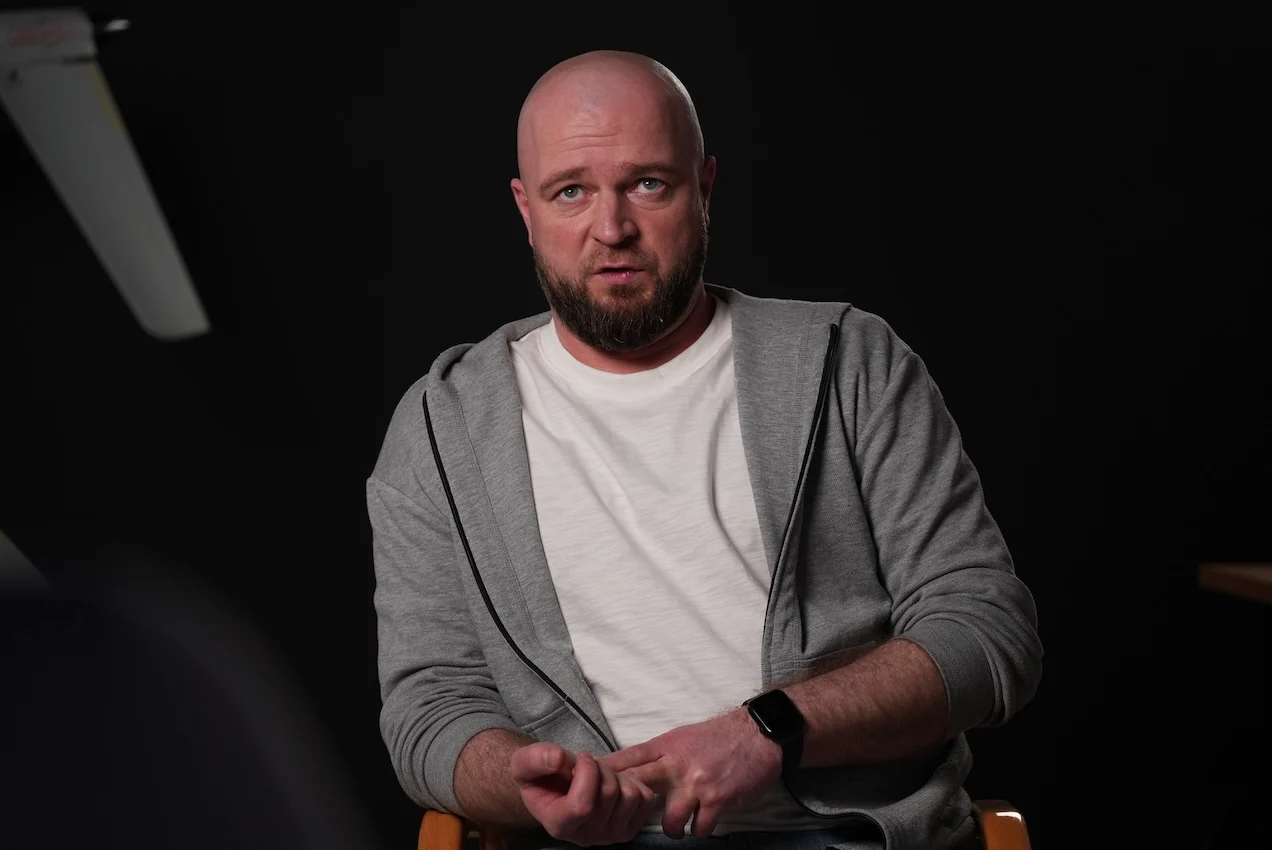
He shot down 24 Shahed drones in one night: an interview with “Miguel,” an interceptor drone pilot who set a record
A serviceman of the 1020th Anti-Aircraft Missile Regiment explains how interceptor drone pilots operate, and why speed isn’t the key factor

On the night of 6–7 September 2025, a drone interceptor pilot from the 1020th Anti-Aircraft Missile Artillery Regiment, known by the callsign “Miguel”, shot down 24 Russian Shaheds — a record-breaking feat for Ukrainian air defence. Behind that figure lie three years of nightly combat shifts, drones hand-assembled from volunteer-funded kits, and a relentless technological arms race.
Defender Media continues to raise funds for 10 interceptor drones for the unit where “Miguel” serves. We spoke to the record-holder about how an interceptor pilot’s work is organised, how Ukrainian drones differ from one another, and why speed is not the main factor.
I didn’t wake up that morning expecting to set a record. It was just another intercept mission — intelligence flagged numerous launches, which was nothing unusual. To be honest, I’m not sure why we packed the maximum number of drones that night. We just did — and as it turned out, it was the right call.
When the attack commenced, targets began entering our sector. We had the drones ready, so we simply got to work. Our sapper performed brilliantly; everything was prepped swiftly and seamlessly. The engagement lasted all night, from roughly 9 pm until 5 am. Once we returned to base, we started the paperwork, tallied the hits, and submitted the report to the higher command post. It turned out we had intercepted three-quarters of everything flying in our corridor that night — an intercept rate of 75–80%.
In the heat of the moment, you don’t feel the exhaustion. Generally, during the summer “shreds” (mass drone strikes), we worked every single night. Launches would start at 7 pm, and by 9 or 10 pm, the drones would be reaching our positions. We’d work through the night, get home at 6 or 7 am, grab three or four hours of sleep, and then start prepping the drones all over again. We’ve been in this cycle for months on end. Three years now.
There is no official leaderboard, and no one is chasing trophies — we just work as hard as possible. We know the crew of pilot “Khalk” from the “Bulava” unit is right behind us; those lads recently downed 20 targets in a single night.
On starting his service
I didn’t join the 1020th Regiment immediately. I’d been serving in the 24th Brigade since 2023. I was looking to transfer and considered several options, including infantry and mechanised units. However, I knew a few people here in the regiment from my time in the 24th; they told me, “Come over, you’ll be working on combat systems.” The formation of interceptor batteries was just getting underway. The transfer itself took about two or three months — and here I am, in the “one thousand and twentieth”.

We operated in the Sumy region, primarily against enemy reconnaissance UAVs. Back then, we had nothing specialised — just basic “sevens” and “tens” (FPV drones on 7- and 10-inch frames). Everything was hand-built. We used our own money, ran fundraisers, and relied on friends and local communities. Drones would arrive in small batches of five, ten, or twenty.
When I say we “assembled them ourselves,” I mean literally with our own hands. I can do it, and so can the rest of the lads. We would receive “bare” drones: no warhead, no initiator board. We had to strip them down, solder the initiators, arm them, and fit the munitions, batteries, and cameras. We bought the initiator boards with volunteer funds because there was simply no other way to source them. Roughly 60–70% of everything we received had to be manually reworked.
FPV drones have evolved immensely since then. We can’t afford to keep both drone-rockets and FPV systems at the same position; it requires an extra ground station, creating a “zoo” where no one knows where to run. It’s chaos. Our priority remains having extra drones specifically for Shahed interception.
A new generation of interceptors
The era of purpose-built combat drones began with the Stings. My first impression upon seeing one was: “What a load of rubbish.” But we decided to put them to the test.
Before that, we had tried a different interceptor drone of the same type. We were sent for training, and the briefings were incredibly impressive. But when we put them into practice… I tried to intercept a helicopter with one. It took off, immediately started twitching, flew 200 metres, and self-destructed. I never touched one again.
Four or five months later, the lads in my platoon were the first to receive Stings. They put them straight into action and downed eight Shaheds. I was on leave at the time; they started sending me videos, and I couldn’t believe what I was seeing — a Shahed being hunted down as I’d never seen before. Then they sent footage of the drones themselves — these strange, square things with curved components, totally unrecognisable. When I returned, we sat down with the manufacturer, watched it fly, and figured out the mechanics. We had a few losses on the first night, but then we found our rhythm. After that, we had no desire to use anything else.
We did test everything, though: P1-SUN, Litavr, Jedi. Every system is judged against specific criteria. We trial it, give the manufacturer feedback on what needs fixing or redesigning, and only then do we adopt it. The Pegases were around too — decent enough, but they’re out of production now. Small units, running on 270 batteries with a maximum range of just over 20 kilometres.
The Sting’s range is significantly greater, and even if you lose the signal and it drops off the radar, you can still pursue the target visually. And we do.
What interceptors need next
The P1-SUN is a capable interceptor, but there’s room for improvement. The main issue is video quality: at longer ranges it degrades, and without a clear picture you can’t engage a target effectively. Range is another open question. Part of it comes down to the ground station — we have lads who fly the same P1-SUN notably better simply by pairing it with a different one. So the potential is there; it’s a matter of finding the right equipment and improving the video link.
I’ve seen the Jedi. I won’t say it’s bad, but it doesn’t suit my style — it flies like a heavy cart. It struggles to maintain a level flight path when facing an incoming Shahed; turning it feels like manoeuvring an articulated lorry. The throttle starts burning, and it shudders. It gets the job done, but it’s hard work.
I’d choose the Sting not because it’s flawless, but because it’s the closest thing we have to a true combat drone.
In terms of progress, the biggest leap has been the video signal. We started with purely analogue; now we have digital. Ground stations have improved, too — 360-degree antenna tracking means you no longer need a dedicated person just to point the antenna. The three-man crew — pilot, navigator, sapper — manages everything.
There is always room for improvement. What we need most is automatic target acquisition. Currently, you’re glued to the screen, searching by eye. We need the drone to lock onto targets autonomously. We’re working on it, but it takes time; I haven’t seen a truly reliable auto-targeting system yet.
The second priority is speed. We need to be faster to intercept jet-powered Shaheds. We know the Geran-5 is coming, capable of around 500 km/h, so our interceptors must exceed that. Training will have to change too: at those speeds, managing a turn is far more difficult, and the targeting systems will need to operate on an entirely different level.
My advice to new operators: don’t focus on flying fast. Speed comes with time. Learn to fly slowly and with precision — that is what matters for landings, lining up a target, and the final approach. At 100 km/h, you barely have time to hit the detonation trigger. Start with the simulator. Get a feel for the inertia, learn how to bleed it off, and master those micro-inputs. Everything else comes with experience.
Reading now
1
SkyFall officially unveils Thor Hammer mid-strike and announces 1,000+ km version
2

260+ vacancies in Ukrainian defence technology at BlueBird Tech, Sine Engineering, Buntar Aerospace and more
3
British-Ukrainian Occam Industries raises €3.8m. The funds will go towards scaling drone autonomy software
4
Terra Drone acquires 50% of Ukrainian Kurin Technologies for $3.5 million
5

Autonomous interceptor drones need radars to work. Why is there still a lack of them
By submitting this form, you give Defender Media consent to the processing of personal data.
Надсилаючи цю форму, ви надаєте Defender Media згоду на обробку персональних даних.

Latest insights
1
Everything about the RAM-2X mid-strike drone: interview with Ukrspecsystems deputy director Andrii Rymaruk
2

A demo is not demand: How to prove the value of a defence tech product. Column by Tekever Ukraine Director Kateryna Bezsudna
3
How to choose the right video link for an FPV drone: analogue, digital, or fibre-optic?
4

How a frontline signal becomes an engineering task. A column by Defence Builder Accelerator Director Yana Shkvarovska
5