How Lava is building the robotic regiment of the future. An interview with the commander of the high-tech Khartiia unit
The regiment’s mid-strikes cut off Russian logistics, but they need cheaper reconnaissance drones as a pair
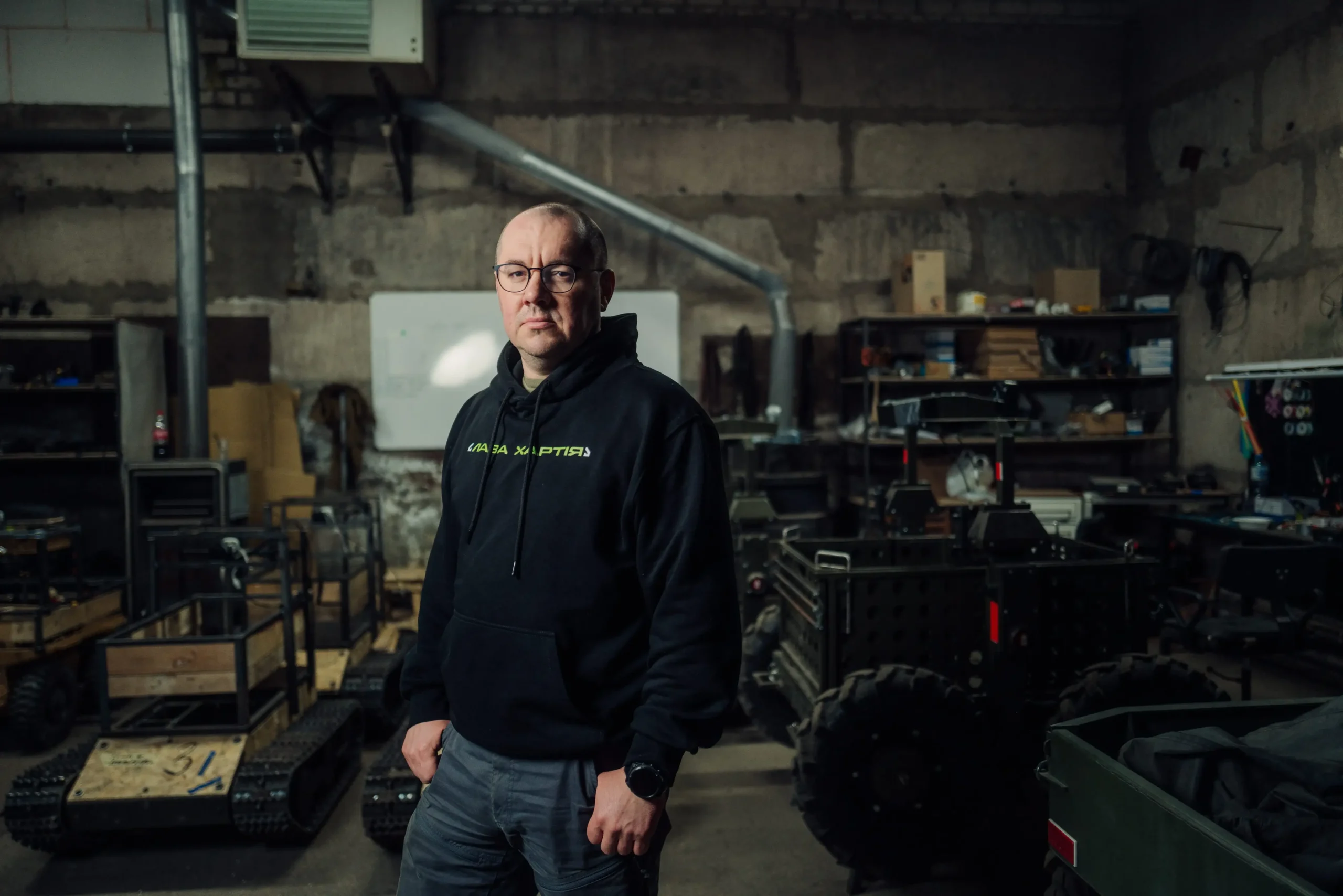
Volodymyr Mirchuk served in the Territorial Defence Forces and the Marine Corps, and later headed the Lava regiment (Photo from the unit)
An aerial drone conducts reconnaissance over a building in Kupyansk that has become a Russian stronghold. Following behind it, UGVs roll out from their position. Some are equipped with grenade launchers and thermobaric munitions – they will provide covering fire for the ground-based kamikaze drones, which are meanwhile approaching the building.
To destroy the Russian stronghold in February 2026, Lava did not deploy a single person on the battlefield. Volodymyr Mirchuk – commander of the regiment that is part of the Khartiia Corps – says he does not believe in any war other than a robotised one. He served in the Territorial Defence Forces and the Marine Corps, where he likewise worked with unmanned systems.
Now he and his brothers-in-arms are building a unit of the future, which in less than a year has grown from a newly formed battalion into a regiment. Lava’s task is to control the operational depth of 120–200 km and to support brigades on the Kharkiv axis. How is the regiment managing this? On middle strikes, the potential of UGVs and its own R&D centre, in an interview by Defender Media with the commander.
“Our priority is to develop the UGV sector”
— You’re already making active use of unmanned ground vehicles. How much faith do you have in this segment?
— The potential in the UGV sector is enormous, but things have come to a standstill in this area at the moment. If you go to an exhibition, you’ll see the same things you saw there a year and a half or two years ago. Iterations in this field aren’t happening very quickly; there’s nothing groundbreaking.
For example, there isn’t a reliable connection for control and lag-free video. Although Starlink does work with minimal latency, it’s only in open fields. But what happens if we drive into a forest or between plantations?
The latency affects the speed, which is still low – 10 km/h on average – and the screen might show a slideshow rather than a video. This makes us vulnerable: we can’t manoeuvre properly, and so on.
I think the sector will move beyond this plateau towards sustainable development, but for now, everyone is searching for something, and we in particular. We’re testing various concepts: I simply don’t believe in any other kind of war except a robotic one.
— What equipment do you use for this?
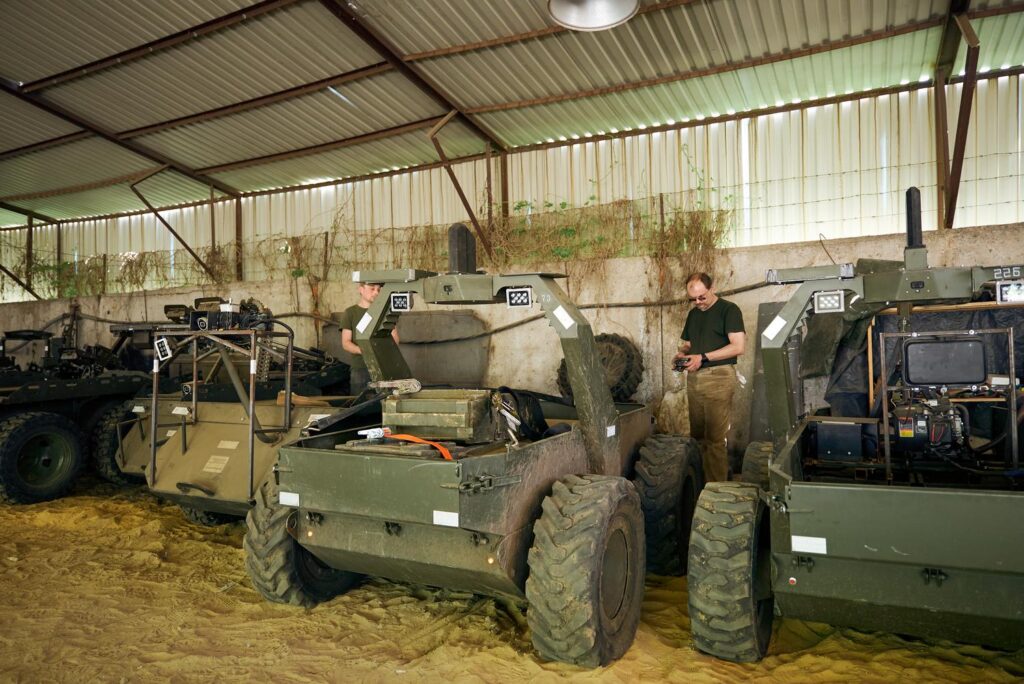
— Among our combat platforms are: DevDroid, the Saber and Buria modules. We build some of the equipment ourselves – mounting flamethrowers or grenade launchers onto a logistics platform. During the robotic operation in Kupyansk, we provided covering fire for the kamikaze drones using homemade combat UGVs.
Then two drones would fly into the building, and we would blow them up. Kamikaze UGVs are becoming more widespread – we’re developing some of our own here too. We need to find a solution that is more or less cheap and mass-producible. The economy is a constraint; we cannot use expensive kamikaze drones frequently.
For logistics, we have the Tor-1000, Tor-800, Zmiy, Targan, TerMit and Gulliver. A delivery drone can withstand 15-17 missions, each costing around 70,000 UAH. When I was serving with the Marines in the Pokrovsk and Novopaliivka sectors, UGVs there could withstand much less.
— How often can fully unmanned operations like the one in Kupyansk be carried out?
— I can’t say for certain: we need to time it right, particularly in terms of the weather. There are nuances linked precisely to the limitations of UGVs. Again, it all comes down to funding. But we plan to use them more and more.
Our priority is to develop the UGV component, but I don’t know how quickly that will progress. For now, I’m not very satisfied with the level of technology currently available on the market.
— On funding: have you felt the shortage that emerged after VAT was introduced on UGV sales?
— We have: we don’t have an incredible reserve of UGVs. Sometimes we have to turn down additional missions on the front, because we plan other tasks, and there is a risk of losing the system. And the situation is not improving for now. I know the reasons, but I don’t want this to be an excuse for the fact that parliament cannot get together and solve the problem.
Editorial’s note: On 19 May, a group of MPs registered a draft law that is meant to abolish VAT for UGV manufacturers. Industry organisations welcomed the decision, and the Verkhovna Rada’s tax committee supported the draft law. According to MP Halyna Yanchenko, there is a high probability that parliament will consider it in the upcoming plenary weeks.
— How is your supply organised overall?
— The main route is state procurement. In second place are orders through ePoints, and in third – fundraising and assistance from sponsors. It is essentially what keeps us afloat. Khartiia has its own foundation, to which we submit our needs.
Mid-strike targets and the problems with cheap reconnaissance drones
— Let’s move from UGVs to mid-strikes. What do you use here?
— Here we have systems with warheads from 3.5 kg and upwards. These are Bulava, Beshketnyk, Hornet, and Baton. A whole set of different frequencies, with analogue and digital video.
— And which targets become a priority for these drones?
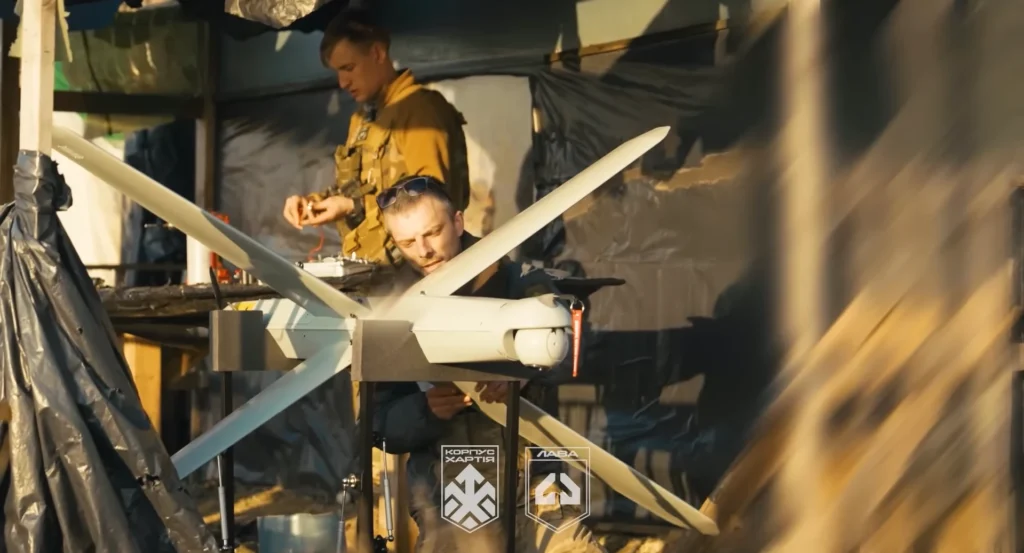
— Overall, we have clearly divided all targets into three levels, and we operate within this framework. Our priority task is to cut off Russian logistics with them. Then comes the task of “blinding” the enemy. These can be radars, air defence and so on, which will allow us to strike logistics more effectively. The third is countering enemy take-off sites, because they too are moving a little further from the line of contact. And then there can be targets related to communications. Bulava, for example, works on more important targets, where the reconnaissance-strike link is precisely what is needed: air defence, EW, ELINT, enemy pilots.
But the problem is that air defence is sufficiently well developed on both sides, in Kharkiv and near Belgorod. So it is very difficult to operate. Since last year, the enemy has been detecting our aircraft fairly well, so we are starting to use tricks: flying one after the other, approaching from different sides and so on.
The biggest threat to us is being shot down. There is also EW, but “cures” are appearing. If you have passed the air defence line, you will reach the target in 80-90% of cases. But getting through is a challenge.
On top of that, we cannot use Starlink, it does not work in Russian territory. We have to look for new communications, install relays, and do something else. There are manufacturers offering solutions for this territory.
— If asked about your “biggest” target hit, what would you name?
— It’s pilots. They conduct direct strikes and fly missions over Kharkiv and the region, so they’re very important. Without them, the enemy would be “blind,” and there would be fewer strikes. Finding them, calculating the timing for the approach, hitting them while they’re on the surface – this is very difficult, as they’re also cautious. So in terms of sophistication of execution – it’s pilots, and if we judge by scale – command posts, infrastructure.
— What does the process itself look like, from target detection to engagement?
— Roughly speaking, we can either observe in real time or we can have a certain list of targets. Reconnaissance drones, for example, photo-mapping UAVs, go up. Targeting is mainly handled by planning personnel: they analyse the imagery, prioritise targets, and pass them to the operational duty officers. Those officers already know which assets are available in the units, and allocate who works on what and how.
In parallel, reconnaissance drones observe a particular area, find something, and we can direct strikes there. Someone from adjacent units can also pass on a target.
If we have a specific task – for example, over a week we need to reduce the number of enemy radars – then we work to a defined target list.
— Regarding reconnaissance: which drones operate in pairs with strike platforms?
— Leleka is something of a basic training aircraft for wing pilots for us. It is the most numerous, the simplest and technically very decent. Plus, the Bulava has appeared, so we are cooperating well with the manufacturer. Among photo-flight aircraft, we have the standard Mara and BZIK. Then there is the German Vector, and the Shark.
— The reconnaissance drone market is called the most structurally stable, and on top of that, the oldest. But is there room for manufacturers to grow in it?
— Actually, I hold the view that there should be certain changes. The most shoot-downs occur at altitudes of 1 to 2.5 km. This is precisely the operating tier of the popular Leleka, Doma and the rest. They are not cheap – tens of thousands of dollars.
Next comes the upper tier: Shark, Raybird, Penguin. These are good aircraft with optics that allow the enemy to be observed quite well from altitude. And now the lowest and cheapest group is being created – like the Sokil from Vyriy.
I believe in these “lower” and “upper” product lines. Because the middle one gets shot down very quickly, even though it is helped by “ukhylyant” systems (systems for evading interceptor drones, which are installed on reconnaissance aircraft – ed.).
The cheapest reconnaissance drones should ideally cost between 2 and 5 thousand dollars. Let it be cheap Chinese optics, hand launch, but it will be inexpensive, and stocks will be replenished quickly. Such drones are still raw, but the segment has potential for development. You know how FPVs were a bit crooked in the first months? But whoever stuck with them, hit. It’s the same with these. I tell my pilots: “Guys, you see a problem in this, because you are used to flying refined ones. But you have to pay for that.”
And the mindset needs to change: yes, for now they are a bit slow, but with them we won’t be jammed. They shoot one down – we send another, and another, and tomorrow new ones arrive, and so on.
In-house innovations and how they motivate people
— You have already mentioned the regiment’s own developments. What exactly does your R&D centre do?
— The first direction is UGVs. In the workshops, the systems are prepared for use, baskets are welded on, for example, and in-house projects are developed. One of them is a system that sees an FPV approaching via a camera and ejects a net when it gets close. It works in 66% of cases.
You could say: “But 40% remains.” Yes, but the number of missions will increase by 60% for me. And that means I will buy 60% fewer systems and save money – at this stage, that is already great.
The second project is a kamikaze UGV. Then there is a project for a single control box for all systems, because they often arrive without proper controls. We are making our own logistics platform, installing flamethrowers and grenade launchers on UGVs.
But this is only proof of concept; engineers need to be brought in further. I’m not sure we will be able to do R&D fully within the Armed Forces, because there are not enough resources. There should be cooperation between manufacturers and us. We give them feedback in the process.
— And within the corps itself, do you somehow share your developments?
— There is an exchange of experience between units as well, but here the initiative has to come from below. We operate on the “unless otherwise directed” principle – the commander of a UGV group, for example, can send a person or go himself, if he has not been forbidden to do so.
We tell and show others what we do. This exchange is the most useful because someone gives you a hint of something you can then do in your own unit.
— UGVs are clear, but what are you doing with aerial drones?
— On FPVs, we wind our own spools, experiment with media converters and “waiting” drones. With Mavics, there is less work: it is essentially firmware, repairs, in-house production of antennas, batteries and so on. On UAVs, we install Starlink.
These modifications also motivate the guys: they look for something, come up with things. It seems to me that they find it more interesting to work this way. It is important to do this throughout long service, to have at least a little interest, involvement in the process and satisfaction.
— How are things with personnel, by the way?
— A shortage is definitely felt. And although there is a lack of understanding as to why new units are being created in this situation, I will say – sometimes it is easier to build something right from scratch than to reform something old. This is a plus in favour of units like mine.
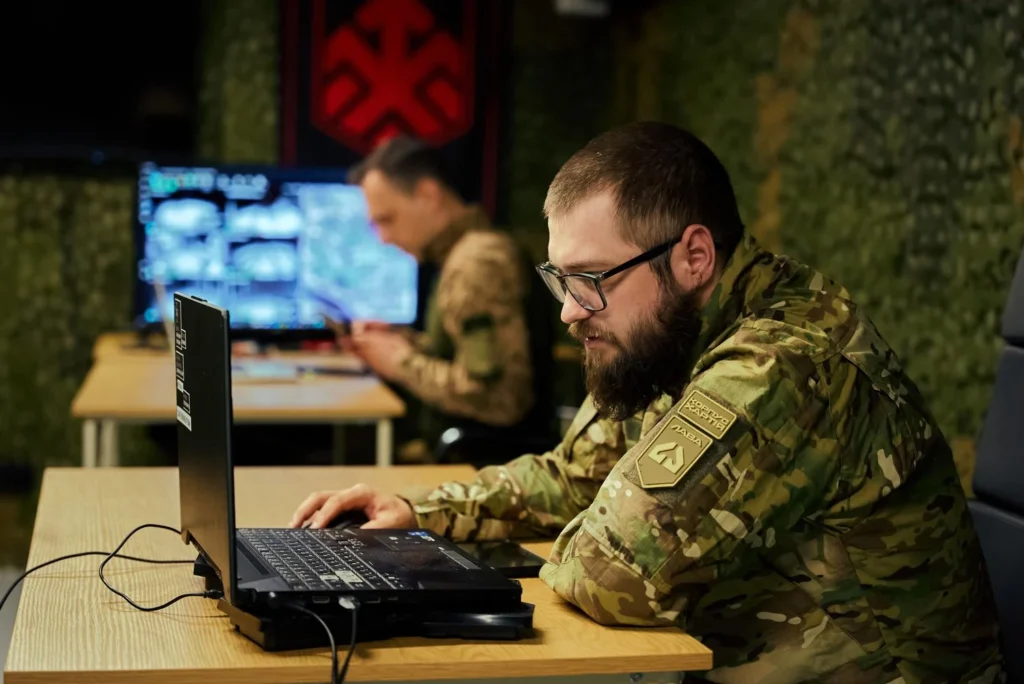
We bring people in through the Territorial Centres of Recruitment and Social Support. Recruiting works weakly, but we are moving forward step by step. Everyone is in short supply: pilots, analysts, ISTAR dispatchers who have management experience and can put together a thought properly, and make reports.
We are trying to make pilot crews smaller, but have more of them. We have a norm: three people for a reconnaissance aircraft, for example, four if the aircraft has a relay. So that people can rotate and not sit in dugouts. This is the right approach, if it provides the opportunity to work normally, stably and systematically.
We are also looking for financial officers, accountants, an army alternative to HRs in the headquarters, and meteorologists are in short supply. We can plan work, we use popular weather forecasts, but I do not believe it should work this way. I would like to have a person with a professional approach to planning, who will monitor maps and give a clear forecast.
We also need mechanics, engineers, electricians, IT specialists, so we invite everyone. After basic training, there are two weeks of adaptation. During it, we take stock of what the person has learned in basic training. Then we conduct an interview and show what we have. From the conversation, it is immediately clear who will be a good analyst, who can be assigned to multi-rotors and who to reconnaissance drones.
It would be good if one could “level up”, fly a Mavic, look at the tactical level, and then move on to the operational one. Then a person would understand and value the infantry more, but these are ideal conditions. They are unfortunately not available now.
The unit’s vacancies can be found on the regiment’s website or by calling the recruiters on 3333.
Reading now
1
SkyFall officially unveils Thor Hammer mid-strike and announces 1,000+ km version
2
Pentagon to hold Drone Dominance trials for bomber drones, with UFORCE, Gurzuf Defence, Grim Tech and others taking part
3
British-Ukrainian Occam Industries raises €3.8m. The funds will go towards scaling drone autonomy software
4
Terra Drone acquires 50% of Ukrainian Kurin Technologies for $3.5 million
5

Autonomous interceptor drones need radars to work. Why is there still a lack of them
By submitting this form, you give Defender Media consent to the processing of personal data.
Надсилаючи цю форму, ви надаєте Defender Media згоду на обробку персональних даних.

Latest news
1
Dorozvidka #80: European defence tech boom, Drone Forces, Artem Moroz and Eric Schmidt
2
US Buys 1,320 more FPV drones from Ukraine’s F-Drones for $6.5M
3
Robotic systems carried out 94 assault and sabotage operations during Operation Vivaldi, says NC13 unit commander
4
NeoLens, an AI assistant for military vehicle repair, is now available as an Android app
5