Black Mirror #63: Molniya for ISR, Kalibr upgrades, a new USV from ZALA, and other new Russian miltech developments
A review of developments in Russia’s defence industry during the second week of June
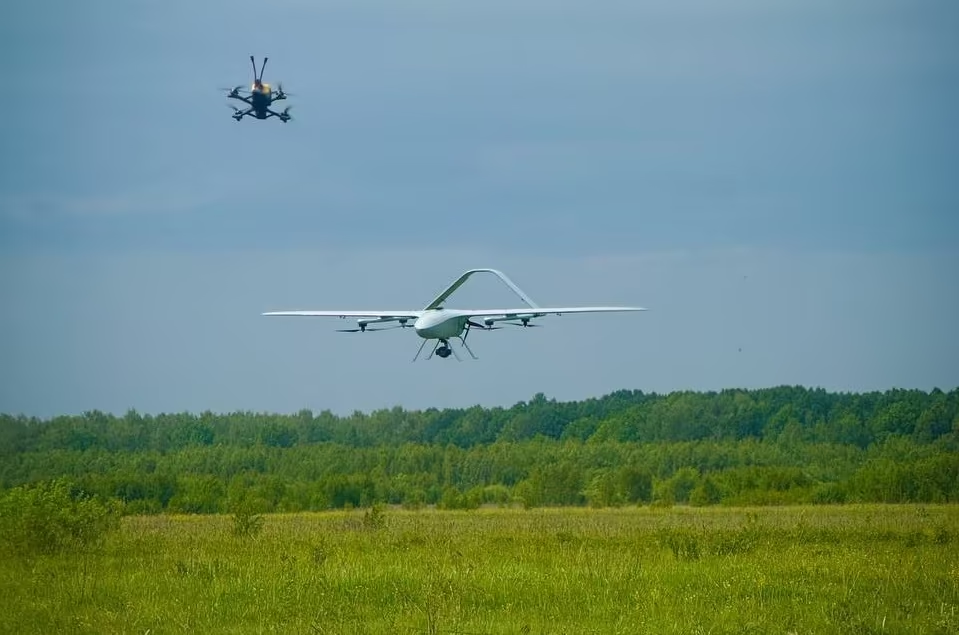
Russian Oko-3 reconnaissance UAV
Last week, Russia unveiled upgrades to its Geran-4 attack drones and one of its cheapest and most widely deployed uncrewed systems, the Molniya, in a reconnaissance configuration. It also presented a vertical take-off reconnaissance UAV. In addition, reports emerged detailing upgrades to Kalibr cruise missiles and the production of uncrewed surface vessels. These and other developments within Russia’s defence industry are covered in Defender Media’s weekly Black Mirror review.
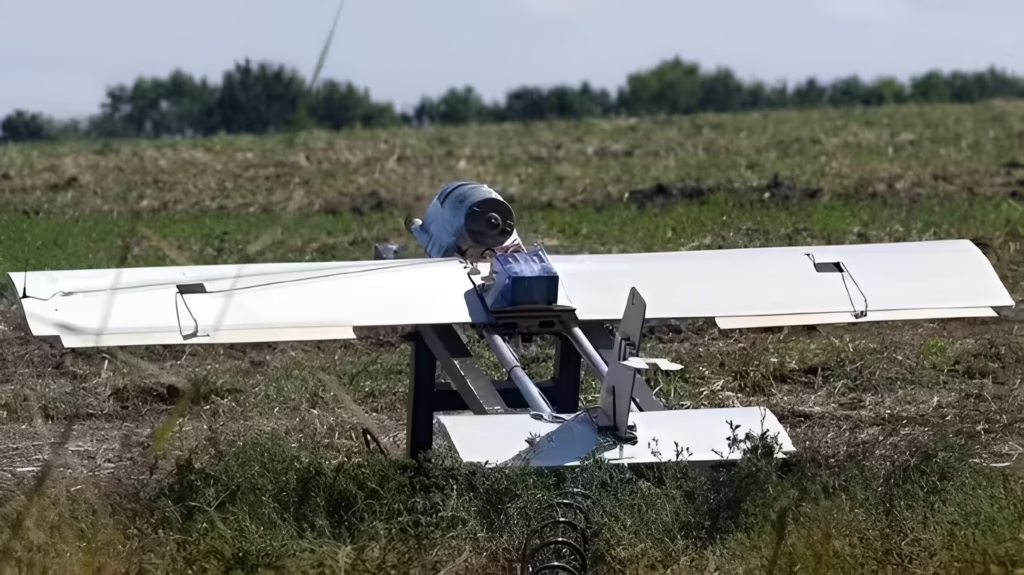
Molniya-R UAV receives reconnaissance capabilities
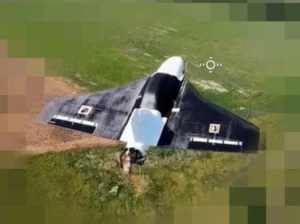
Russia has upgraded the Molniya-2 kamikaze drone by developing a reconnaissance UAV variant designated Molniya-R. The new modification is equipped with a reconnaissance camera, an expanded compartment configured for two batteries, and an air pressure probe utilised to determine wind direction and velocity.
Following mission execution, the aircraft lands on its fuselage utilising specialised skids. The developers claim the UAV can return to base even while operating under active electronic warfare conditions.
Geran-4 drone receives an automatic target recognition system
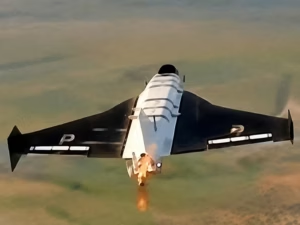
The Geran-4 jet-powered drone has been equipped with an automatic target selection function. The system independently identifies objects, marks them on the display suite, and tallies potential targets without operator intervention. According to available data, the drone can perform real-time target recognition by type.
The UAV has also received a modified aerodynamic design: the wings are now rigidly integrated into the airframe, while the number of access panels on the fuselage has been reduced to minimise aerodynamic drag.
The Geran-4 is powered by a turbojet engine and can achieve speeds of up to 500 km/h. Its warhead section weighs up to 70 kg.
Katyusha UGV for demining and logistics
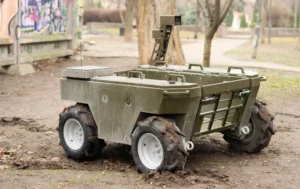
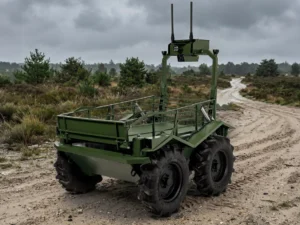
During the Flot-2026 International Naval Salon in the Russian city of Kronstadt, Katyusha uncrewed ground vehicles were showcased. These platforms are already being supplied to operational units of the Russian military.
The tracked platforms are engineered for demining operations and cargo transport in challenging terrain. Each vehicle features a combat weight of 177 kg and can transport payloads of up to 200 kg.
The systems can be remotely controlled at ranges of up to 20 km. A fibre-optic cable is integrated as a backup communications link. Battery endurance is stated at six to seven hours. The manufacturer notes that it is prepared to produce up to 1,000 platforms per month.
Kalibr missiles receive a decoy deployment system and a cluster warhead
Russian 3M14 Kalibr cruise missiles have begun to be fitted with L-504 dispensers designed for releasing chaff decoys. These systems generate additional radar signatures, complicating interception and tracking by air defence networks.
Similar dispensers had previously been observed integrated onto Kh-101 air-launched cruise missiles. Their operational deployment has now also been reported on sea-launched Kalibr variants.
In addition, foreign media outlets report the potential emergence of a Kalibr variant with a cluster-warhead architecture, although Russian commentators have not confirmed these claims.The
Peppa control system is used in every fourth FPV drone
The Russian company Aviron claims that its Peppa control system has been integrated into approximately 25% of FPV drones deployed in combat operations.
The manufacturer states that production volumes amount to “hundreds of thousands” of units per month. Products marketed under the Peppa brand include communications kits featuring Moxon and Yagi antennas, JR modules for long-range communications, airborne relay platforms, magnetic navigation sensors, and other components for uncrewed systems.
Oko-3 reconnaissance UAV receives vertical take-off and landing capability
The Svarog Research and Production Centre has presented the Oko-3 fixed-wing UAV configured with a vertical take-off and landing capability designed for reconnaissance missions.
The UAV is equipped with a SIYI ZR30 camera integrated onto a three-axis gimbal, a thermal imaging system, and optical zoom capability. The aircraft features a maximum operational range of 130 km, a flight endurance of up to two hours, and a top speed of 90 km/h.
The drone can carry a payload of up to 2.5 kg. It requires a take-off and landing footprint approximately 15 metres in diameter.
In February, representatives of the Svarog Research and Production Centre reported that the Oko-3 had entered operational deployment in combat operations. According to them, the UAV utilises a digital communications link and exhibits resilience against electronic warfare systems.
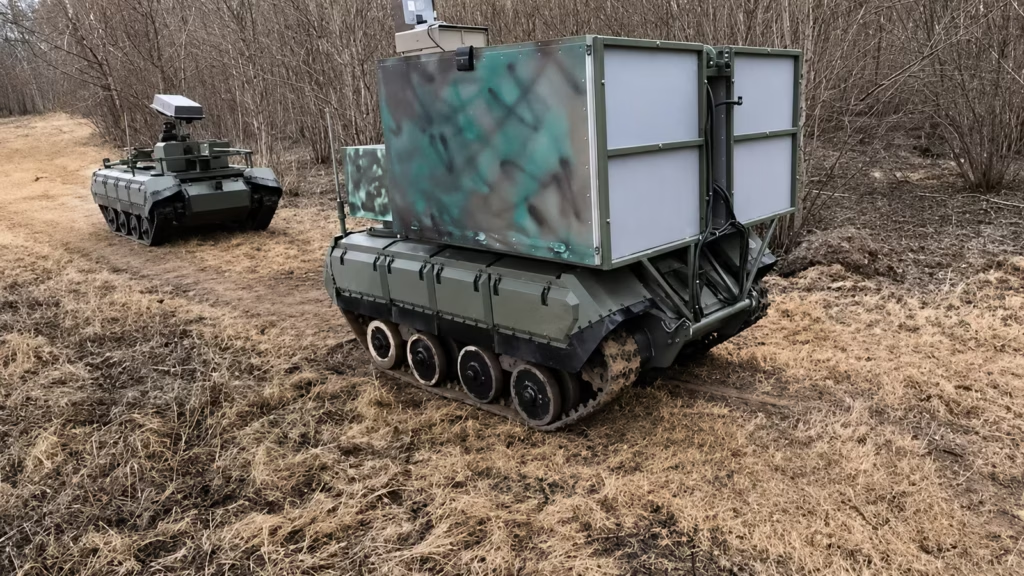
Impuls mobile counter-drone system
The company Gumich RTK has unveiled the Impuls mobile counter-drone architecture, engineered to protect frontline areas and critical infrastructure. According to the developers, the UAV detection range varies from 4 to 18 km depending on target radar cross-section and operating conditions.
The system consists of two Impuls-M robotic ground platforms. The first is equipped with a radar station optimised to detect small aerial targets. The second platform serves as a carrier for interceptor drones intended to neutralise detected targets. Their specific technical characteristics have not been disclosed.
Russia develops compact version of the R-18 hexacopter
Russian servicemen have developed a downscaled variant of the heavy R-18 hexacopter, known unofficially as Baba-Yaga. Two variations of the aircraft have been created: one capable of carrying up to 3 kg of payload and another capable of carrying up to 6 kg.
The structural design allows for the integration of various payload mounts, including those configured for 82 mm mortar rounds, grenade launcher munitions, and equipment designed for recovering lost drones. The drone’s maximum operational range is 15 km.
ZALA presents KAMA uncrewed surface vessels
The Russian company ZALA has presented two variants of the KAMA multi-purpose uncrewed surface vessel. The vessels are designed for hydrographic surveys, environmental monitoring, waterway patrols, search-and-rescue operations, and cargo delivery missions.
The vessel features an operational endurance of up to 12 hours. Its cruising speed is 12 knots (22.2 km/h), while its maximum speed reaches 30 knots. The uncrewed vessel can operate at ranges of up to 700 km from its staging base and accommodate payloads weighing up to 600 kg.
The design integrates thermal imaging cameras and an automatic return-to-base function activated in the event of a total loss of communications. The vessel is also claimed to be capable of maintaining a station-keeping position in sea states of up to three points.
Reading now
1

Ukraine’s Roboneers is launching a joint venture with ARX Robotics to produce tens of thousands of UGVs per year
2
Ukraine’s Phantom Defense unveils integrated counter-UAS ecosystem at Eurosatory 2026
3
Naval drones became a game-changer in the Black Sea. Now European countries are waiting for a chance to buy them
4
Sting 2.0 and updated Bullet. How interceptor drone manufacturers are preparing to counter jet-powered Shaheds
5

7 July events: The month’s key defence tech gatherings in Europe and beyond
By submitting this form, you give Defender Media consent to the processing of personal data.
Надсилаючи цю форму, ви надаєте Defender Media згоду на обробку персональних даних.

Latest news
1
Dorozvidka #67: New Drone Deals, Operation Art-Auchan, FP-1 in Omsk, and Anubis and Behemoth over the Azov Sea
2

State Bureau of Investigation raids Vyriy Industries founder Oleksii Babenko
3
F-Drones unveils ‘the first fully autonomous interceptor drone’
4
Ukraine’s Ministry of Defence has codified the Lynx+ UGV from Roboneers
5