Former senior officials in Ukrainian defence tech: editor’s column
What connects Oleksii Honcharuk, Oleksandr Danyliuk, Ben Wallace, Brooks Newmark and Mike Pompeo with UA defence tech

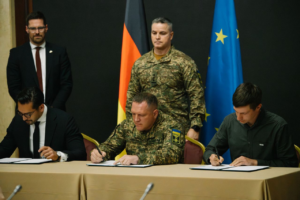
Former senior officials with interests in Ukrainian defence tech. Collage created using ChatGPT
Recently, the Defender Media editorial team noticed that at least two former members of the Ukrainian government are among the co-founders of leading defence tech companies. And if you count foreign ex-officials linked to Ukrainian defence businesses, the number is even higher.
This piece doesn’t aim to be exhaustive, but highlights some of the most prominent former top-level officials now involved in the defence tech industry.
Oleksii Honcharuk — from a short-lived premiership to launching a unicorn
Oleksii Honcharuk was the youngest prime minister in Ukraine’s history. Still, his time in office was brief — the so-called “technocratic government” he led lasted just six months, from August 2019 to March 2020.
His involvement in defence wasn’t new: he chaired the supervisory board of Aerorozvidka, advised Mykhailo Fedorov, served on the supervisory board of Ukroboronprom between 2023 and 2025, and advised the commander of Ukraine’s Unmanned Systems Forces in 2024–2025.
But the broader public only recently learned about his main venture — when UForce emerged from stealth, raising $50 million for its UK entity at a valuation exceeding $1 billion. Honcharuk appeared as a co-founder and board member.
UForce holds majority stakes in several Ukrainian defence businesses, including manufacturers of Magura naval drones, Nemesis bombers, UGV and turrets, and more.
Oleksandr Danyliuk — from finance minister to missile production
Before Honcharuk, Ukraine’s government was led by Volodymyr Groysman, with Oleksandr Danyliuk serving as finance minister from 2016 to 2018. In 2019, he briefly headed the National Security and Defence Council and led the National Cybersecurity Coordination Centre.
For a while, little was known about his next steps. Then, during the second year of the full-scale invasion, it emerged that he is a co-founder and now president of Destinus.
Destinus has an unusual backstory. It was founded by Mikhail Kokorich, who left Russia in the 2010s. After an unsuccessful attempt at an aerospace startup in the US, he relaunched in Switzerland with Destinus.
Initially focused on civilian hypersonic aircraft and drones, the company pivoted to defence after February 2022. Kokorich renounced his Russian citizenship, and Danyliuk joined the company in 2023.
While details of their partnership remain limited, Danyliuk’s connections appear to have helped bring Destinus products to Ukraine’s military. The company began supplying drones in 2023, and in 2024, Volodymyr Zelensky announced successful tests of the Ruta cruise missile, developed by Destinus.
Unlike UForce, Destinus is not officially a unicorn, but external estimates put its valuation well above $1 billion.
Recently, the company has been active across Europe — becoming a strategic partner of Quantum Systems and agreeing to launch a joint venture with Rheinmetall.

Last week, Destinus announced successful tests of its second-generation Ruta Block 2 cruise missile, unveiled earlier in 2026. It can carry a 250 kg payload and has a range of over 700 km.
Beyond Ruta, Destinus’ portfolio includes the Kryla air-to-ground cruise missile, the long-range Lord drone, and the Hornet interceptor.
British and American officials in Ukrainian defence tech
Among foreign officials involved in Ukrainian defence tech, several come from the UK.
Ben Wallace, former UK defence secretary, sits alongside Honcharuk on UForce’s board as an independent director. He held his ministerial role from 2019 to 2023 and frequently visited Ukraine during that time. Now, he is helping one of Ukraine’s largest defence companies unlock its export potential — still constrained by state mechanisms.
According to Defender Media sources, UForce’s export ambitions became one of the triggers behind tensions with the president Zelensky, who reportedly criticised certain arms manufacturers in meetings with industry representatives and journalists.
Another former UK minister, Brooks Newmark, co-founded the Ukrainian-British startup Trypillian. He previously served as minister for civil society and as an MP, and since the full-scale invasion has supported Ukraine through his Angels for Ukraine initiative, which helped evacuate over 35,000 civilians.
In 2025, Newmark co-founded Trypillian with Ukrainian veteran Ivan Matvieichenko and invested $5 million of his own funds.
The company has since launched a range of UAVs, including FPVs, a relay drone, a bomber, and a VTOL reconnaissance platform. In 2026, it introduced strike platforms VORON-10 and BOMBER-15, and announced the ATOM fixed-wing UAV.
It also formed an advisory board led by David Richards, former Chief of the Defence Staff of the UK.
Across the Atlantic, Mike Pompeo — former CIA director and US Secretary of State under Donald Trump — sits on the supervisory board of Fire Point.

Fire Point is one of Ukraine’s largest modern weapons manufacturers. Its products include the FP-1 deep-strike system, FP-2 mid-range strike platform, FP-5 Flamingo cruise missile, and FP-7 short-range ballistic missile. It is also developing the long-range FP-9 ballistic missile and an air defence missile system.
At the company’s first public event in November 2025, Pompeo described Fire Point as a “game changer” and expressed confidence in its global potential.
Defender Media is aware of several more high-profile officials reportedly linked to Ukrainian defence projects. If confirmed, this column will continue.
Reading now
1
SkyFall officially unveils Thor Hammer mid-strike and announces 1,000+ km version
2
Pentagon to hold Drone Dominance trials for bomber drones, with UFORCE, Gurzuf Defence, Grim Tech and others taking part
3
Terra Drone acquires 50% of Ukrainian Kurin Technologies for $3.5 million
4
British-Ukrainian Occam Industries raises €3.8m. The funds will go towards scaling drone autonomy software
5

Frontline Robotics CBDO Mykyta Rozhkov: Ukraine and Norway are working on an autonomous system to protect maritime infrastructure
By submitting this form, you give Defender Media consent to the processing of personal data.
Надсилаючи цю форму, ви надаєте Defender Media згоду на обробку персональних даних.

Latest news
1
Nataliia Mykolska to become VP of Growth and Affairs at Sine Engineering
2
Black Mirror #79: What’s inside Geran-4, unmanned tanks, balloon barrages and more of a new russian miltech
3
6,000 lives saved by replacing people with robots. “Makar” on the ground strike drone unit NC13 and its role in Operation Vivaldi
4
M-Fly and Dwarf Engineering announce partnership: what it involves
5