Dorozvidka #54: private air defence, plus Ben Wallace, Artem Moroz, Taras Ostapchuk, Mykyta Rozhkov, and Denys Shtilerman
The most interesting interviews and quotes from leading officials and business figures on Ukrainian defence tech over the past week

Ben Wallace, UK Secretary of State for Defence in 2019–2023 and a board member of Ukrainian defence unicorn UForce. Photo: Getty Images
In the new edition of Dorozvidka:
– President Zelensky again criticises Ukrainian arms manufacturers over a false start on exports;
– Mykyta Rozhkov on how Frontline secured approval for defence exports;
– An interview with Ben Wallace, former UK defence secretary and independent director at UForce;
– Forbes on how private air defence works in Ukraine;
– Ukraine and Romania discuss joint drone production;
– Fire Point co-founder Denys Shtilerman appears on Serhii Sternenko’s stream;
– Artem Moroz on Ukrainian deftech companies’ US tour;
– Ratel on Valeriia Ionan’s Meet the Startup podcast.
Zelensky again criticises Ukrainian arms manufacturers over export false start
Last week, Ukrainian President Volodymyr Zelensky met with journalists and once again sharply criticised domestic arms manufacturers allegedly entering foreign markets behind the state’s back. Selected quotes were published by Livyi Bereh. In particular, Zelensky said that a leader of a Middle Eastern country told him about an agreement with a Ukrainian company that has production facilities in Spain. According to him, the leader had already reached a deal with the manufacturer to purchase interceptor drones. The company’s head spent a week in the Middle East offering its products. The foreign leader asked Zelensky whether Ukraine would provide training on using the interceptors. Zelensky replied that it would not — unless the state is paid for it.
“That’s not how it works. Why? First, this is not only their achievement. For these drones to work, our military tested them, fought with them, improved them, and brought them to results. This is not just business. There must be respect for what our military does. Second, we are at war. The state must define which exports are permissible to strengthen defence first and foremost. Third, all of this only works as a system — drones, integration with other air defence elements, software, and experienced personnel. Representatives of different countries — not even at the leadership level, but at the company level — come to Ukraine and buy something… And then it doesn’t work as it should because a systemic approach is needed: the drones themselves, our specialists’ expertise, software, and many other factors. Most importantly, there must be respect for our state and long-term cooperation so that Ukraine benefits from this, not just someone making money somewhere,” the president said.
Zelensky added that he wants to sign ten long-term international defence agreements, each lasting ten years. According to him, this would secure billions for the defence industry’s development. He noted that Ukraine’s export strategy will primarily target countries that have invested in Ukrainian defence.
Mykyta Rozhkov on how Frontline secured defence export approval
Mykyta Rozhkov, Business Development Director at Frontline Robotics, appeared on the UT-2 podcast. In a two-hour conversation, he подробно explained how the company became the first in Ukraine to receive permission to export military technology.
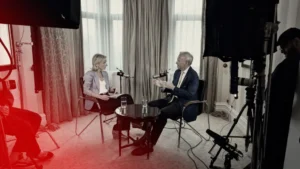
Interview with Ben Wallace — former UK defence secretary and independent director at UForce
During the early years of the full-scale war, Ben Wallace led the UK Ministry of Defence and was one of the key Western policymakers supporting Ukraine. He is now a director at British-Ukrainian defence startup UForce, which recently became a unicorn.
“I understand the nature of warfare. That allows me not only to advise the company’s leadership, but also to help improve potential export markets for Ukraine,” Wallace said about his involvement.
What underpins UForce’s $1 billion+ valuation, and how does its product work? How did a former defence secretary join a Ukrainian defence startup? Why is opening defence tech exports important not only for companies, but also for the state? Wallace answered these questions in an interview with Forbes Ukraine.
Ukraine and Romania discuss joint drone production
Romania and Ukraine are in talks to produce drones jointly, funded by the EU, Reuters reports. Discussions are taking place in Bucharest with the participation of Ukrainian manufacturers and Romanian defence officials. The project is part of the EU’s SAFE rearmament initiative, under which Romania has been allocated €16.6 billion, including around €200 million specifically for joint drone production.
The plan builds on a recent bilateral agreement to manufacture Ukrainian defence technologies in Romania, combining battlefield-proven Ukrainian drone solutions with Romania’s industrial base and access to EU funding. Around 15 Ukrainian companies are involved in the talks, and the contract is expected to be finalised by the end of May.
Fire Point’s Denys Shtilerman appears on Serhii Sternenko’s stream
Denys Shtilerman, chief designer and co-owner of Ukrainian deftech company Fire Point, took part in a livestream hosted by volunteer Serhii Sternenko. In a 70-minute conversation, they discussed a range of key topics, including exports of Ukrainian weapons and localisation of production.
Shtilerman supports opening exports of Ukrainian weapons, but believes it should happen under clear rules and only after the needs of the Defence Forces are fully met. He also noted that Fire Point has achieved 90% localisation of its drones.
How private air defence works in Ukraine
On March 30, Defence Minister Mykhailo Fedorov announced that private air defence is now operational in Ukraine — and has already recorded its first interceptions. As an example, he cited the downing of enemy drones in the Kharkiv region by Carmine Sky.
The “private air defence” project was launched in November 2025, when the Cabinet of Ministers approved an experimental framework allowing companies to form air defence units. Forbes Ukraine spoke with early participants in the sector about how the system works and why not all companies are interested in joining.
Artem Moroz on a Ukrainian deftech companies’ US road show
An investment roadshow in the US was recently organised by Brave1 for Ukrainian defence companies. Ukrainian projects presented their technologies to funds managing trillions of dollars in assets.
AIN spoke with Artem Moroz, Head of Investor Relations at Brave1, about the outcomes of the trip, how average investment ticket sizes in defence tech have changed, and what foreign investors are looking for in the Ukrainian market.
Ratel on Valeriia Ionan’s Meet the Startup podcast
Taras Ostapchuk, founder of the drone manufacturer Ratel, appeared on the English-language Meet the Startup podcast, hosted by Valeriia Ionan, an adviser on international projects to Defence Minister Mykhailo Fedorov.
According to Ostapchuk, Ratel is already producing up to 200 robots per month, making it one of the largest UGV manufacturers in Ukraine.
He also discussed:
– how war accelerates innovation cycles;
– why Ukrainian solutions are up to 10x more cost-effective;
– how UGVs are evolving into dual-use technologies (from firefighting to rescue missions);
– why international partnerships are critical to scaling production.
Reading now
1
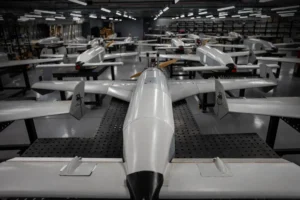
SkyFall officially unveils Thor Hammer mid-strike and announces 1,000+ km version
2
260+ vacancies in Ukrainian defence technology at BlueBird Tech, Sine Engineering, Buntar Aerospace and more
3
British-Ukrainian Occam Industries raises €3.8m. The funds will go towards scaling drone autonomy software
4
Terra Drone acquires 50% of Ukrainian Kurin Technologies for $3.5 million
5

Autonomous interceptor drones need radars to work. Why is there still a lack of them
By submitting this form, you give Defender Media consent to the processing of personal data.
Надсилаючи цю форму, ви надаєте Defender Media згоду на обробку персональних даних.

Latest news
1
Acoustic sensor developer Zvook raises investment from new Czech fund managed by DEPO Ventures
2
Denmark to hold first-ever Danish Defense Tech Week in four cities: what to expect
3
Forbes: Airlogix plans to raise $100m at a $2bn valuation
4
Tencore launches an ecosystem to bring together UGVs and components from several manufacturers
5