Black Mirror #39: 65-km fibre-optic control, Buryat FPV, a passive drone locator, and other Russian miltech developments
A review of Russian military technology developments in the final week of 2025

Over the past week, Russian sources have highlighted a range of developments, including surface unmanned vessels, a method for intercepting slow quadcopters using a rope, the use of UGVs to construct temporary crossings, and preparations to deploy a North Korean cruise missile. Following Vladimir Putin’s statement about a shortage of heavy drones, reports have also emerged about the delivery of test batches to the combat zone. More details are provided in our weekly review of Russian miltech.
Surface and aerial unmanned systems by Ushkuynik
The Russian research and production centre Ushkuynik is preparing to deploy a fibre-optically controlled USV with the maritime drone named Ushkuynik. Tests of the Ushkuynik were conducted in the autumn, and the current discussion concerns deployment to combat positions, without specifying production volumes. In addition, the centre has announced new unmanned aerial vehicles that have “already passed initial trials”.

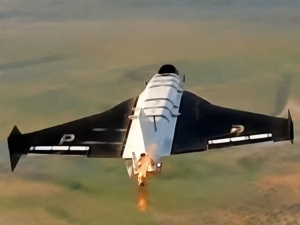
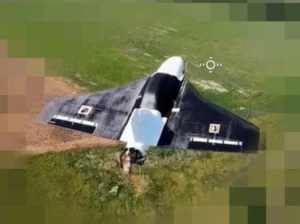
In addition to the surface drone, the developer reports a significant modernisation of the UAV Knyaz Vandal Novgorodsky. In particular, the drone has been assigned a new tactical role as a so-called “ambush” platform capable of landing and waiting for a target. An increase in operational range is also claimed, achieved through upgraded fibre-optic control coils: solid cast coils are now used instead of 3D-printed ones.
The developer also reports the unification of the initiation board and the electronic contact-detonation sensor, as well as the creation of a night version of the drone. According to the centre, Knyaz Vandal is produced in “tens of thousands” of units.
The Verevka device for drone interception
Russia’s Ministry of Defence has reported the use of a device known as Verevka for intercepting multicopter-type drones. According to the released footage, a rope with several weights is suspended from a UAV and deployed above an enemy quadcopter. The target drone’s propellers become entangled in the rope, causing it to lose altitude.
The Verevka method is used against reconnaissance drones, kamikaze drones, and bomber drones.
Russia prepares to field a North Korean missile
Russia may soon use a variant of North Korea’s Hwasal-1 Ra-3 strategic cruise missile in the war against Ukraine, according to OSINTWarfare. The missile is reportedly capable of carrying a high-explosive warhead weighing around one tonne and has an estimated range of 130–250 km.

The Hwasal-1 Ra-3 (also referred to as Hwasal-1D-3) first appeared publicly in April 2024 during a test on North Korea’s western coast. The missile was equipped with a modified large-diameter warhead and presented as an evolution of the standard Hwasal-1, a subsonic land-attack cruise missile with terrain-following capability. According to analysts, the enlarged warhead reduces fuel capacity and range but increases effectiveness against fortified targets and logistics hubs.
The threat posed by the Hwasal-1 Ra-3 lies in its ability to fly at extremely low altitudes and bypass radar and air-defence systems optimised for high-altitude or ballistic targets.
The Buryat FPV drone Burged for Russia’s African Corps
Serial production of the multifunctional FPV drone Burged has been launched in Buryatia. These drones are designed for reconnaissance, remote mining, logistics, and strike missions. They are intended primarily for Russian forces and their allies engaged in combat operations in African countries.

The drones first became known in the summer of 2025. It has now been confirmed that production capacity has been scaled up and that the programme has moved to mass production, although exact volumes remain undisclosed.
Regional publications note that the drone frames are manufactured by hand, with electronic boards also installed manually. Some reports claim that the total number of drones already delivered for use may reach several thousand units, although these figures are not officially confirmed.
The 3D PKL locator and SERP counter-drone systems
The state-owned holding Rosel states that the 3D PKL locator, combined with SERP counter-drone systems, makes it possible to create a multi-layered protection system for infrastructure facilities against unmanned aerial vehicles.
The key difference between the 3D PKL and traditional radar systems is its passive operating principle: it does not emit its own radio signals but instead uses external signals (from radio and television transmitters) reflected off targets to build a three-dimensional picture of an object’s location.
Developers claim that the 3D PKL can detect light aircraft and low-observable UAVs at distances of several tens of kilometres, monitoring the air, ground, and surface space around protected sites. It is also reported to be complemented by the Ogonyok system, which intercepts video feeds from drone cameras.
FPV drones with 65-km fibre-optic coils
Russian developers have announced the creation of a fibre-optic communication channel for integration into FPV drone control systems, with a claimed range of up to 65 km. Relevant information has appeared in specialised Russian sources and technical communities. Also, a video is being shared showing a fiber-optic spool of 65 km.
It is claimed that such a range, for the first time, allows FPV drones to achieve parity in operational radius with guided rocket-assisted artillery munitions such as the M982 Excalibur Block IA-2 and Vulcano, which have ranges of 60–70 km.
There is currently no publicly available official information on the technology’s readiness level, manufacturer, serial production, or field-test results.
Use of the Kurier UGV for engineering tasks
Open sources have published video footage showing the use of the Kurier UGV to build an earthen crossing over a small water obstacle. It is noted that such tasks are increasingly being assigned to unmanned ground platforms.
The footage shows one drone dropping stones into the water, followed by a second drone compacting the stones into the roadbed to enable movement across the river.

The heavy Berdysh multicopter
The enterprise Uraldronzavod has sent a test batch of heavy Berdysh drones to the combat zone, comprising approximately 100 units.
Development of the Berdysh first became known in September last year. According to published specifications, the multicopter can carry up to 20 kg over a distance of up to 15 km, or up to 25 km in a reconnaissance configuration. It can be equipped with a multispectral electro-optical system, a laser rangefinder, and software modules incorporating elements of artificial intelligence.
The possibility of arming the drone with handheld anti-tank grenade launchers has also been reported. Data on combat use, effectiveness, and serial production volumes have not been independently confirmed.
Reading now
1

Ukraine’s Roboneers is launching a joint venture with ARX Robotics to produce tens of thousands of UGVs per year
2
Naval drones became a game-changer in the Black Sea. Now European countries are waiting for a chance to buy them
3
Sting 2.0 and updated Bullet. How interceptor drone manufacturers are preparing to counter jet-powered Shaheds
4

7 July events: The month’s key defence tech gatherings in Europe and beyond
5
Griffen becomes the first Ukrainian jet-powered interceptor confirmed to have shot down a Shahed, manufacturer says
By submitting this form, you give Defender Media consent to the processing of personal data.
Надсилаючи цю форму, ви надаєте Defender Media згоду на обробку персональних даних.

Latest news
1
Ukrainian Armor presents two new fibre-optic FPV drones
2

Thirty $50,000 grants for Ukrainian defence startups: VD Accelerator accepts applications until the end of the week
3

Searches at Vyriy Industries: key points from CEO’s press conference and law enforcement statements
4
Ukraine and Germany sign agreement on joint production of Bars drones
5