Black Mirror #34. A new Shahed, drones at the Dubai Airshow, missile loadouts on Orion UAVs and other developments in Russian miltech
Overview of Russian military technology developments for the third week of November

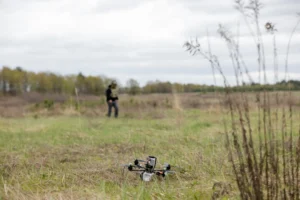
Supercam S180
Russia has showcased new modifications of reconnaissance and strike drones at the Dubai Airshow, announced a drone-carrier naval craft, while a new version of the Shahed and updated drone-dropped munitions have already been identified on the frontline. These and other developments in Russian miltech are covered in Defender Media’s weekly review.
A new generation of Shahed 101/107
A new type of Shahed 107 is being seen in frontline regions. As analyst Serhii “Flash” Beskrestnov reports, this UAV has not yet been fully studied. It is known to carry an 8–9 kg warhead, has an internal combustion piston engine and can fly an estimated 500–800 km.

The drones were manufactured in Iran in 2024. “It can be assumed that the Russians will continue producing this UAV on Russian territory. This is an attempt to cover the need for UAVs in the mass mid-strike segment,” Beskrestnov writes.
What’s new Russian miltech showcased at the Dubai Airshow
At Dubai Airshow 2025, Russia presented several updates to its reconnaissance drones and their modifications, as well as a surface-to-air missile system designed to counter drone swarms.
- The Supercam S180 reconnaissance UAV is claimed to be “unreachable for anti-air drones” thanks to a short-term boost mode. According to the manufacturer, the drone can remain airborne for up to two hours and offers a higher speed compared with the S350. It is equipped with video cameras and thermal imagers and has a low-noise electric motor. Other stated advantages include increased payload capacity and the ability to operate at temperatures from –40 to +40 degrees and in winds of up to 15 m/s.
- The Supercam X4 quadcopter is designed to drop explosive and fragmentation munitions weighing 0.5 kg. It has been tested during exercises in Belarus and in the combat zone on Ukrainian territory.
- ZALA has announced a doubling of the range of its loitering munitions, the 51E and 52E models, better known as the Lancet, along with their modifications. It is claimed that the drones now have an operating range of up to 45 km and can stay airborne for up to 50 minutes. The range of the 52-series modifications has increased to 35 km, with flight time extended to 30 minutes.
- The ZALA T-20 unmanned aviation system, used for monitoring energy, oil and gas infrastructure, has increased its endurance to seven hours and can cover up to 500 kilometres in a single flight.
- According to ArmyRecognition, the UAE exhibition also featured a Pantsir modification designated SMD-E, presented in a configuration carrying only missiles, without anti-aircraft guns. The report notes that this setup is positioned as a counter to swarms of small UAVs: the missile component is intended to engage large numbers of small targets at varying distances.
The new Sekira Prizraka droneport
The Kingpro company has unveiled the Sekira Prizraka droneport, which combines the multirotor Sekira drone and the fixed-wing Prizrak UAV. The multirotor lifts the fixed-wing drone into the air, after which it launches directly from altitude. According to the developers, this saves up to 20% of the energy normally spent on ground take-off and increases launch safety.
The airborne droneport also acts as a relay. Developers claim a flight range of up to 120 km and the ability to carry a warhead of up to three kilograms.
Vladivostok reports development of a low-observable drone-carrier boat
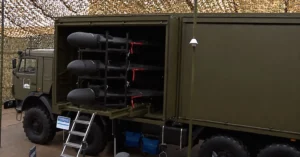
Russian scientists have announced the creation of an unmanned boat with a launch system and compartments for storing and deploying UAVs. Up to four fixed-wing drones are planned to be launched from the craft. However, there is currently no documentary evidence of the technology’s effectiveness, technical specifications or footage from sea trials.
According to Russian media descriptions, the drones are protected from seawater and shock loads by dampers. The hull is covered with a lightweight radar-absorbing mesh, which reportedly reduces its radar visibility fourfold.
Orion now carries two Kh-BPLA missiles
ArmyRecognition has published new images of the Russian strike-reconnaissance UAV Orion showing two Kh-BPLA missiles mounted under the wing, indicating an expansion of its precision-strike capability.

The missile is based on the 9M133 Kornet design and uses laser guidance similar to Krasnopol-M shells. It weighs around 32 kg (up to 42 kg in its container) and is intended to engage unarmoured or lightly armoured targets. The stated operating range is approximately 2–8 km when launched from an altitude of up to 4,000 m, while its warhead contains about 6 kg of fragmentation-high-explosive charge, including roughly 3.2 kg of explosive.
KOBЕ-3М cumulative-fragmentation munition for drones
Russian forces have been observed using the KOBE-3M munition designed for drone integration. This is a cumulative-fragmentation charge intended to strike personnel and lightly armoured vehicles. It is equipped with a G-684T nose fuze with a piezo element and a V-5KPE base fuze with a safety-and-arming mechanism; both components are connected by an electrical wire.
The munition features an electronic long-range arming mechanism activated by the operator. Its total weight is around 1.8 kg.

Serial production of “smart” AI GOEN-60 sensors
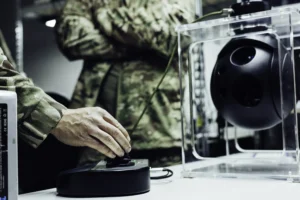
The Rosel (Rostec) holding has announced the launch of serial production of GOEN-60 gyrostabilised electro-optical systems for strike drones. The system is equipped with artificial intelligence for detecting, identifying and tracking targets. There is a daytime version with a TV camera and an all-day variant with a thermal imager.
According to the developer, high sensor sensitivity and stabilisation allow operators to track high-speed UAVs and detect distant stationary objects. The system transmits high-resolution imagery, has a diameter of 60 mm and weighs no more than 300 g.
aSel Labs H231b drone sensors for aviation platforms
Russian forces are testing aSel Labs H231b detectors on combat and transport helicopters. The devices detect signals from UAVs and FPV drones within the declared frequency range of 300–7210 MHz. It is claimed that the detectors can identify drones in ambush positions. Detection range in open terrain is 4–5 km, and up to 15 km with direct line-of-sight.
Developers note that proximity to powerful radio transmitters or electronic-warfare equipment may damage the input circuits or reduce sensor sensitivity. The detectors operate passively, emit no signals, require no special training and are supplied ready for use.
Reading now
1
SkyFall officially unveils Thor Hammer mid-strike and announces 1,000+ km version
2
Pentagon to hold Drone Dominance trials for bomber drones, with UFORCE, Gurzuf Defence, Grim Tech and others taking part
3

Terra Drone acquires 50% of Ukrainian Kurin Technologies for $3.5 million
4
British-Ukrainian Occam Industries raises €3.8m. The funds will go towards scaling drone autonomy software
5

Frontline Robotics CBDO Mykyta Rozhkov: Ukraine and Norway are working on an autonomous system to protect maritime infrastructure
By submitting this form, you give Defender Media consent to the processing of personal data.
Надсилаючи цю форму, ви надаєте Defender Media згоду на обробку персональних даних.

Latest news
1

Nataliia Mykolska to become VP of Growth and Affairs at Sine Engineering
2
Black Mirror #79: What’s inside Geran-4, unmanned tanks, balloon barrages and more of a new russian miltech
3

6,000 lives saved by replacing people with robots. “Makar” on the ground strike drone unit NC13 and its role in Operation Vivaldi
4
M-Fly and Dwarf Engineering announce partnership: what it involves
5