“Tango” vs Shaheds: Inside Ukraine’s interceptor drone crew
Defender Media visited the positions of an interceptor drone crew and spoke with the operators about their roles and missions

The 1020th Anti-Aircraft Missile Regiment is an elite unit of the Armed Forces of Ukraine, specialising in air defence. While the regiment’s primary area of responsibility encompasses Kyiv and the surrounding region, its crews remain highly mobile, ready to redeploy to protect the skies over other provinces whenever necessary.
In March 2026, Defender Media visited the positions of a newly formed air defence team. At that stage, the “Tango” crew had been operational for only three weeks, yet they had already successfully intercepted their first Gerbera. The team operates P1-SUN interceptor drones; the moment an enemy target surfaces on radar, the crew can have a drone airborne within minutes.
The unit consists of four specialists: a pilot, a navigator, a technician, and a sapper. On every shift and every sortie, there are no secondary roles—each member is vital. Using their experience as a blueprint, Defender Media explores how an interceptor crew functions and defines the specific responsibilities of its members.
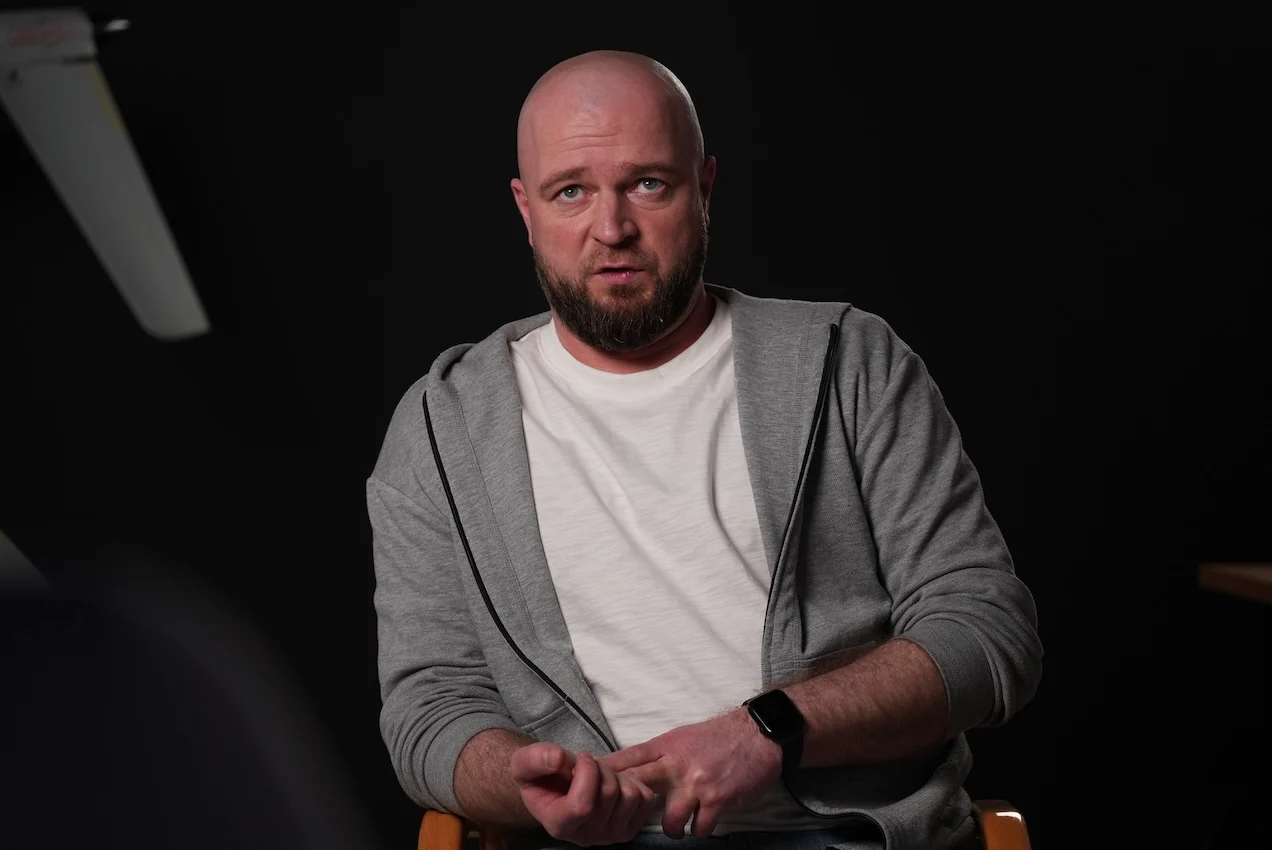
The crew commander, Andrii, callsign “Tango”, joined the regiment via mobilisation. Representatives of the unit happened to be at his local recruitment centre and offered him a contract. Initially serving at a radar station, Andrii spent his leisure time mastering a flight simulator—first with a borrowed controller, and later with his own. His battalion commander, noting his aptitude, transferred him to an interceptor crew. After a period of assisting various teams and honing his expertise, Andrii was appointed commander and pilot of the “Tango” crew.

Pilot training and operations
The work of an interceptor crew is defined by its nuances. A marginal error can result in the loss of a drone or a missed interception window, and in combat, every second is critical. Initially, missions may fail simply due to a lack of technical intuition, but proficiency grows with time. Eventually, the process becomes instinctive as the finer details of the craft are mastered.
While simulators are invaluable, interceptor drones possess unique characteristics. The pilot must memorise a significantly higher number of controls on the transmitter. One must simultaneously manage video transmitter power, operate the camera, monitor inversion, and control detonation—all whilst maintaining the extreme focus required to avoid accidental self-detonation.
A pilot must know the controller so intimately that physical sight of the device becomes unnecessary. When it is suggested that three days on a simulator is sufficient to prepare a pilot, this refers only to those already proficient in FPV flying. Learning to operate a specific system and its dedicated interceptor drones from scratch is an impossibility in such a short timeframe.
The defining principle of this work is the relentless pursuit of new solutions. If a tactic fails, one must identify what has not yet been attempted. There is always a different approach to be found.

For instance, during one sortie, we failed to detect a target that should have been visible. When another crew later intercepted it, I sought their feedback. It emerged that the Gerbera had been constantly manoeuvring and shifting altitude, causing us to lose track. That exchange provided us with the tactical knowledge required for future encounters.
The P1-SUN drones we currently employ are excellent. They are rapid to deploy, fast on the ascent, and the controls are intuitive and well-engineered. We are also keen to trial the Sting models, which come highly recommended by our peers.
We rely on analogue communication. While digital signals offer stability, the primary advantage of digital is image clarity, which makes target detection far simpler. On an analogue feed, a target may appear as a mere speck, and the pilot must be able to distinguish it amongst the various symbols on the screen that can obscure the view.
The mechanics of interception
Once enemy Shaheds are detected on the map, we begin immediate preparations: arming the drones, installing explosives and detonators, and powering up the systems at the launch point. By the time the target enters our sector, we are fully prepared. The mission then becomes a matter of launching and visual acquisition.
Under alert conditions, the transition from receiving a signal to being flight-ready takes less than two minutes. Once airborne, we have approximately 15 minutes to locate and neutralise the target.
To date, our primary targets have been Gerberas. Prior to our first successful interception, we conducted test flights several times a day. As a new crew, constant training was essential. When the first real target appeared, the task was manageable because we had mastered the terrain, identified the landmarks, and refined our coordination. The navigator was precise, the antenna was expertly directed, and the connection remained stable. We flew out and completed the task because we were ready.
The role of the navigator
If Andrii represents the “hands” of the crew, then Artem, the navigator, is its “eyes” and intellectual guide. Their synergy is rooted in a 13-year friendship; when Andrii was mobilised, Artem followed him into service. A design engineer with a master’s degree in civilian life, Artem’s technical background allowed him to master the complexities of navigation within a single week.
While the pilot focuses on the flight path, Artem performs the analytical heavy lifting. He must correlate the drone’s video feed—often a blur of treelines and fields—with satellite imagery to pinpoint the target’s exact coordinates. He provides the pilot with distance, altitude variances, and the optimal direction of attack to ensure maximum precision.
On the ground, the navigator is the custodian of the drone’s “health”, ensuring everything from antenna positioning to the clearance of the propellers during launch.
“It is not just a duty; it is the thrill of the result,” Artem remarks. “Seeing the target burn and fall provides the motivation to continue. Every ‘Shahed’ we bring down is a contribution to the safety of our families.”
The person at the antenna
The third member, Andrii, the technician, holds one of the most physically demanding roles. A former professional electrician, he now maintains a vigil over the antenna system. During sustained attacks, he may spend hours at his post, ensuring the pilot maintains a stable video link as waves of enemy drones approach.
Andrii describes his work as “straightforward,” yet the success of a mission hinges on his precision. When an interceptor closes in on its target, a deviation of just a few degrees in the antenna’s alignment can result in a total loss of signal.
At home, he has a wife and three children, the youngest of whom is only two. Though he primarily sees them through a screen, it is for them, and for millions of others, that he maintains his daily watch.
The most dangerous specialism
At 22, Rustem is the youngest member of the crew. A chef in his civilian life, he now serves as the team’s sapper. His role is the delicate precursor to every flight: while his colleagues calculate trajectories, he handles C-4 plastic explosives and detonators.
“My work dictates whether the drone functions as intended. The detonator must not trigger in your hands or during transport. There are numerous safeguards, but the work remains technically sensitive,” he explains.
Rustem’s ambitions extend beyond his current role; he intends to master related specialisms to eventually command a crew and mentor others.
“We are responsible for lives. Every Shahed we intercept represents homes and people saved. This is our contribution to victory,” says Rustem.
The P1-SUN interceptor drones are more than just a convenient tool for the “Tango” crew. In February 2026, these drones were responsible for 70% of all successful interceptions over Kyiv and the surrounding region. Since the start of the year, they have neutralised over 3,000 “Shaheds”. However, every drone deployed is a consumed resource. Defender Media is currently raising funds to provide the 1020th Regiment with new P1-SUN units—you can support the fundraiser via the link provided.
Reading now
1

70+ vacancies in Ukrainian defence tech at Ukrspecsystems, Strix Air, DoD Solution and other industry leaders
2
Swarmer acquires Ukrainian UGV and UAV manufacturer Ratel Robotics for $224m – and this is just the beginning
3
Ukrainian Skyeton secures $10.6M US army contract
4

Vluchnyk develops interceptor planned for production in Sweden and other countries: what attracted investors and what the team is working on
5
Canadian General Dynamics signs agreements with Ukrainian GreenTech
By submitting this form, you give Defender Media consent to the processing of personal data.
Надсилаючи цю форму, ви надаєте Defender Media згоду на обробку персональних даних.

Latest insights
1
Everything about the RAM-2X mid-strike drone: interview with Ukrspecsystems deputy director Andrii Rymaruk
2

A demo is not demand: How to prove the value of a defence tech product. Column by Tekever Ukraine Director Kateryna Bezsudna
3
How to choose the right video link for an FPV drone: analogue, digital, or fibre-optic?
4
How a frontline signal becomes an engineering task. A column by Defence Builder Accelerator Director Yana Shkvarovska
5