Defence tech in Central and Eastern Europe: The Recursive research supported by Defender Media
Key findings from the study, along with an overview of the Ukrainian defence tech ecosystem

The European media outlet The Recursive has published a report on the state of the defence tech and cybersecurity in Central and Eastern Europe for 2024. According to the authors, this is the first comprehensive study of the defence and cybersecurity innovation market in the CEE region. The report maps startups, investment flows, and key ecosystem players across 14 countries. The research is available for free and can be downloaded by filling out a form. Defender Media shares key insights from the study, along with a shortened version of our overview of the Ukrainian defence tech ecosystem, which The Recursive included in its report.
Data collected by The Recursive’s experts shows that Ukraine is significantly ahead of other countries in the region in terms of the number of defence startups, talent involved in the industry, the share of defence spending in GDP, and several other key indicators. Notably, this lead comes despite the study offering a very conservative estimate of Ukraine’s defence tech sector – counting only publicly declared companies with a proven track record.
The Recursive experts estimate that there are over 170 defence tech and dual-use startups across the CEE region—with more than a third based in Ukraine. In contrast, Ukraine’s state-backed defence tech cluster Brave1 reports that over 1,500 teams are currently working in the country’s defence tech sector.
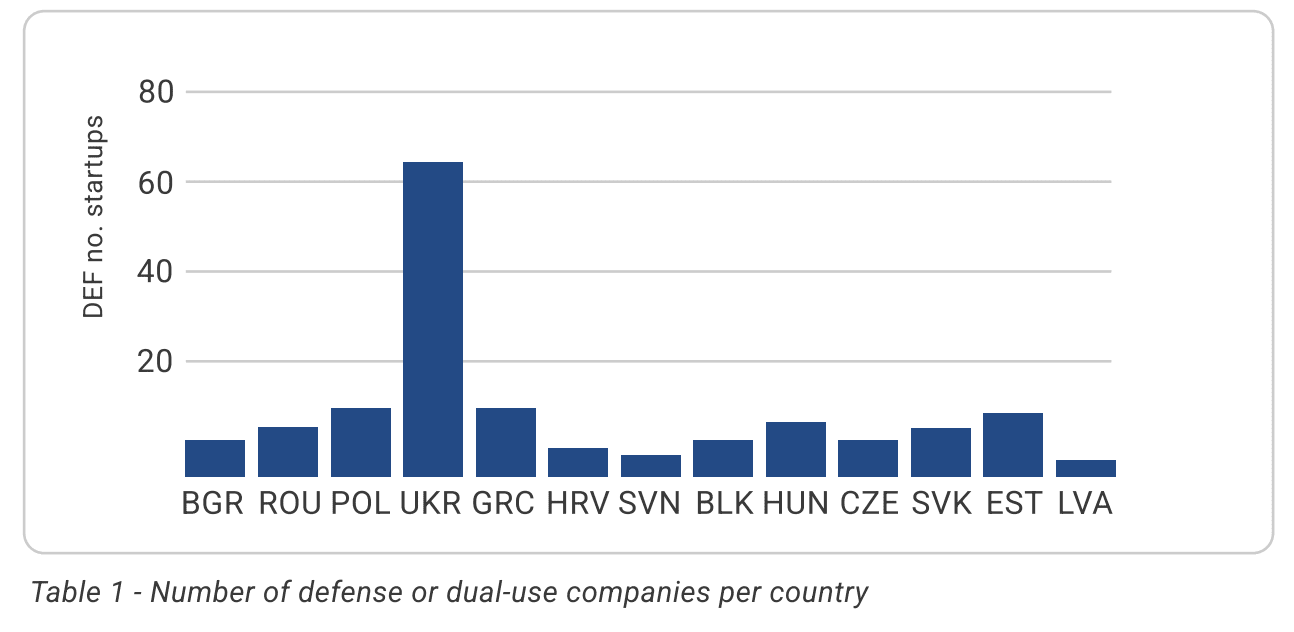
According to The Recursive estimates, more than 4,000 professionals work in the defence tech sector across Central and Eastern Europe. Nearly half of them are based in Ukraine, where the publication estimates the talent pool at over 1,500 specialists.
Ukraine also ranks first by a wide margin in terms of defence spending as a share of total GDP.

At the same time, Ukrainian defence startups remain severely underfunded. Despite significantly outperforming other countries in terms of the number of companies and talent, Ukraine does not even rank among the top five in private investment in the sector. According to The Recursive, the total amount of funding raised by Ukrainian defence tech in 2024 was just over €36.5 million.

The authors of the study included Ukraine’s Ajax Systems among the ten most heavily funded defence tech companies in the region. Meanwhile, two Ukrainian funds – SMRK VC and the Nezlamni Fund – were ranked among the top five most active investors.
How Ukraine’s Defence Tech Evolved in 2024: An Overview by Defender Media
The authors of the report invited the founders of Defender Media to contribute a dedicated overview of Ukraine’s defence tech sector. The full article appears on pages 68–75 of the report. Below is a shortened summary of that overview.
The Ukrainian defence tech ecosystem is growing around Brave1
In 2024, private investment in Ukrainian defence tech grew significantly, but it was the state-owned defence tech cluster Brave1 that emerged as the largest investor in the sector, distributing nearly €35 million in grants. Since its founding just two years ago, Brave1 has awarded over 500 grants to developers, totalling more than €42 million.
However, Brave1 is not just a grant fund — it is also the largest incubator and accelerator for startups in the field. The cluster helps codify new products, develops industry-relevant legislative initiatives, facilitates networking, and supports securing military contracts. Over its two years of operation, Brave1 has fostered an entire ecosystem of Ukrainian defence technologies, uniting more than 1,500 teams and over 3,600 different developments. Approximately 80% of the technological products currently used by the Ukrainian military were born “within the walls” of Brave1.

The cluster is responsible for creating entire market verticals, notably in unmanned ground vehicles (UGV) and EW/ELINT (electronic warfare/electronic intelligence). Two years ago, these verticals lacked regulatory frameworks, and the number of private companies could be counted on one hand. Today, with support from Brave1, over 50 domestic electronic warfare systems have been codified, including those from Kvertus, UNWAVE, Rebel Group, mudro.tech, and Abakus Tech. The same applies to UGVs – while there were only two domestic manufacturers two years ago, today there are nearly 70.
“It’s amazing to see that concept come to life and make such a significant contribution. Thanks to Brave1, more teams have emerged, and they’re progressing toward building products faster – and it’s not just about the money. It’s also about access to military expertise and the community,” says Anton Verkhovodov, partner at D3, one of the most active funds in Ukrainian defenсe tech.
Who invests in Ukrainian defence tech
In terms of private investments in Ukrainian defence tech, the most active funds include D3, MITS Capital, NEZLAMNI Fund, Green Flag Ventures, Angel One Fund, SMRK, and Double Tap Investments.

Angel One Fund participated in 7 syndicate deals involving Ukrainian defence tech startups in 2024. Medium checks of the fund’s investments in those deals ranged between € 50,000 and € 200,000. Till the end of the year, the fund plans to close five more deals. “We would especially like to highlight our two most recent investments: Frontline and Norda Dynamics – they are relatively young but growing very quickly,” highlighted Ivan Petrenko, Managing Partner of Angel One Fund.
Recently, Frontline also received investment from Germany’s Quantum Systems and entered into a strategic partnership with them.“At the turn of 2024/25 and now, I see the irreversibility of international collaboration – not just in terms of entering new markets, but also technological integration and the use of global R&D capabilities,” Ivan commented. Among the most mature projects, he highlights Swarmer, Skyeton, Airlogix, and Himera. “Our defence tech market has matured and now has a better understanding of what it needs,” he says.
Deborah Fairlamb from Green Flag Ventures says the fund specifically looks for scalable product companies founded in Ukraine that offer innovations in dual-use military, cyber, and AI technology. “We focus on early-stage investments (pre-seed through Series A) with ticket sizes between €100K – €600K. We prioritise startups whose wartime experiences have given them strategic and tactical advantages that can be translated to broader international defence and commercial markets.”
What trends dominated Ukrainian defence technology in 2024? Ivan Petrenko from Angel One Fund points out three key ones:
- A second wave of young startups has emerged – they’re developing their products quickly and without the mistakes made by earlier pioneers.
- The technological level of teams has increased.
- Many manufacturers have shifted their focus from building entire systems to finding their niche and working on specific components, including communications and optics.
In 2024, European investors also became more active in the Ukrainian defence tech market. One example is Czech-based Presto Tech Horizons which backs companies that enhance not just state and institutional security, but also personal safety and data privacy. Their ticket sizes range from €300,000 to €5 million, with a sweet spot around €2 million.

Almost a year since its inception, the Presto Tech Horizons fund has already welcomed its first four portfolio companies, including two Ukrainian defence tech startups – Vidar Systems, known for its portable acoustic locators, and Bavovna.ai, a hybrid AI platform for autonomous drone navigation.
If you’re a Ukrainian founder in defense, your motivations are through the roof. You want to survive. You want to win the war. That’s dedication on a whole different level. And it’s crucial – because in the early stages, talent and motivation are everything. That’s what really matters. So this is a huge plus when it comes to the attractiveness of Ukrainian companies,” says Matej Luhovy, an investor at Presto Tech Horizons.
He admits that Ukrainian hardware manufacturers still have a lot to learn to grow, though there are some top-level projects in the communication field and electronic warfare. “The way Ukrainian drones communicate with ground stations, the mechanisms they use to avoid jamming, and the location systems that prevent drones from crashing when jammed – these are areas where Ukraine might be the number one manufacturer of such technologies in the world,” Luhovy concludes.
The year 2024 also marked the launch of the Defence Builder accelerator, which aims to connect Ukrainian defence startups with Western capital. “Ukrainian innovations are changing the industry with advanced tech solutions, and many Western technologies are being enhanced based on battlefield requirements in Ukraine, setting a quality standard for militaries worldwide,” says Daria Yaniieva, Head of Defence at Sigma Software Group, which is one of Defence Builder’s founders
The challenges: Money and technology
Despite the rapid growth of investments in Ukrainian defence technology, the market still lacks sufficient funding. Yaroslav Azhnyuk reminds that his previous company, Petcube, which develops high-tech entertainment for pets, raised €23 million in investments. In comparison, he points out that it is approximately the same as the total volume of private funding Ukrainian defence tech raised in 2024 (excluding grants from Brave1).
“Components are costly, and the development team is very expensive because it comprises many high-quality senior engineers – you can’t solve this problem with juniors. Therefore, capital will significantly aid the development of Ukrainian defence tech if directed in the right way,” says Ivan Kaunov, Co-founder of Buntar Aerospace. – “Defence tech is not cheap, so we are talking about hundreds of millions.”

Another challenge is technology. Being in the early stages of its development, Ukrainian defense tech could greatly benefit from partnerships with major players from abroad. “Quite frankly, if we compare hardware companies – what’s being built in the U.S. versus in Ukraine – it’s still not at the top level,” says Matej Luhovy from Presto Tech Horizon.
Combining technological expertise with Western partners would significantly help Ukrainian defense tech rise sharply. “They have the technologies we need but don’t always know how to use them in modern warfare. And we do,” pointed Ivan Kaunov.
Reading now
1
SkyFall officially unveils Thor Hammer mid-strike and announces 1,000+ km version
2
260+ vacancies in Ukrainian defence technology at BlueBird Tech, Sine Engineering, Buntar Aerospace and more
3
British-Ukrainian Occam Industries raises €3.8m. The funds will go towards scaling drone autonomy software
4
Terra Drone acquires 50% of Ukrainian Kurin Technologies for $3.5 million
5

Autonomous interceptor drones need radars to work. Why is there still a lack of them
By submitting this form, you give Defender Media consent to the processing of personal data.
Надсилаючи цю форму, ви надаєте Defender Media згоду на обробку персональних даних.

Latest insights
1
Everything about the RAM-2X mid-strike drone: interview with Ukrspecsystems deputy director Andrii Rymaruk
2

A demo is not demand: How to prove the value of a defence tech product. Column by Tekever Ukraine Director Kateryna Bezsudna
3
How to choose the right video link for an FPV drone: analogue, digital, or fibre-optic?
4

How a frontline signal becomes an engineering task. A column by Defence Builder Accelerator Director Yana Shkvarovska
5