Darkstar, Presto Tech Horizons, and Techosystem on Ukraine’s defence tech: key takeaways from Latitude59 side event
What Ragnar Sass, Tichomir Jenkut, Oleksandr Yatsenko, and others said at the conference in Tallinn

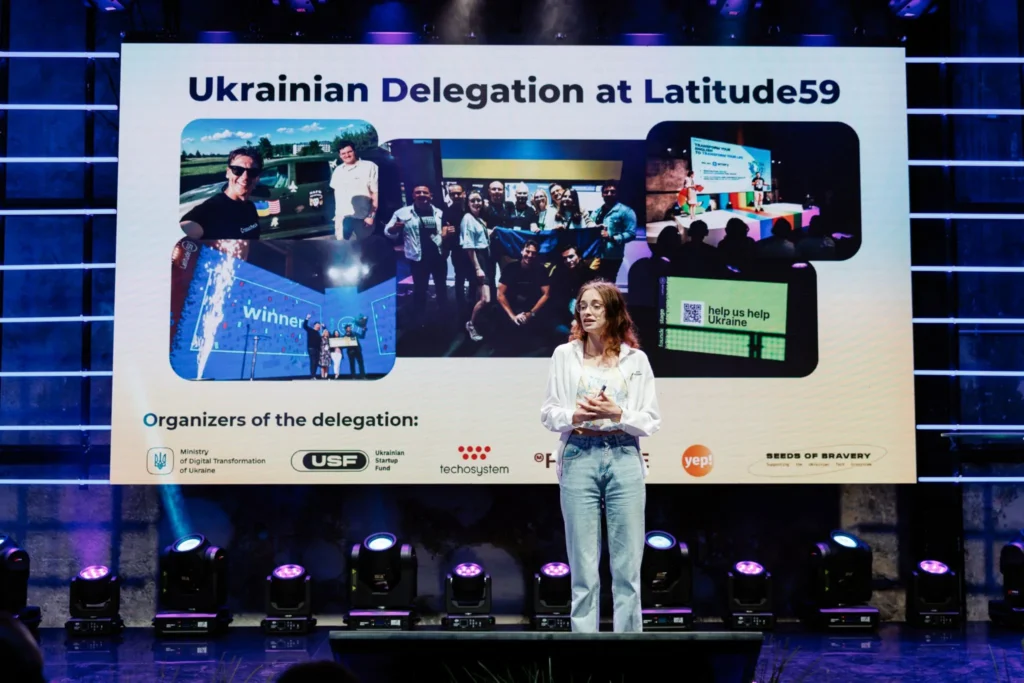
From 21 to 23 May, Tallinn hosted Latitude59 — the flagship event of Estonia’s digital ecosystem. One of the conference days featured a side event organised by the Techosystem DefenseTech Cluster, dedicated to Ukrainian defence innovations. It included two panel discussions featuring Ragnar Sass from Darkstar, Tichomir Jenkut from Presto Tech Horizons, Oleksandr Yatsenko from Techosystem, Misha Rudominskyi from Himera, Lukas de Bont from Civitta, and many others. At the request of Defender Media, Techosystem Project Manager Marharita Horokhova shares key insights from the panel discussions.
For Latitude59 side event Techosystem DefenseTech cluster brought together Ukrainian defence tech startups and stakeholders vital for their development – from government, business support organisations, venture funds, and accelerators – for a series of short, interactive, practical discussions. The event emphasised how everyone at different levels can support Ukraine’s fight for independence.
Ukrainian war: lessons for Baltics
The war has changed modern warfare, and Ukraine is currently the only army with practical experience in this new type of warfare. European countries are struggling to adapt quickly enough to these changes. The independence of countries like Estonia, Latvia, Lithuania, and Finland depends on how much they can help Ukraine win and how fast they can rebuild their own armies.
There is a significant risk of Russian drone attacks on European countries in the near future, with some Russian drones already present in Estonia. The Baltic states lack adequate systems to tackle these threats. A recent incident involved a Ukrainian-jammed Shahed drone entering Lithuanian airspace before crashing in Latvia. The biggest threat for countries like Estonia is the potential for large-scale drone attacks from seemingly innocent vessels, aimed at destroying infrastructure.
“It’s extremely critical for the modern independent countries like Estonia, Latvia to not only do everything to help you to win the war, but learn from that because no one else can basically teach how to survive in modern warfare.
Because Russia is a threat for us, which is extremely realistic, exactly across the sea. And can you just imagine if one moment this one huge thing is opening up and sends thousand drones to Estonia with one goal to destroy”
Ragnar Sass
Co-Founder at Darkstar Coalition
The war in Ukraine is characterised by rapidly changing tactics and technologies, with innovations occurring every three to four months. This is the first time since World War II that such rapid changes in warfare tactics and technology have been observed in Europe.
Ukrainian defence tech companies have the fastest innovation cycle globally due to the urgency of their situation. The conflict is taking place in urban environments, making it more relevant to European contexts than conflicts in desert landscapes. Ukraine is also taking a proactive approach to legislation, quickly adapting laws to allow for faster testing and implementation of new technologies. For example, obtaining NATO codification for new technologies can be done in as little as 9 days in Ukraine, compared to the usual 10-12 weeks.
The discussion also touched on the need for faster, more decentralized procurement processes in the future. There’s a recognition that Europe needs to relearn efficient defence procurement, drawing on historical experiences. The speakers emphasized the importance of creating structured ways for innovative companies to quickly demonstrate the relevance of their products to government buyers, and the need for updated legislation to accommodate new technologies like autonomous systems.
Kalev Koidumäe, CEO at Estonian Defence and Aerospace Industry Association:
“If we’re talking about procurement, we need to make some changes about the technology in the future. It’s unattainable if you start to procure, for example the drones, and deliver it after six months or more. That process has to be much faster than we used to have. The right away is a decentralised procurement system.”
Investing in Ukrainian defence tech
Investors are looking for teams that plan to stay in the defence tech sector for the long term, not just for the duration of the current conflict. There’s a focus on companies that can contribute to rebuilding security globally. Investors are spending significant time vetting potential investments, often working closely with founders and being available 24/7 for support.

«Pacifism is a privilege we don’t have. And that is why we need to invest in defence tech companies.
Everything that helps Ukraine win is important and needs financing, but not every type of technology is suitable for VC financing”
Tichomir Jenkut
Presto Tech Horizons
Many European investors and banks are hesitant to invest in defence tech due to ethical concerns and existing mandates. This creates challenges for defence tech companies seeking funding. To tackle this, some funds in Estonia and other European countries have been specifically designed to invest in defence technologies or expending their investment thesis to defence tech startups ((for example, Darkstar, Coinvest Capital, Plural, Presto Tech Horizons, and others).
Oleksandr Yatsenko, Chairman of the Board at Techosystem: “We have those unloaded production on the defenсe tech companies, 1500+ of them are waiting for contracts to deploy.”
Investors prefer companies that brand their products as dual-use technologies, as it opens up more funding opportunities. There’s a growing recognition that defence tech is becoming more crucial, with some investors who previously avoided the sector now showing interest. The export restrictions on Ukrainian defence tech are expected to be lifted soon, which could lead to increased investment opportunities.
Ragnar Sass: “Dual use is nice, but for winning a war you need single use products for Military. This is where Darkstar focus is 100%.”
Common mistakes for defence tech startups include not understanding regulations and procurement processes, trying to provide complete solutions instead of focusing on specific innovations, and entering oversaturated markets (like drone manufacturing) without a unique value proposition. Startups are advised to focus on components or system integrations that can fit into existing frameworks rather than trying to create entirely new systems.
Lukas de Bont, Project Manager at Civitta: “I’ve noticed that defence‑tech startups often try to offer a complete, end‑to‑end solution — but that’s not always necessary, especially when it doesn’t integrate with existing systems. We recommend they focus on excelling in one specific component — whether that means being faster, cheaper, or capable of mass‑scale production — so it can fit seamlessly into current frameworks.”
12 key takeaways in one line each
- Ukraine has developed the world’s fastest defence innovation cycle due to 24/7 battlefield testing and survival necessity.
- European defenсe procurement needs fundamental reform to match the speed of technological development.
- Building dual-use technologies and long-term companies is preferred over short-term battlefield solutions.
- Strong ecosystem support through associations, accelerators, and government partnerships is crucial for defence tech success.
- Ukraine’s export restrictions will soon be lifted, creating significant opportunities for international partnerships.
- Ukraine represents the only army with modern warfare experience against an advanced enemy.
- Innovation cycles happen every 3-4 months driven by survival necessity.
- Urban warfare landscape makes Ukrainian experience directly relevant to European defence needs.
- Legislative changes in Ukraine happen within days/weeks vs months/years in Europe.
- Most European VCs cannot invest in lethal defence technology due to LP mandates.
- Dual-use positioning helps companies access broader investor base.
- Estonian funds leading European defence tech investment.
About Techosystem
Techosystem is a civic union of the Ukrainian tech ecosystem players for startups, scaleups, and investors with a mission to unite startups, scaleups and investors in Ukraine to create a powerful innovation ecosystem, facilitating the development of member companies’ and increasing investment into the Ukrainian technology sector. Techosystem Defence Cluster goal is to unite the leading DefenceTech players for the sake of strong representation of the industry’s interests in the world and in Ukraine, and to solve common problems and challenges.

Marharyta Horokhova
Head of Projects at Techosystem. She is leading startup ecosystem projects such as Ukrainian Tech Ecosystem Overview Platform, Top 100 Rising Ukrainian Startups, and more. She is supporting Ukrainian delegations at international conferences and actively promoting Ukrainian tech and startup ecosystem internationally.
Reading now
1
SkyFall officially unveils Thor Hammer mid-strike and announces 1,000+ km version
2
Pentagon to hold Drone Dominance trials for bomber drones, with UFORCE, Gurzuf Defence, Grim Tech and others taking part
3
Terra Drone acquires 50% of Ukrainian Kurin Technologies for $3.5 million
4
British-Ukrainian Occam Industries raises €3.8m. The funds will go towards scaling drone autonomy software
5

Frontline Robotics CBDO Mykyta Rozhkov: Ukraine and Norway are working on an autonomous system to protect maritime infrastructure
By submitting this form, you give Defender Media consent to the processing of personal data.
Надсилаючи цю форму, ви надаєте Defender Media згоду на обробку персональних даних.

Latest insights
1
Everything about the RAM-2X mid-strike drone: interview with Ukrspecsystems deputy director Andrii Rymaruk
2

A demo is not demand: How to prove the value of a defence tech product. Column by Tekever Ukraine Director Kateryna Bezsudna
3
How to choose the right video link for an FPV drone: analogue, digital, or fibre-optic?
4

How a frontline signal becomes an engineering task. A column by Defence Builder Accelerator Director Yana Shkvarovska
5