Black Mirror #9. Chinese drones and lasers for Russia, plus updated Supercam, “Strekoza”, “Rubicon”, and “Dan-M”
Review of Russian military-industrial complex innovations happening during the last week of May

Drone detection system / Source: Rosoboronexport manufacturer's website
Ukrainian military personnel, officials, and entrepreneurs are increasingly concerned about the development of enemy drone technologies. At a monthly meeting on the use and advancement of unmanned systems, Commander-in-Chief of the Armed Forces of Ukraine, Oleksandr Syrskyi, heard an intelligence report on the formation of drone forces within the Russian army and the arrival of new UAV and loitering munition systems. “The enemy is copying the experience of Ukraine’s Defence Forces and is actively scaling its drone units,” Syrskyi noted. This week, bloggers and participants of defence-related events paid special attention to the activities of the Russian “Rubicon” unit—a drone development center directly overseen by Russian Defence Minister Belousov.
Another pressing issue is the supply of DJI Mavic drones, which remain among the most widely used in the Ukrainian military. According to President Zelensky, China is blocking Mavic deliveries to Ukraine while continuing to supply them to Russia. Also, Russian forces have received the Chinese Silent Hunter laser air defence system. These developments have led to a situation where the Ukrainian army no longer holds the upper hand in the use of drones on the battlefield.
More on how Russian miltech is evolving—in “Black Mirror” #9. Defender Media is publishing this digest to help Ukrainian developers, military personnel, and their partners understand what they’re up against.
How to deal with “Rubicon”
On April 29, during the presentation of the Buntar-3 reconnaissance drone and the Buntar Copilot software shell in Kyiv, a panel discussion was held with commanders of UAV units, Deputy Minister for Strategic Industries Artem Romanyukov, and Buntar Aerospace co-founder Ivan Kaunov. Military representatives noted that Russian forces have significantly improved their drone fleet and personnel training, which is creating serious problems for Ukrainian fixed-wing reconnaissance UAVs. In particular, they pointed to the activities of the enemy unit “Rubicon,” whose operators are regularly intercepting Ukrainian fixed-wing drones even at altitudes above 2,000 meters.
Panelists agreed that Ukrainian manufacturers need to focus on improving drone alert systems and software to increase the chances of reconnaissance UAVs evading interceptor drones.
Well-known military blogger Serhiy “Flesh” Beskrestnov wrote that it was the Rubicon unit that played a key role in disrupting Ukrainian logistics in the Kursk direction. The unit is now operating in Sumy and Donetsk regions, attacking Ukrainian positions at depths of 20–30 km. The Rubicon Center for Advanced Unmanned Technologies was established in the summer of 2024 and is directly overseen by Russian Defense Minister Belousov. The center is given top priority in terms of equipment and carefully selected personnel. It includes not only combat units but also a UAV and loitering munition development hub, a training center, and an analytics division.
According to “Flesh,” Rubicon’s combat units are using strike drones such as the Lancet and Molniya, as well as anti-air and fiber-optic drones, long-range FPVs, and other systems.
Chinese laser air defence system
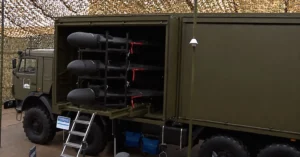
Russian forces have received the Chinese Silent Hunter laser air defence system to destroy Ukrainian drones, according to Militarnyi.
The Silent Hunter, also known as LASS (Low-Altitude Laser Defence System), is a turret-mounted fibre-optic laser with a power output of 30 kW, installed on an off-road vehicle chassis. It is believed to have been developed by the China Academy of Engineering Physics. The system is equipped with a radar and an optical station for target detection, tracking, and aiming. Reportedly, the radar can detect targets at a range of up to 5 kilometers, while the optical station can lock onto targets for tracking at distances of up to 3 kilometers.
The stated range for shooting down drones is up to 1.5 kilometers, while the range for blinding cameras is up to 3 kilometers. Judging by the published footage, Russian forces have successfully intercepted drones at distances exceeding 1,300 meters.
It is reported that the laser is being used by a mobile air defence unit from the special “Kochevnik” (Nomad) detachment.
Supercam S350 has become even more dangerous
Russian engineers have applied new algorithms to improve their Supercam UAVs. They managed to increase the accuracy of target capture by the drone and increase the speed of its response to commands received from the operator.

Now the auto-guidance system has become faster and more accurate. It captures the target and marks it on the video with a frame, making it easy for the operator to track it.
The modular design ensures quick assembly of this UAV and replacement of the payload. It also has automatic and semi-automatic flight modes and the ability to hover over an object.
Universal pilot station for drones
The Moscow Aviation Institute has created the first universal external pilot station. This device allows for controlling various types of unmanned aerial vehicles — fixed-wing, helicopter, multirotor, and hybrid types.
The station is a portable device with an eight-inch touch screen, a control panel and a durable body protected from adverse weather conditions and external influences. The battery provides up to five hours of work without recharging.
The operator needs to set a route and specify key points, altitude, speed and additional tasks. For example, turning on the camera, filming, and stopping in the air. All this data is transmitted to the drone control system. As soon as it rises into the air, a continuous exchange of information with the ground station begins. The operator can also send commands to the aircraft at any time.
Artificial intelligence and stereo vision
In Samara, an artificial intelligence system with stereo vision has been created for UAVs. The Navigator system allows drones to follow specified routes in autonomous mode, bypass no-fly zones, and independently react to obstacles that suddenly arise. Drones can fly around, including other drones or birds flying towards them.
In addition, the neural network analyzes the intended landing site to determine whether any objects – such as vehicles, people, or hazardous items – are obstructing the drone and whether the terrain is suitable for a safe landing.
Navigator can ensure the safe joint operation of several “smart drones” within a given area of the territory. To do this, the operator simply needs to mark the working and prohibited zones before the flight, and then the system will do everything itself.
Strekoza, a drone for detecting explosive devices
The Moscow company STT GROUP has begun practical tests of the updated UAV complex Strekoza, designed for remote detection of explosive devices. This device carries a modified nonlinear locator.

Strekoza can survey the terrain at a speed of 5-10 km/h, is capable of flying in automatic, semi-automatic and manual modes, and the flight time is 55 minutes. The drone can be used not only to detect explosives but also to search for people under snowdrifts.
Drone detection complex
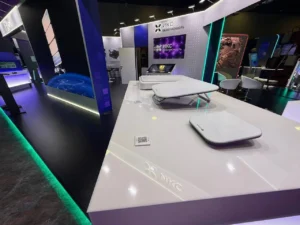
Rosoboronexport presented the Radeskan-Antidron detection, trajectory tracking and countermeasures complex for unmanned aerial vehicles.

It can suppress targets at a distance of up to 1.5 km, and detect them at a distance of 4-6 km. The complex is equipped with a visual tracking system in the form of a gyro-stabilized camera with a thermal imager. In this case, it is possible to create entire defence lines by combining several complexes into a single system. The complex can be made both stationary and mobile.
Kamikaze drone Dan-M
The Russian Armed Forces have begun using new kamikaze drones Dan-M to strike targets in Ukraine. Dan-M is a reactive target for training and testing air defence, which Russia has converted into a strike UAV.
Characteristics of UAV Dan-M:
- flight time 25 – 40 minutes;
- speed 400 – 750 kilometres per hour;
- flight altitude up to 9 kilometres.

5G communication system for UAV control
A communication line based on 5G technology was tested in the Tomsk region for simultaneous control of five UAVs from a flying laboratory. All this was done based on the TVS-2MS aircraft, which acted as an analogue of a satellite. The occupants managed to ensure stable communication with ground terminals that simulated 5G phones.
Reading now
1
SkyFall officially unveils Thor Hammer mid-strike and announces 1,000+ km version
2

260+ vacancies in Ukrainian defence technology at BlueBird Tech, Sine Engineering, Buntar Aerospace and more
3
British-Ukrainian Occam Industries raises €3.8m. The funds will go towards scaling drone autonomy software
4
Terra Drone acquires 50% of Ukrainian Kurin Technologies for $3.5 million
5

Autonomous interceptor drones need radars to work. Why is there still a lack of them
By submitting this form, you give Defender Media consent to the processing of personal data.
Надсилаючи цю форму, ви надаєте Defender Media згоду на обробку персональних даних.

Latest news
1

US-based PDW to test Odd Systems’ Kurbas cameras on its drones
2
Black Mirror #80: Rassvet terminals, high-speed jet-powered interceptors, Kinzhal upgrades and other developments in Russian miltech
3
Phantom Defense acquires net-launcher developer KARAKURT to integrate its technology into own ecosystem
4

Acoustic sensor developer Zvook raises investment from new Czech fund managed by DEPO Ventures
5