Black Mirror #82: Filin cruise missile, Geran upgrades, new interceptor drones and other Russian miltech developments
Overview of Russian defence-industrial complex developments for the third week of October
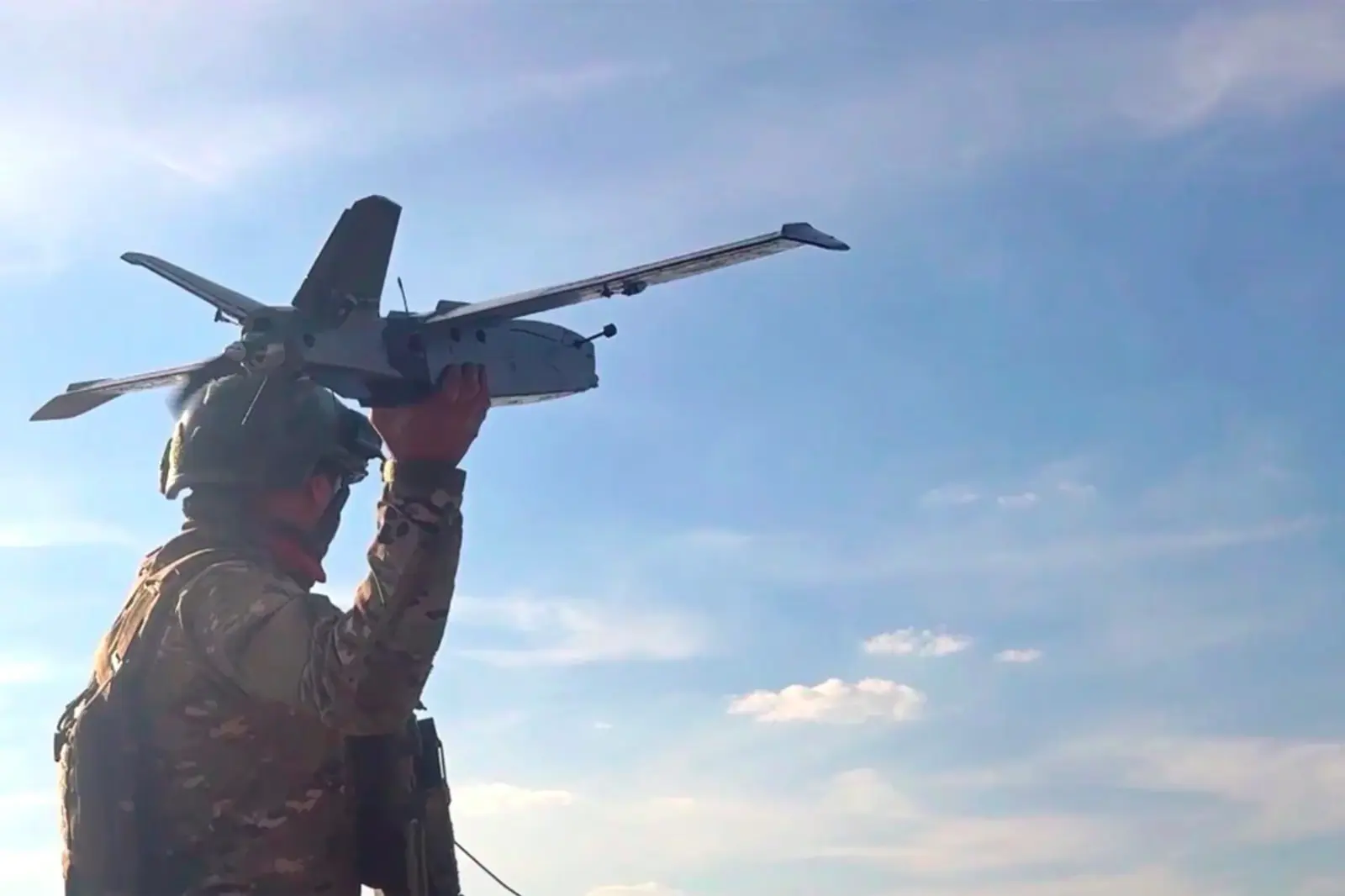
Russian F-1 interceptor drone
Last week, Russia attacked Kyiv with an Iskander-M missile carrying a cluster warhead, while the use of a Filin cruise missile was recorded in the combat zone. In addition, details emerged about two new interceptor drones and anti-drone systems that use artificial intelligence to coordinate drone launches. Read more about these and other developments in Russia’s military-industrial complex in Defender Media’s weekly review, Black Mirror.
Filin cruise missile with a range of up to 1,200 km
According to Ukraine’s Defence Intelligence (HUR), Russia has developed and begun operating a new Filin cruise missile, with a potential range of up to 1,200 km.
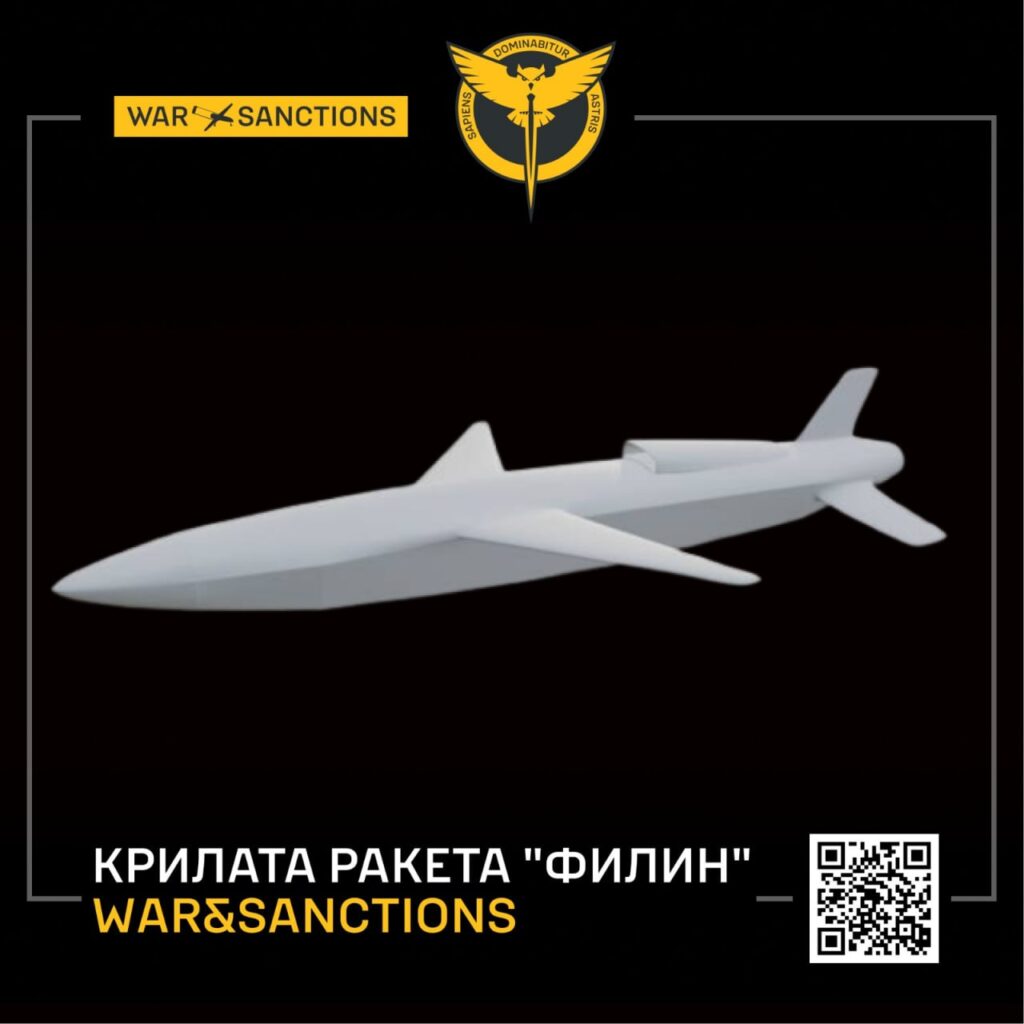
The missile’s stated maximum speed is 800 km/h. Preliminary data suggest it is about 3.5 m long, has a 3 m wingspan, and weighs 210 kg at launch. It can carry a high-explosive fragmentation, shaped-charge or thermobaric warhead weighing either 50 or 100 kg.
Russian military expert Viktor Baranets claims that the missile contains no foreign components. According to him, it may use the GLONASS satellite navigation system.
However, other Russian sources report that the missile has an inertial navigation system, a Kometa satellite navigation module, and a system that matches terrain images against preloaded data.
According to HUR, Russia’s NPO Molniya joint-stock company manufactures the missile. Its engine is the R500, manufactured by Reynolds LLC of Russia. The engine previously powered the S-71,000 Kover and S-71M Monokhrom air-launched missiles.
HUR also reports that the missile’s onboard equipment is manufactured by PLAZ, while its navigation system contains Chinese-made components.
HUR publishes data on foreign equipment used by Russian missile manufacturers
Ukraine’s Defence Intelligence has published details on the War&Sanctions portal of 30 pieces of foreign technological equipment used by Russian companies involved in producing ballistic missiles and their components.
According to HUR, the equipment originates from China, Germany, Taiwan, the United States, Türkiye, Switzerland and Italy. The list includes machine tools and machining centres, as well as measuring equipment used to manufacture altimeters, aerodynamic control surfaces, gyroscopes, and other missile components.
Among the examples is a Chinese-made GX-650 five-axis machining centre that, according to Ukrainian intelligence, the Votkinsk Plant uses. The facility manufactures 9M723 missiles for the Iskander-M system and the missile section of the Kh-47M2 Kinzhal aeroballistic missile.
The list also includes Chinese-made Shtral turning and milling machining centres used at the Molot Production Electromechanical Plant joint-stock company, which manufactures electronic equipment units for Iskander-M missiles.
HUR reports that the UPKB Detal design bureau, which manufactures altimeters for Zircon missiles, has installed equipment made by German manufacturer Rohde & Schwarz.
Ukrainian intelligence also says Chinese machine tools may contain components made in Europe, Japan, and Taiwan, including numerical control systems, servo drives, spindles, bearings, and measuring systems.
Terrain image-matching navigation system found in Geran-5 wreckage
An optical-electronic DSMAC (Digital Scene Matching Area Correlator) system was found in the wreckage of a Russian Geran-5 unmanned aerial vehicle. It lets the vehicle determine its position by matching terrain images against preloaded data.
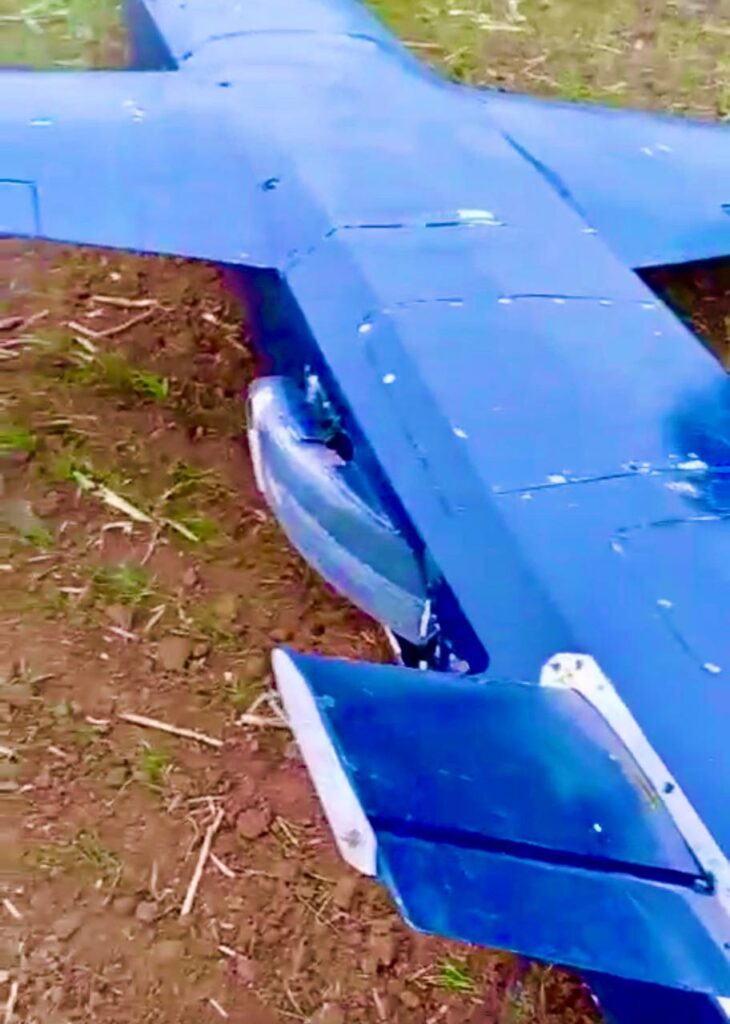
The DSMAC system compares images captured by the onboard camera with reference images stored in a database. This approach makes it possible to refine navigation without relying exclusively on satellite signals.
This technology brings some of the Geran-5’s capabilities closer to those of long-range cruise missiles, including the Kh-101, which also uses terrain image-matching systems. The discovery of this equipment may indicate further upgrades to the Geran-5’s onboard systems.
Geran-4 travels more than 1,400 km with a minimal payload
The Russian Geran-4 jet-powered kamikaze drone has travelled more than 1,400 km for the first time. Russian commentators report that the UAV carried a minimal payload to extend its range.
According to open sources, the Geran-4 can carry a payload of 50-90 kg and reach speeds of up to 500 km/h at altitudes up to 6 km.
Earlier reports said the drone flew 960 km. This range was reportedly achieved using new Telefly LX-WP-160 and Telefly TF-TJ2000A engines.
Following modernisation, the vehicle received a revised aerodynamic configuration and a reinforced structure. In particular, the wings are no longer detached from the centre section, and the fuselage has fewer access panels to reduce aerodynamic drag.
Geran-4 Seeker enters service with Rubicon
The Russian Rubicon unit has begun using Geran-4 Seeker strike drones equipped with optical-electronic homing heads and command-and-telemetry transmission links.
According to Russian media reports, the system allows the operator to observe the target and adjust the drone’s guidance during the final stage of flight. This control method may reduce the UAV’s dependence on satellite navigation, which electronic warfare systems can disrupt.
Prizrak presents concept for multi-layer UAV interception
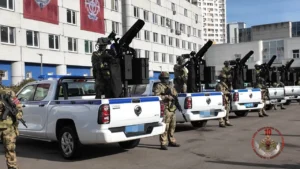
The Prizrak project has presented the AI Armor v.77 system, designed to detect and intercept unmanned aerial vehicles. According to its developers, it combines artificial intelligence-based data processing, acoustic and optical target detection, and FPV interceptor drones.
The system uses mobile launchers integrated with radars and detection equipment. According to the developers, this allows the system to manage a network of interceptors and allocate targets among launchers.
Artificial intelligence algorithms are intended to automate target acquisition and tracking, as well as selecting a launcher for an interceptor. According to the system’s description, the operator can adjust the drone’s flight or return it to base.
The developers also claim that the system can be deployed on vehicles and used to protect vehicle convoys on the move.
Harpiya-A1 receives a jet engine
Russian forces have begun using a Harpiya-A1 unmanned aerial vehicle equipped with a jet engine.
The official specifications of the UAV’s baseline version have not been disclosed. Previously, the vehicle had a delta wing, a small fuselage with an elongated nose and wingtip plates. It was powered by a piston engine with a pusher propeller.
The export version of the Harpiya has a top speed of 170 km/h, can remain airborne for up to six hours, and can fly at altitudes between 5 and 2,500 m. The UAV is launched from a multi-round launcher mounted on a truck.
Russia attacks Kyiv with an Iskander-M missile carrying a cluster warhead
On the night of 22 October, Russia attacked Kyiv’s historic centre with an Iskander-M ballistic missile. According to presidential adviser Serhii “Flash” Beskrestnov, the missile carried a K5 cluster warhead designed to strike personnel and equipment over a large area. Its submunitions explode in the air, scattering fragments.
According to Russian sources, a 9M723 missile for the Iskander-M system equipped with a cluster warhead contains up to 58 fragmentation submunitions.
F-1 interceptor drone
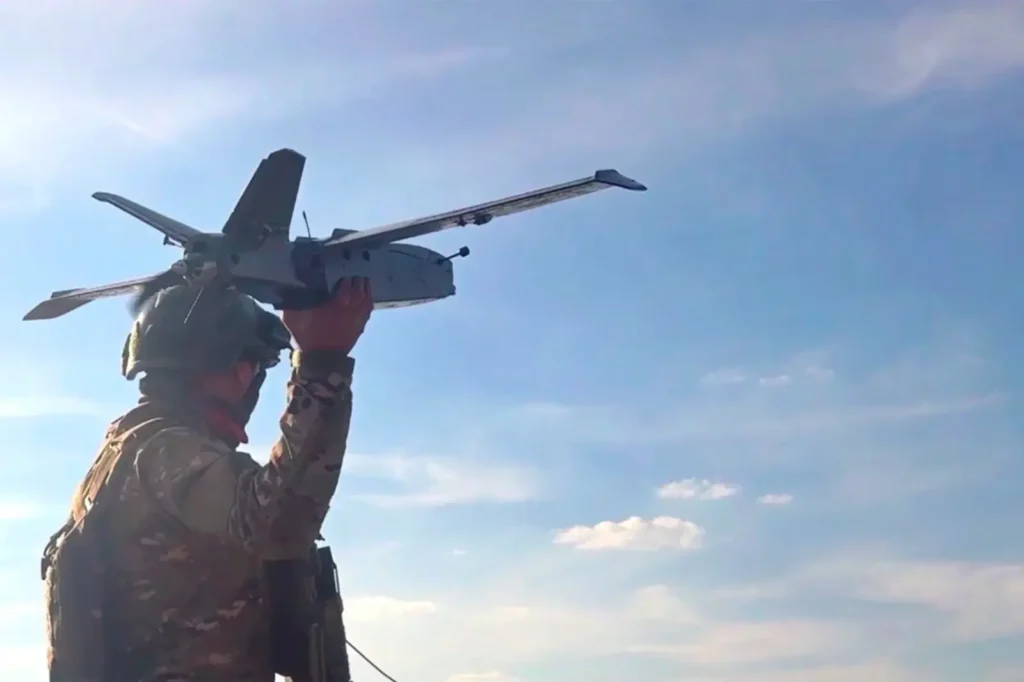
Russia’s Ministry of Defence claimed that the F-1 interceptor drone helped destroy more than 20 Ukrainian strike UAVs of various types in four days. The ministry released footage showing the drone being prepared for launch and intercepting aerial targets.
The footage shows a fixed-wing UAV launched by hand without a complex launch system.
Reports of a fixed-wing interceptor with a V-shaped tail date back to August. The drone is now known to carry up to 800 g of explosives, reach speeds of up to 150 km/h, and operate at an altitude of around 5,000 m.
Kashchei interceptor drone
The Russian company Zashchita ot Dronov has presented the Kashchei interceptor drone at an exhibition in Moscow.
According to its founder, Ildar Almazov, the UAV comes in two variants with five-inch and seven-inch propellers. Both versions can reach speeds of up to 320 km/h and can be equipped with day- or night-vision systems.
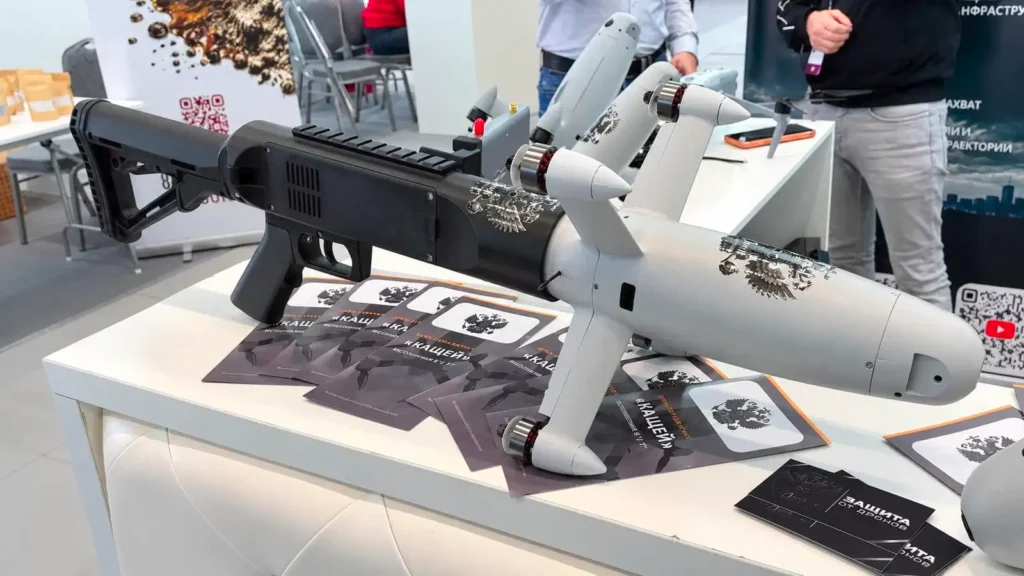
The developer claims an artificial intelligence system enables the drone to autonomously pursue aerial targets, even when electronic warfare systems are operating. According to Almazov, Kashchei can intercept targets travelling at speeds of up to 220 km/h.
The seven-inch variant can carry a 400 g warhead. Its maximum flight altitude is 4 km, while its flight time at maximum speed is limited to eight minutes.
Yastreb mobile anti-drone system
Russian forces have developed the Yastreb mobile system to counter unmanned aerial vehicles. Its primary means of engagement is a high-speed interceptor drone that can destroy targets by ramming them or detonating its warhead.
The system is mounted on a four-wheel-drive pickup truck equipped with electronic warfare equipment, as well as radar, acoustic and optical systems for detecting UAVs.
According to the developers, the interceptors can reach speeds of 350-400 km/h. They carry high-explosive fragmentation warheads weighing 0.8 or 1.5 kg.
Project head Aleksandr Tavalika said the system is designed to counter not only unmanned aerial vehicles but also uncrewed boats. According to him, Yastreb underwent joint trials with representatives of the Russian Navy and was recommended for use by active units.
Rostec reports on night operations using the Depesha-3 UGV
Russia’s state-owned Rostec corporation has stated that the Depesha-3 unmanned ground vehicle can carry out night missions using camouflage netting, a low profile and quiet movement.
According to the corporation, during night raids the operator receives a black-and-white image from the camera, which is harder to interpret than a daytime image. Operating the robot therefore requires prior familiarisation with the route, including the terrain.
The UGV was previously equipped with a panoramic display system that gives the operator images from all directions.
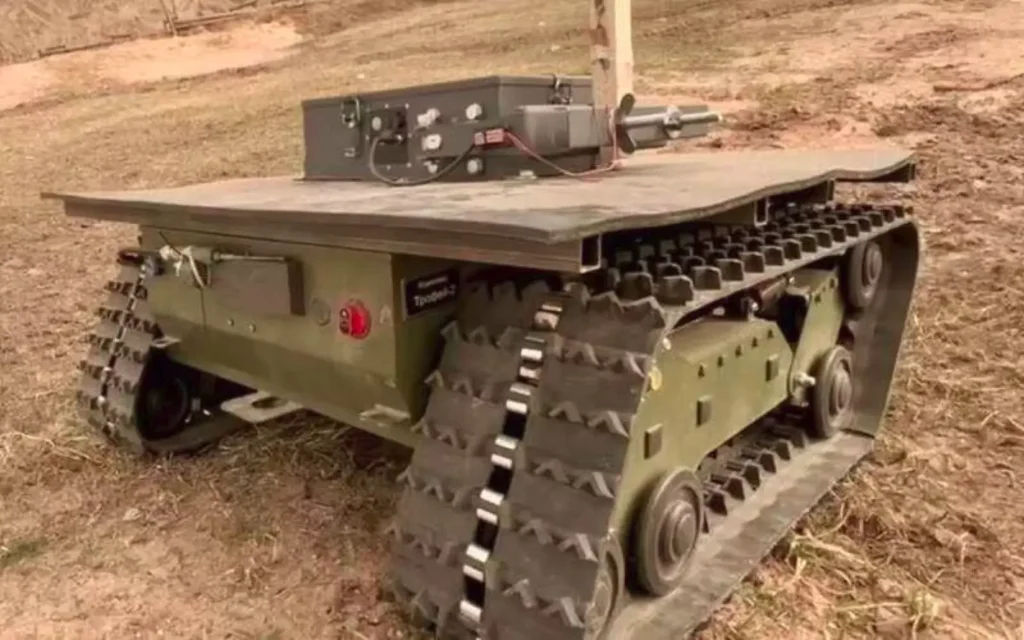
Open sources indicate that the tracked version of the Depesha-3 can carry up to 150 kg of cargo, while the wheeled version can carry around 200 kg. The UGV can also tow a trailer weighing up to 500 kg.
Dobrynya Nikitich cargo drone almost fully switches to domestic components
Russia’s Svarog Research and Production Centre has announced that its 15-inch Dobrynya Nikitich cargo drone has been almost fully localised. According to the centre, the drone uses domestically produced frames, motors, propellers and a flight controller. The next stage is expected to be the localisation of its digital communications system.
The upgraded model has a control unit with a larger screen. It allows operators to plan flight missions, set routes and add waypoints without connecting a separate computer.
According to the developer, the Dobrynya Nikitich can carry payloads weighing up to 10 kg over a distance of up to 12 km.
Testing of the Dronoskop 6 FPV drone video signal detector
The Russian Dronoskop design bureau is testing the Dronoskop 6 mobile FPV drone video signal interception system. The device receives signals across a frequency range from 800 MHz to more than 12 GHz. The developers plan to begin production of the first batch in November 2026.
The device is designed for passive radio-frequency monitoring and reception of the video signal transmitted by an FPV drone’s camera to its operator’s control unit. The data obtained can help detect the UAV and determine the appropriate countermeasures.
Reading now
1

380+ vacancies in Ukrainian defence tech from Fire Point, DevDroid, UFORCE and others
2

A new Ukrainian fund, WildField Ventures, plans to invest $10-15 million in 20 dual-use startups. What areas is it interested in
3

230+ vacancies in Ukrainian defence tech from Tencore, Zvook, Airlogix and others
4
SkyFall unveils new StarGate hexacopter for casualty evacuation
5
Ukrainian units conduct “world’s first airborne evacuation from the frontline” using Audag-6 drone
By submitting this form, you give Defender Media consent to the processing of personal data.
Надсилаючи цю форму, ви надаєте Defender Media згоду на обробку персональних даних.

Latest news
1
Black Mirror #82: Filin cruise missile, Geran upgrades, new interceptor drones and other Russian miltech developments
2

Ukrainian defence firms sign 54 subsidised leasing agreements worth UAH 244.5 million
3

Himera and Danish GomSpace launch OBRIA NANO – a test satellite for the future Ukrainian communications network
4
TAF Industries and DoD Solution have integrated the Aura autonomy module into the Kolibri 10 Advance FPV drone
5