Black Mirror #75: terminal-guidance for interceptors, mesh communications, a mini mine-layer and other Russian miltech developments
An overview of new developments from Russia’s military-industrial complex during the first week of September
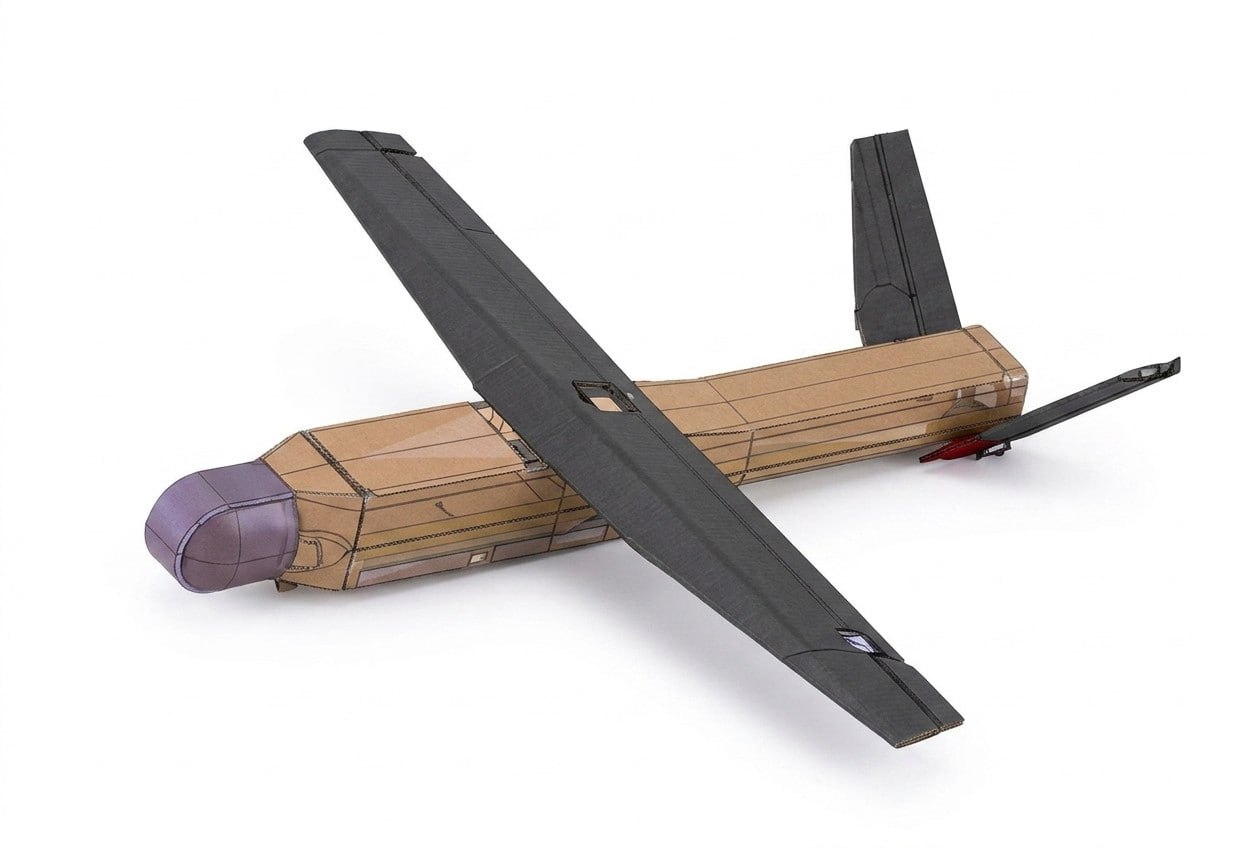
Russian guided loitering munition UBB
Last week, the Russians unveiled several new and upgraded interceptors, a new radar for detecting small UAVs, and a remote mining device. In addition, military observers revealed more details about the use of mesh networks in strike drone operations. Read about these and other developments from Russia’s military-industrial complex in Defender Media’s weekly review Black Mirror.
Zanoza-10 interceptor receives AI-based target guidance
The Ural-based Zanoza drones design bureau has upgraded the Zanoza-10 FPV interceptor, integrating an artificial intelligence system for automated terminal guidance.
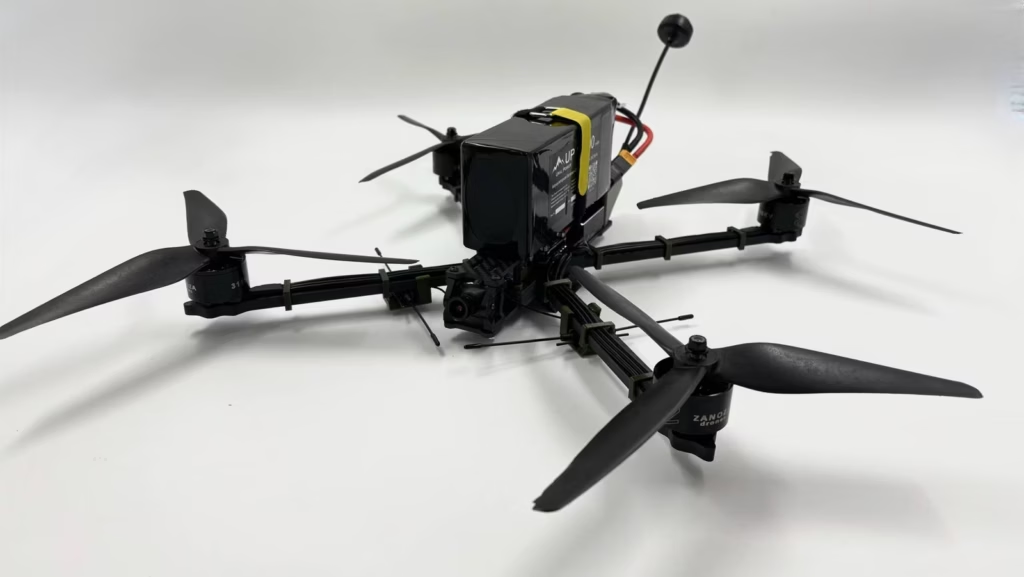
The terminal guidance suite operates during the terminal phase of flight. The manufacturer claims that the platform maintains target tracking even amidst complete video signal loss or severe radio frequency interference.
The Zanoza-10 is a ten-inch FPV drone. The developer previously stated an operational range of up to 40 km, a payload capacity of up to 3.5 kg, and top speeds of up to 400 km/h.
Skat 350M features combined electro-optical payload
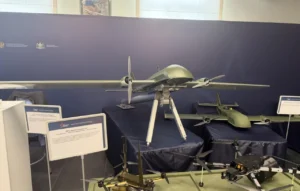
The Kalashnikov Concern has unveiled the modernized Skat 350M UAV, featuring a thermal imager and a high-sensitivity daylight camera integrated onto a shared gyro-stabilized gimbal. The system was displayed at the Integrated Security (Kompleksnaya bezopasnost) defense exhibition in Kazan.
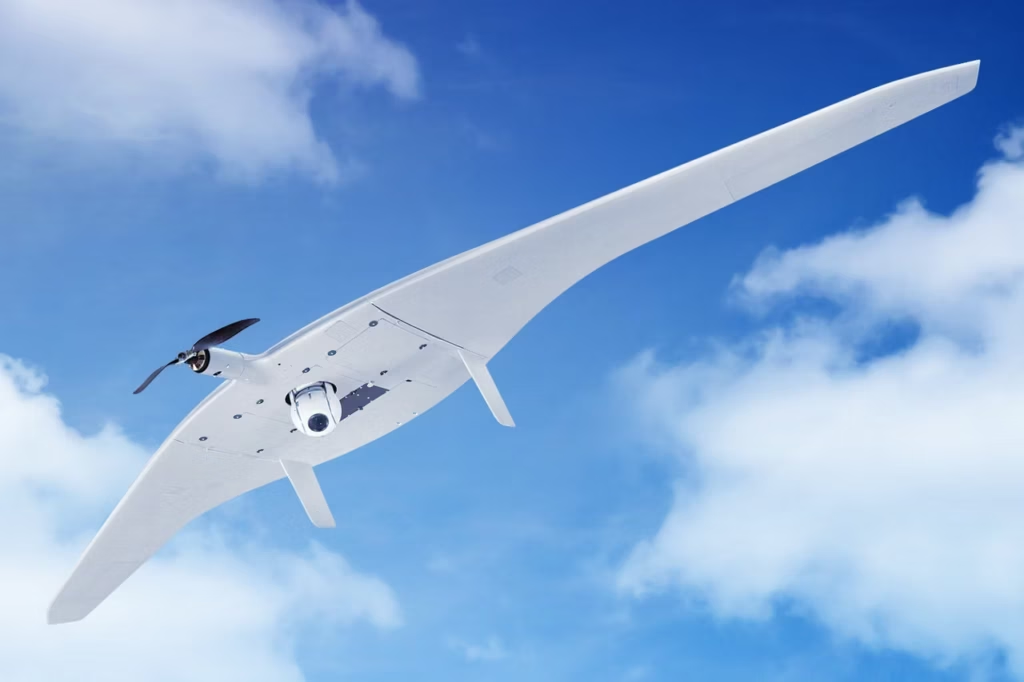
The thermal sensor detects targets by their thermal signatures, while the ultra-sensitive camera identifies visible light sources, allowing simultaneous dual-channel observation.
Derived from the Supercam S350 architecture, the Skat 350M features a maximum takeoff weight of 15 kg, a wingspan of 3.2 m, and a flight endurance of up to four hours, with a reported speed range of 72 to 120 km/h.
Veter-PRO interceptor fitted with automated terminal guidance
Russia has unveiled the new Veter-PRO interceptor drone, fabricated using additive manufacturing (3D printing).
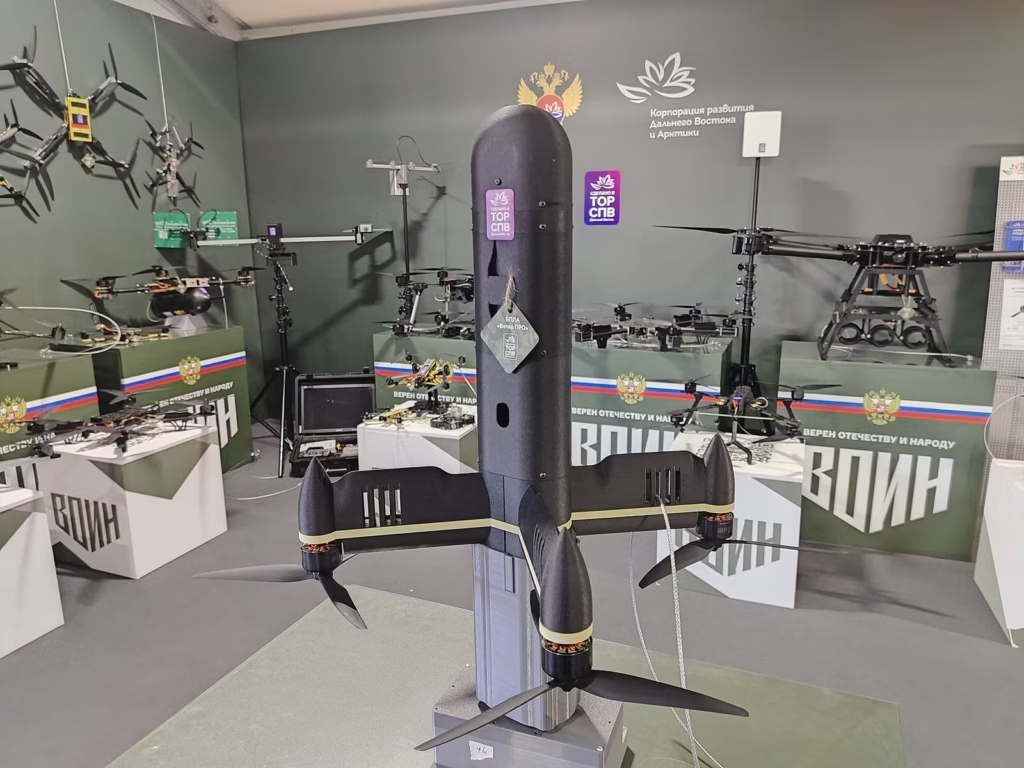
According to the developer, the interceptor is assembled from domestic components, excluding the optical camera. The platform reportedly reaches speeds of up to 260 km/h with a payload capacity of up to 850 g. The UAV supports both manual piloting and automated intercept modes, wherein the onboard system autonomously guides the drone onto the target.
Operators can maintain control at stand-off ranges of 20–25 km via an optical communications link. The drone is reportedly undergoing combat trials.
Atom-M magnetic sensor for remote mining
Russian developers have introduced the Atom-M magnetic sensor, engineered for remote area denial and detecting metallic target movement.
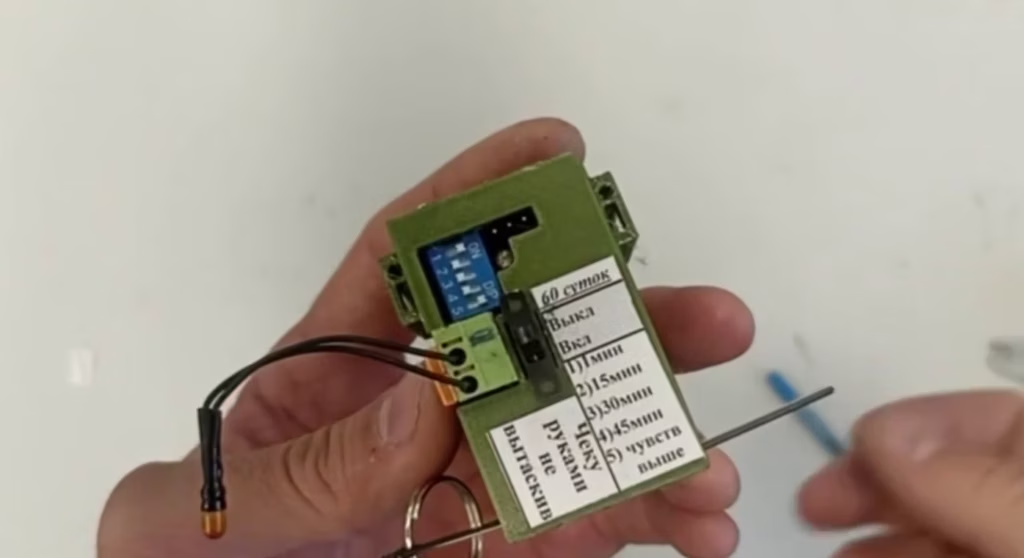
According to published specifications, the sensor triggers when a vehicle approaches within 2.5 m or personnel within 30 cm. Anti-handling features trigger detonation if an attempt is made to move or neutralise the device.
Measuring 30×65×36 mm and weighing 70 g, the device operates at 3.6 V, draws approximately 3 mA in armed mode, and incorporates a 4,800 mAh internal power cell.
Over 50 mobile fire teams in Crimea deploy Nabat V.3 detectors
Russian mobile fire teams in occupied Crimea are utilizing Nabat V.3 drone detectors developed by GoDrone. According to Russia’s Centre for Unmanned Systems and Technologies, these detectors are also being installed on patrol craft operating in the Black Sea.
The Nabat V.3 is designed to detect low-altitude UAVs (operating up to 100 m AGL) and calculate target bearings via digital or analog communication channels at ranges exceeding 11 km.
The system is also claimed to intercept and display live video feeds from detected drone cameras.
UBB loitering munition adapted into counter-UAS interceptor
Russian defense observers have published technical documentation for the UBB-M interceptor drone, developed by Research and Engineering Company on the foundation of the UBB guided loitering munition.
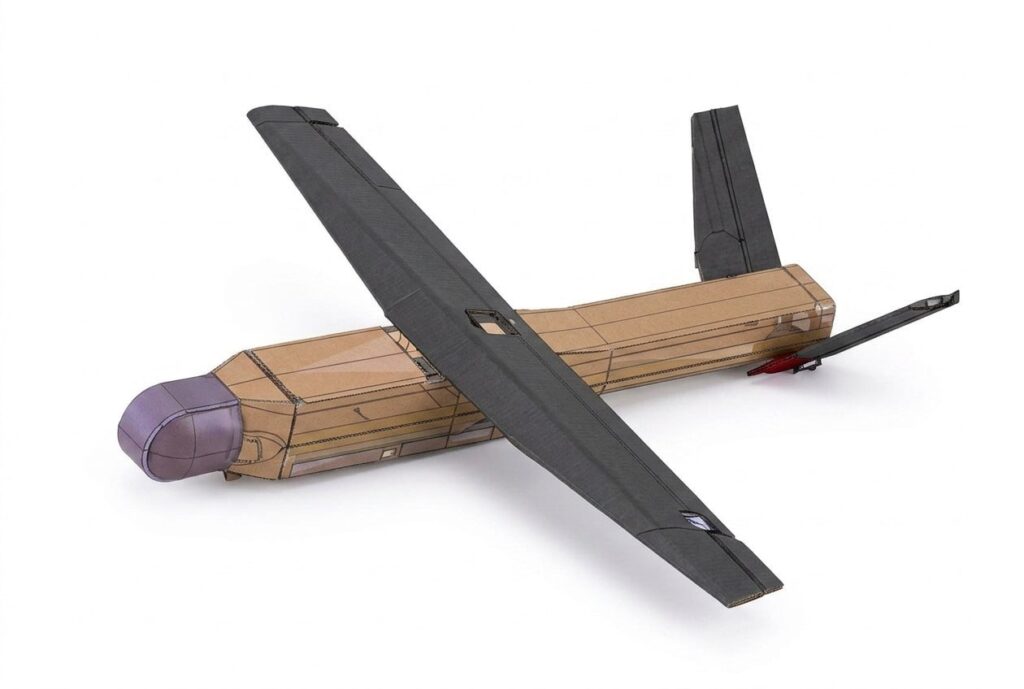
According to leaked documents, the airframe design has been modified for counter-UAS roles. Key structural changes include replacing the straight wing with a reduced-area swept wing, alongside a modified empennage. The iteration also integrates a higher-capacity power cell and a higher-output motor.
The stated launch weight is 15–16 kg with a 3 kg payload capacity. The platform features a top speed of 300 km/h, a flight endurance of approximately 10 minutes, and an operational ceiling spanning 20 to 4,500 m.
Lancet-3 utilizes multi-parametric target classification
Updated computer vision algorithms in the Russian Lancet-3 analyze multiple object parameters prior to final target classification. The developers claim the software evaluates thermal signatures, geometric profiles, and kinematic movement patterns. The tracking algorithm is also engineered to maintain target lock despite partial visual occlusion or changing aspect angles.
According to Russian claims, the software update is tailored to engage low-contrast and partially concealed assets.
Furthermore, Russian sources claim a Lancet strike UAV was deployed at a range of approximately 196 km using a new control link architecture, likely enabled by airborne relay platforms.
Regarding the 196 km engagement reported in southern Ukraine, Russian observers speculate the launch platform may have been a naval surface vessel, citing the Project 02510 BK-16 high-speed craft as a potential carrier.
Russian Geran-5 and Molniya drones transition to mesh networks
Russian Geran-5 strike UAVs and Molniya drones are receiving mesh modems that enable inter-node data exchange across a shared network architecture. In this configuration, individual UAVs function as communications relays for adjacent platforms within line-of-sight, extending effective operational range and mitigating electronic warfare disruption.
Preliminary data indicates Molniya drones are fitted with a compact modem utilizing two 5 W transmission channels operating in the 1300–1500 MHz band. Upon link loss, the platforms revert to autonomous flight modes.
Mesh modems are similarly being integrated onto Geran series long-range strike drones, including platforms deployed against Kyiv.
Alfa sverkhdalnost radar detects small UAVs at ranges up to 7 km
Russia’s Alfa design bureau has unveiled the Alfa sverkhdalnost radar system, reportedly capable of detecting small UAVs at ranges of up to 7 km. Developers claim the station can acquire seven-inch class FPV drones at this distance, while the detection range for larger aerial targets increases to 30 km.
The radar suite can be mast-mounted, installed on rooftops, or integrated onto mobile vehicle platforms. According to the developer, the radar tracks up to 20 targets simultaneously at target speeds between 10 and 270 m/s. The system also features the capability to detect and track low-flying fixed-wing and rotary-wing UAVs operating near ground level.
Hardened shelters for strategic bombers under construction at Engels-2
At the Russian Long-Range Aviation airbase Engels-2, construction of large protective revetments for strategic bombers is nearing completion. Individual structures measure approximately 63×63 m with a height of around 17 m.
The physical dimensions align with Russian strategic bomber footprints: the Tu-160 measures 54.1 m in length, 13.1 m in height, and features a 55.7 m wingspan at minimum sweep, while the Tu-95MS measures over 46 m in length with a wingspan of approximately 50 m.
Surrounding infrastructure includes protective earth berms and newly laid taxiways, indicating the site will be used for housing, servicing, and pre-flight staging of heavy aviation assets.
Reading now
1

400+ jobs in Ukrainian defence tech from BlueBird, Vyriy, The Fourth Law, Odd Systems and other sector leaders
2

8 top defence tech events in September
3

Former defence minister Mykhailo Fedorov launches fund to invest in defence tech
4
20 Ukrainian companies are working on jet-powered interceptor drones. Firebolt Engineering is among them
5

European defence giant Leonardo opens a subsidiary in Ukraine
By submitting this form, you give Defender Media consent to the processing of personal data.
Надсилаючи цю форму, ви надаєте Defender Media згоду на обробку персональних даних.

Latest news
1
Black Mirror #75: terminal-guidance for interceptors, mesh communications, a mini mine-layer and other Russian miltech developments
2
Ukraine’s Bars jet-powered drone to enter production in Germany, with range extended to 1,000 km and warhead payload to 60 kg
3

Ukrainian intelligence officers test new AI system to coordinate UGVs and naval drones
4
400+ jobs in Ukrainian defence tech from BlueBird, Vyriy, The Fourth Law, Odd Systems and other sector leaders
5