Black Mirror #74: Iskander with a range of 1,000 km, the internals of Zircon and other new developments in Russian miltech
Overview of Russian defence-industrial complex developments for the fourth week of August
Last week, the Russians discussed updates to Shahed-type strike drones, showed a modernised Molniya and announced the start of serial production of the Volna Kupol Garant counter-satellite communications system. In addition, plans to manufacture Dan’-T loitering munitions and tests of high-speed interceptors became known. More about these and other new developments in Russia’s military-industrial complex in Defender Media’s weekly Black Mirror review.
GUR published details of the Russian 3M22 Zircon missile
The Main Directorate of Intelligence of the Ministry of Defence of Ukraine (DIU) published an interactive 3D model, along with technical data on the components of the Russian 3M22 missile in the Zircon system. Information on the companies involved in its production, their personnel, and the foreign equipment utilised by these firms was also released.
The missile’s warhead weighs approximately 120 kg. Its maximum recorded speed currently does not exceed Mach 6.8 and is not sustained throughout the entire flight path.
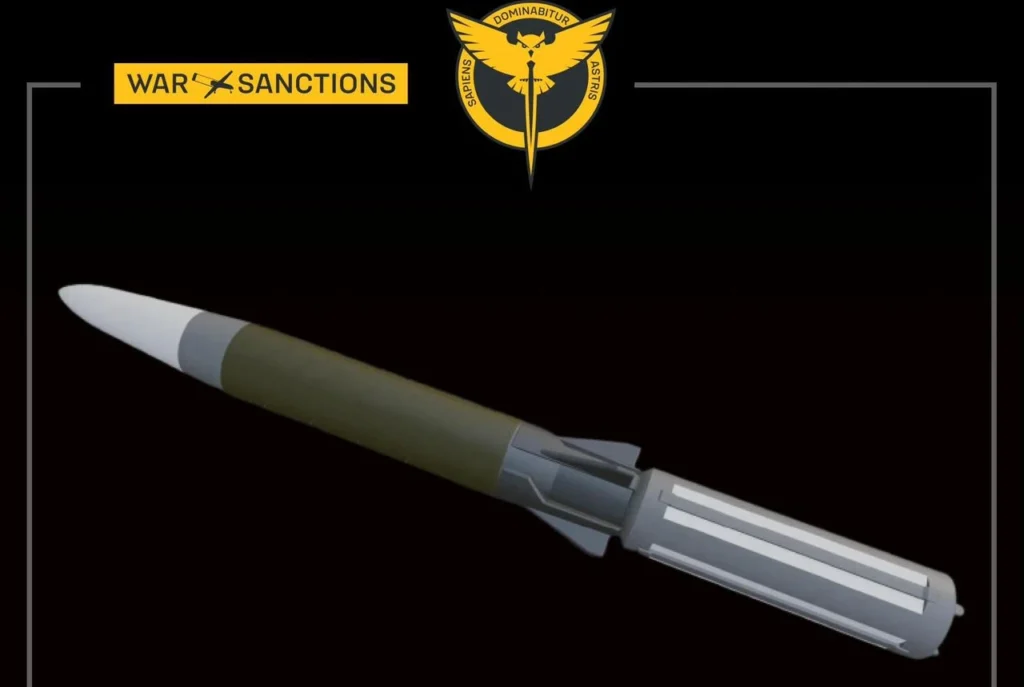
Once the missile exits its launch canister on a ship or coastal defence system, a solid-fuel booster ignites to reach the altitude and velocity required for the main engine to take over. After the booster separates, the primary solid-fuel sustainer engine engages.
Initial guidance of its trajectory is provided by orientation and stabilisation thrusters housed within a protective nose fairing, which is subsequently jettisoned. The 3M22 employs a combined guidance system: inertial navigation during the cruise phase coupled with an active radar homing seeker in the terminal stage. The missile’s onboard flight computer is designated as the Baget-83.
The tail assembly contains electro-hydraulic control actuators and aerodynamic control surfaces. These remain folded in the transport position and deploy after exiting the launch tube. The tail section of the 3M22 is constructed from titanium.
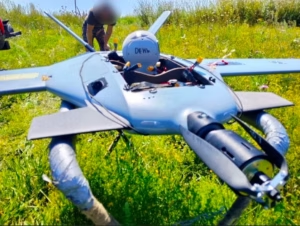
The operation of an EW system on a Shahed was examined
Ukrainian military specialists analysed the operation of an electronic warfare (EW) system installed on Russian Shahed drones. A video demonstrating the mechanism was published by presidential adviser Serhii “Flash” Beskrestnov.
The EW countermeasure works by intercepting the signal of an approaching interceptor drone. The interceptor UAV relies on a video transmitter that sends real-time footage to its operator on the ground. As the interceptor approaches the Shahed, an onboard EW receiver detects the video transmitter’s signal and activates localised jamming on that exact frequency.
Because the jamming signal overwhelms the transmitter’s signal, the ground pilot loses the interceptor’s video feed.
GUR reported Russia’s first use of the 9M723-2 missile against Kyiv
Russia deployed a modernised 9M723-2 ballistic missile, provisionally dubbed the Iskander-1000, for the first time during a combined strike against Kyiv this summer. This was reported by the Main Directorate of Intelligence of the Ministry of Defence of Ukraine.
According to GUR, the missile forms part of the Bora-M system. Featuring an enlarged rocket motor and a correspondingly expanded launcher, it can engage targets at ranges up to 550 km. For comparison, the previously documented 9M723-1 variant has a stated range of 390 km. Other core structural components remain identical to the 9M723-1.
The existence of the modernised 9M723-2 missile was first revealed in July 2024. By December 2025, reports indicated its operational use at ranges extending up to 800 km.
Geran-4 received a fragmentation and high-explosive warhead
Imagery of a new high-explosive fragmentation warhead for the jet-powered Geran-4 drone, which Russian forces have begun deploying against Ukrainian urban centres, surfaced on social media.
The photographs reveal steel or tungsten shrapnel spheres roughly 10 mm in diameter, densely packed inside the warhead casing.

Furthermore, Russian sources claimed a record flight range: a Geran-4 covered 960 km in 1 hour and 55 minutes. The previously advertised operational range for this modification was approximately 550 km.
Volna Kupol Garant EW system enters serial production
The Russian electronic warfare complex Volna Kupol Garant, engineered to disrupt Starlink satellite connectivity, has entered serial production.
According to Russian commentators, the system can generate interference that renders transmitted data unusable. Specifically, claims indicate that the EW platform broadcasts “spurious signals” that disrupt transmissions from ground stations.
Preliminary data suggests the Volna Kupol Garant complex is deployed across four to six vehicles equipped with mobile power generators, creating a disruption zone of up to 20 km². Its rotating antenna arrays operate across eight frequency bands, each 62.5 MHz wide.
Plans for 10,000 Dan’-T loitering munitions
The Russian Dan’-T loitering munition is designed to bridge the gap between long-range strike UAVs and conventional cruise missiles. According to Russian media, the Dan’-T has an operational range of around 500 km and carries a 135-kg warhead. Given these performance metrics, the “Dan” is priced 35% lower than the Banderol.
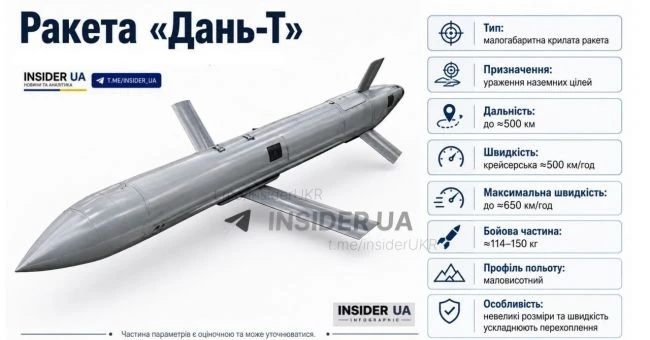
The Dan-T project builds upon the Dan’-M jet-powered aerial target, which Russia adapted for combat employment in Ukraine. The baseline target drone can operate at altitudes up to 9 km and reach speeds of up to 750 km/h.
Ukrainian intelligence previously identified the development of the Dan’-T. Vadym Skibitskyi, Deputy Head of GUR, noted that Russia is attempting to transition the weapon to domestically produced components. By 2027, Russia aims to manufacture approximately 10,000 Dan’-T units.
Rostekh launches production of the SOKOL-08 radar
Russian state corporation Rostekh has initiated production of the SOKOL-08 mobile radar system equipped with machine-learning algorithms. The radar was engineered by the Rosel holding company.
The hardware utilises a 2D phased-array antenna operating in the X-band. According to Rostekh, the radar can detect low-flying and low-observable targets, including micro-UAVs and objects comparable in size to a small bird.
The radar can track up to 100 targets simultaneously. Machine-learning algorithms evaluate detected contacts to filter out false or non-threatening tracks.
The entire system weighs under 28 kg and draws up to 350 W. Power can be drawn from a standard 220 V industrial grid or a 24 V vehicle network, requiring no specialised ground preparation for setup.
Upyr-PVO interceptor drone
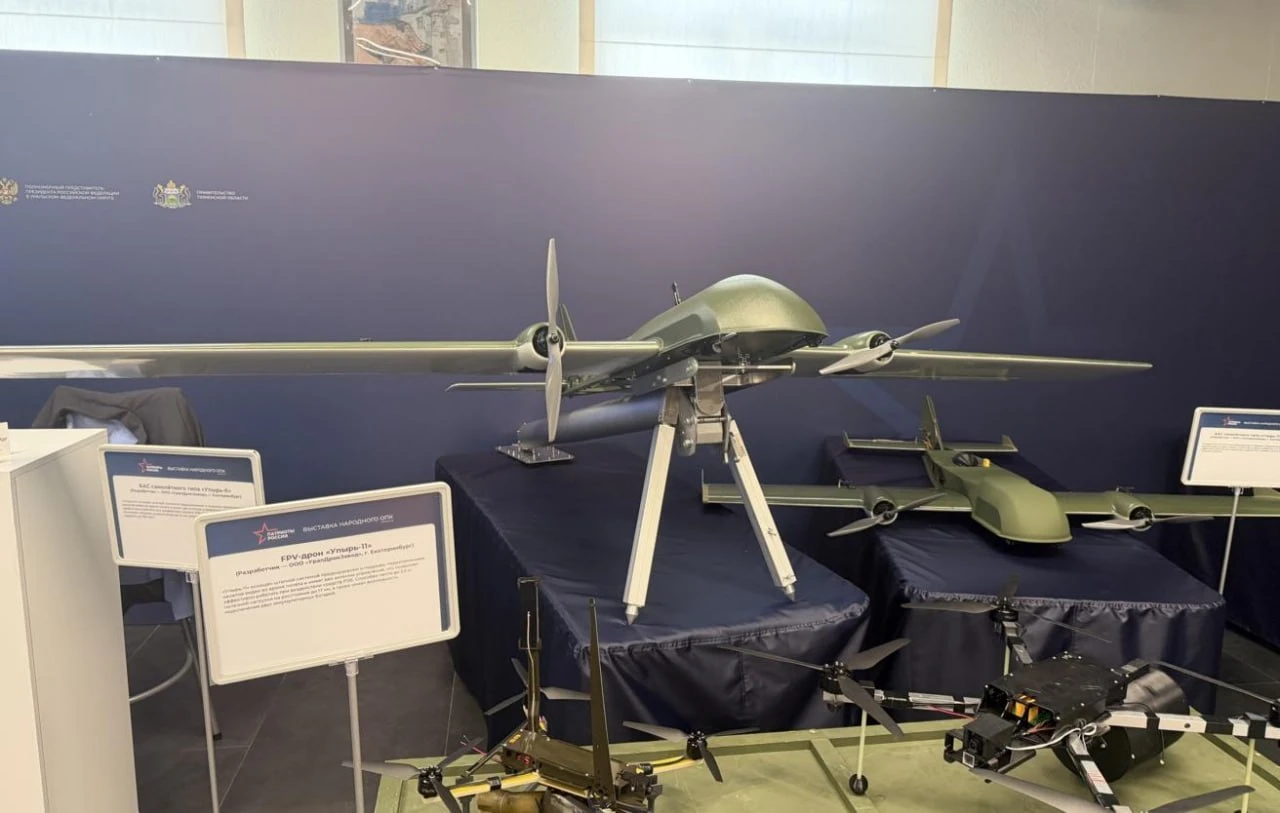
Uralvagonzavod unveiled the Upyr-PVO fixed-wing drone, designed to intercept enemy UAVs. Reference documentation indicates a maximum payload capacity of 4 kg. Further technical specifications have not yet been disclosed.
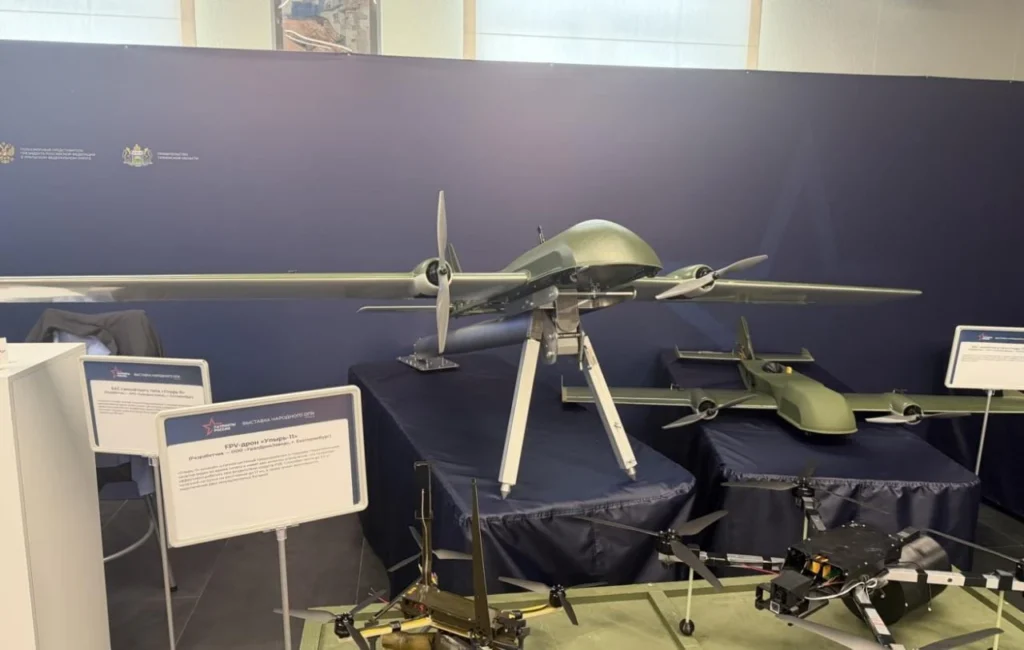
At the same event, “Uraldronzavod” presented the Upyr-K fixed-wing UAV. It features a confirmed operational range of approximately 50 km with a payload capacity of up to 12 kg.
According to the manufacturer, the Upyr-K can carry a warhead weighing up to 12 kg, including antitank landmines such as the TM series.
Russian forces begin using Pole-31 EW system
Russian troops have begun fielding a new iteration of the Pole-31 electronic warfare station, developed by NPO Kilovatt.
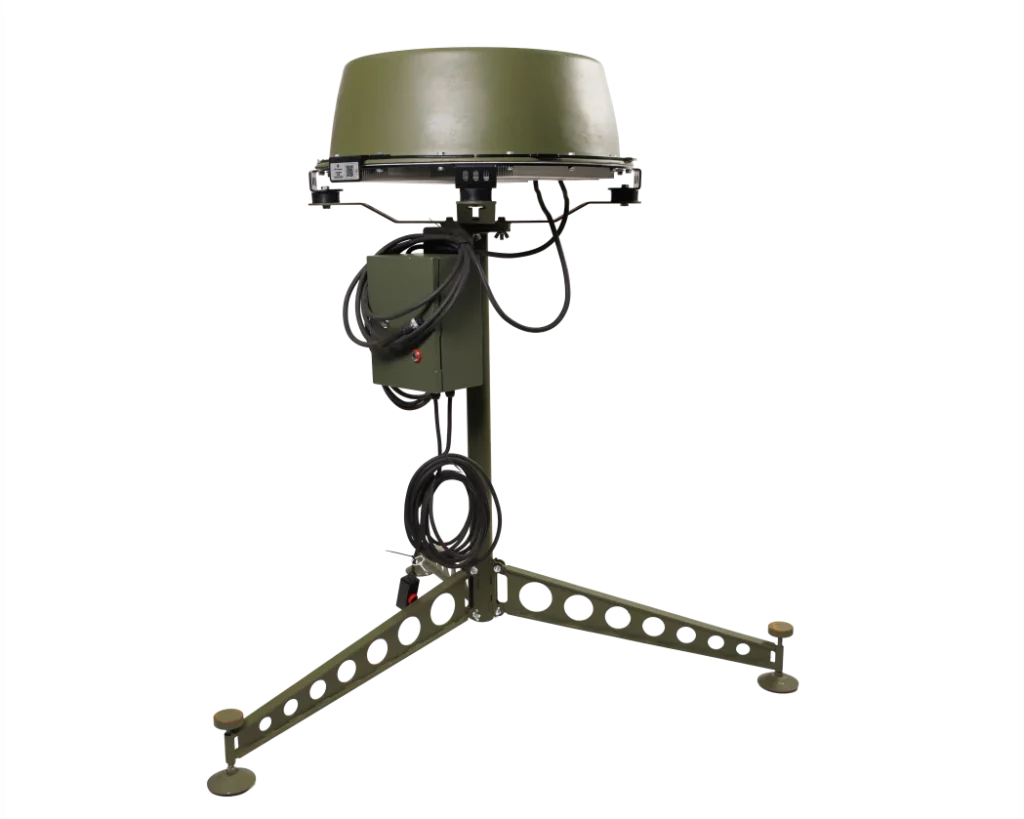
The station disrupts satellite navigation signals that UAVs rely on for position and route guidance. The manufacturer claims an effective jamming range of at least 2 km against GPS, GLONASS, BeiDou, and Galileo constellations.
The hardware operates across two primary frequency bands: 1162–1300 MHz and 1550–1630 MHz. The mobile unit weighs 24 kg and outputs a combined transmitter power of up to 240 W.
Aerokon presents a high-speed interceptor drone project
Tatarstan-based Aerokon LLC showcased a patented concept for a prospective high-speed interceptor drone. Accompanying schematics depict an airframe optimised for high-velocity interception manoeuvres.
The design incorporates a compact turbojet engine engineered to achieve speeds up to 1,000 km/h.
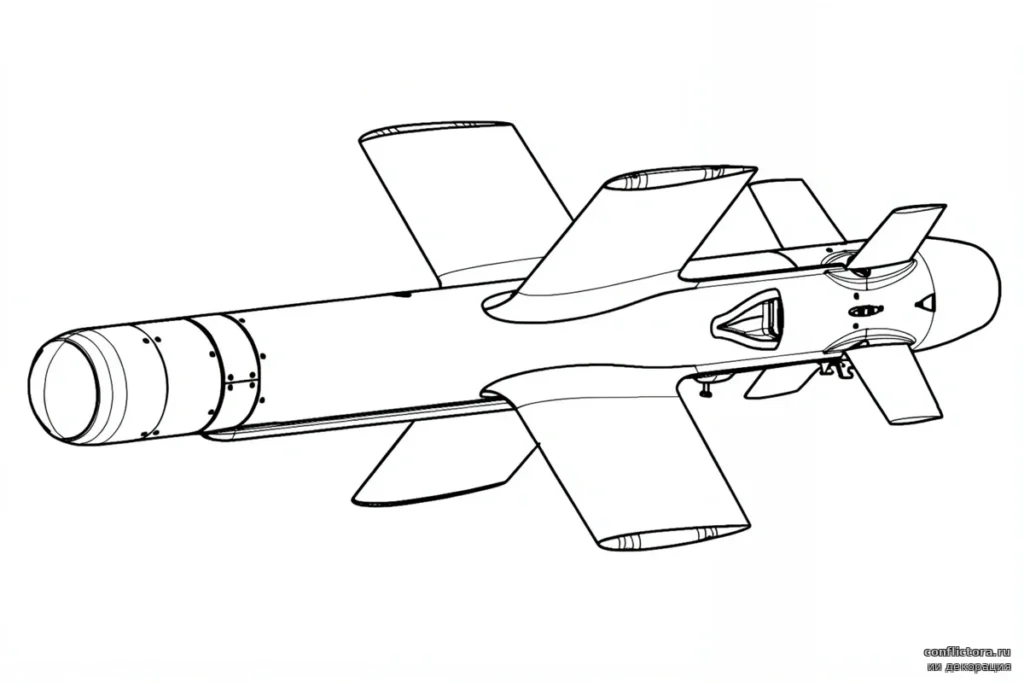
The platform is designed to operate at a service ceiling exceeding 9 km with an operational range of 100–150 km.
Guidance is managed by a thermal imaging seeker paired with machine-vision software, enabling fully autonomous target acquisition and tracking during the terminal attack phase.
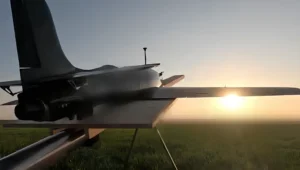
Molniya-P receives a new tail section and three-engine powerplant
An upgraded iteration of the Molniya-P drone features a redesigned tail configuration and a three-engine propulsion system. Developed from the baseline Molniya UAV family, this aircraft serves as a high-speed variant with a previously reported top speed of 270 km/h.
The latest version incorporates a modified empennage alongside a distinctive three-engine arrangement, setting it apart from earlier prototypes.
Official technical specifications for the three-engine variant have not yet been released.
Reading now
1
F-Drones launches FPV drone simulator, Ukrainians to get free access on August 24
2
Rise Technologies unveils Nakande digital communications system for drones
3

200+ new vacancies in defence innovation: Jobs at TAF Industries, Airlogix and other leading industry companies
4
Ukraine’s Defence Ministry codifies first jet-powered Alexa Spatium interceptor drone
5

European defence giant Leonardo opens a subsidiary in Ukraine
By submitting this form, you give Defender Media consent to the processing of personal data.
Надсилаючи цю форму, ви надаєте Defender Media згоду на обробку персональних даних.

Latest news
1

Chernohorenko proposes customs “green lanes” for defence components
2
F-Drones show the interception of a Shahed carrying FPV drones
3

General Cherry challenges the legality of FPV drone tenders based on TS: arguments of the company and its opponents
4
20 Ukrainian companies are working on jet-powered interceptor drones. Firebolt Engineering is among them
5