Black Mirror #73: Ignis laser system, Gruzovichok hexacopter, radar patent, and other Russian miltech innovations
Overview of Russian defence-industrial complex developments for the second week of August
Russian interceptor drone Malysh
Last week, Russian forces showcased further iterations of the Shahed-type Geran and Gerbera strike drones, patented a collapsible interceptor, and tested the Ignis laser system against an anti-personnel mine. Additionally, technical specifications emerged for the Svarog 4T 160 drone and the Gruzovichok reconnaissance UAV. These and other updates from Russia’s defence-industrial base are detailed in Defender Media’s weekly Black Mirror review.
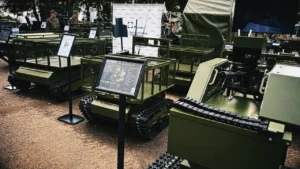
Ignis laser system on the Kuryer UGV
The Russian Kuryer UGV has been integrated with the Ignis laser system, designed for the remote neutralisation of explosive hazards. Demonstration footage shows the system igniting the fuze of an anti-tank mine from a range of 25 metres.
The laser heats the target to approximately 1,000 °C, burning through the munition’s casing and consuming the explosive filler inside. The developers claim this enables render-safe operations without triggering a detonation.
The system’s claimed effective operational range is up to 500 metres. According to Russian media, it remains operational in fog and heavy smoke conditions.
Cost and range of the Geran-4
According to Russian military commentators, the jet-powered Geran-4 strike UAV covered 900 km in 1 hour and 50 minutes. This marks a record distance for the upgraded variant, which is fitted with Telefly LX-WP-160 and Telefly TF-TJ2000A engines.
The claimed maximum speed reaches up to 500 km/h, with an operational ceiling of up to 5,000 metres.
Following the upgrade, the Geran-4 received a revised aerodynamic configuration and a reinforced airframe. The wings are now integrated directly into the centre section, while the number of maintenance hatches on the fuselage has been reduced to minimise aerodynamic drag.
The UAV can carry a 50 kg high-explosive fragmentation or thermobaric warhead, or an enlarged thermobaric payload weighing up to 90 kg.
The unit cost of a single jet-powered Geran-4 is estimated at approximately $100,000 — roughly twice that of the Geran-2.
Spectrum analyser in the Gerbera
A portable Tini SA Ultra spectrum analyser was recovered from a Russian Gerbera UAV, connected to an available port on its MESH modem, according to Serhii “Flash” Beskrestnov, adviser to the Ukrainian presidency.
Available data indicates the device is used for real-time radio-frequency spectrum analysis. Its integration onto a UAV platform likely enables detection of emissions from radar stations or electronic warfare systems.
Reconnaissance configuration of the Gruzovichok
The Russian Gruzovichok logistics FPV drone has been adapted for reconnaissance roles. The platform features an upgraded digital sensor suite comprising a 40x optical zoom video camera and a thermal imager with a resolution of 640×512 pixels.
According to the manufacturer, the Gruzovichok is capable of extended station-keeping. Specifically, in a communications relay role, its claimed hover endurance reaches approximately 1.5 hours. Crucially, the platform retains its transport utility, offering a payload capacity of 6 kg for delivering medical supplies, water, and other equipment.
Flight control is executed via GPS-enabled ArduPilot firmware, providing automated position hold, hovering, and point-to-point delivery navigation.
Specifications of the Svarog 4T 160 unveiled
The Svarog Research and Production Centre has released technical parameters for the updated Svarog 4T 160 multirotor UAV supplied to Russian forces. The developers position the platform as a direct competitor to DJI’s Matrice series.
Claimed specifications for the Svarog 4T 160:
- Range — up to 25 km;
- Flight endurance — up to 40 min;
- Optical zoom — 11×;
- Hybrid zoom — 160×;
- Thermal imager with a horizontal resolution of 640 pixels.
Control is maintained via a ground control station, with live video relayed to a display monitor. In the event of command link loss, the aircraft automatically gains altitude until connection is re-established. The Svarog 4T 160 is capable of GPS-denied operation using an optical flow sensor and lidar.
Malysh strike UAV
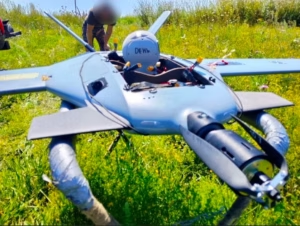
Russian unmanned system units have taken delivery of the Malysh fixed-wing strike UAV. The platform is intended for patrolling and securing logistical lines of communication.
Hand-launched and utilising a fixed-wing layout, the drone achieves higher airspeeds compared to multirotor platforms. Russian claims suggest the UAV can intercept airborne targets at “significant stand-off distances”.
Detailed technical specifications for the Malysh have not been released by Russian authorities.
Roy interceptor drones
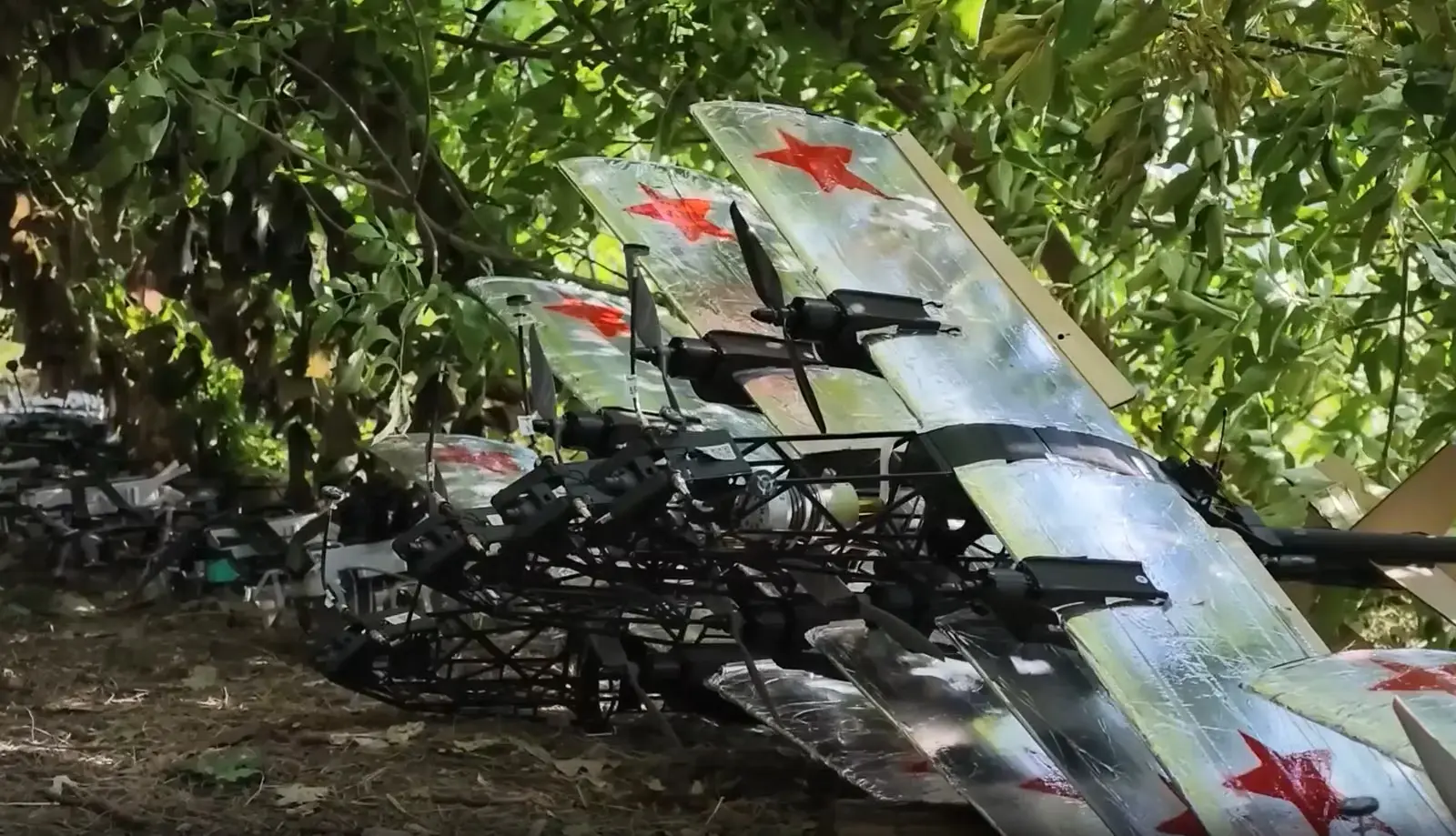
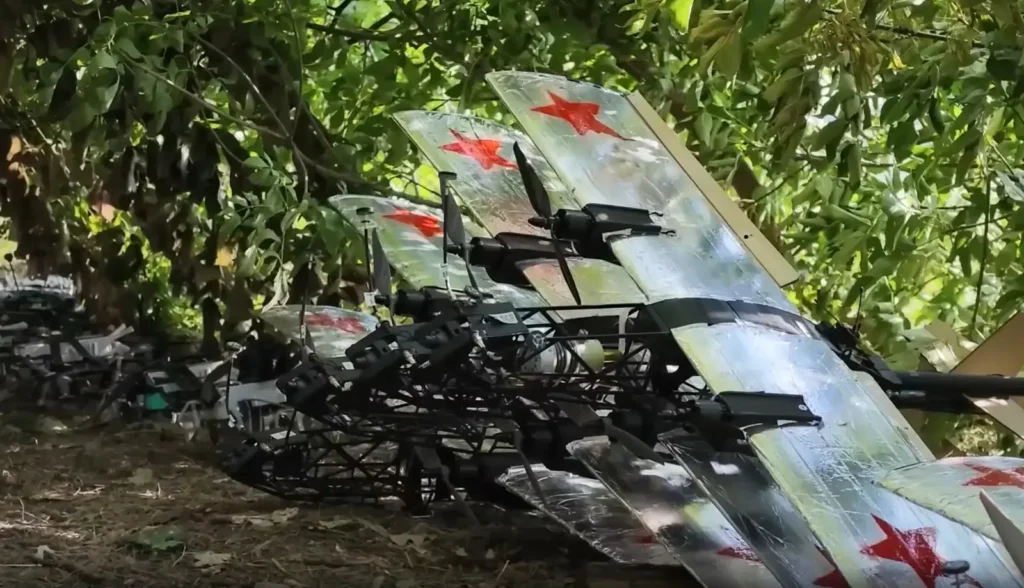
Russian forces report deploying the new Roy multirotor UAV interceptor against Ukrainian drones. Russian sources claim the platform has engaged various aerial targets, including heavy long-range fixed-wing UAVs such as the Lyutyi type. Separately, engagement of Ukrainian R-18 octocopters by the Dnepr grouping using the Roy system was also reported.
Technical details for the Roy remain classified. Reports from Russian state media highlight the kinetic interception of an R-18 octocopter via direct mid-air ramming.
Multistatic airborne radar
Engineers at Innopolis University have proposed a multistatic airborne radar architecture capable of synthetic aperture imaging in the forward sector, achieving an azimuth resolution down to 20 cm.
The architecture employs a distributed array of miniaturised radars: a single active transmitter paired with one or more passive receivers capturing reflections from off-axis angles. This configuration increases Doppler information density, enabling high-resolution mapping of the terrain along the platform’s flight path.
Utilising a 100-metre baseline between array nodes, a flight altitude of 150 metres, and a velocity of 28 m/s, the claimed spatial resolution reaches 0.20 m in azimuth and 0.27 m in range. For context, conventional forward-looking radars typically yield an azimuth resolution of approximately 1 metre.
Compact interceptor drone
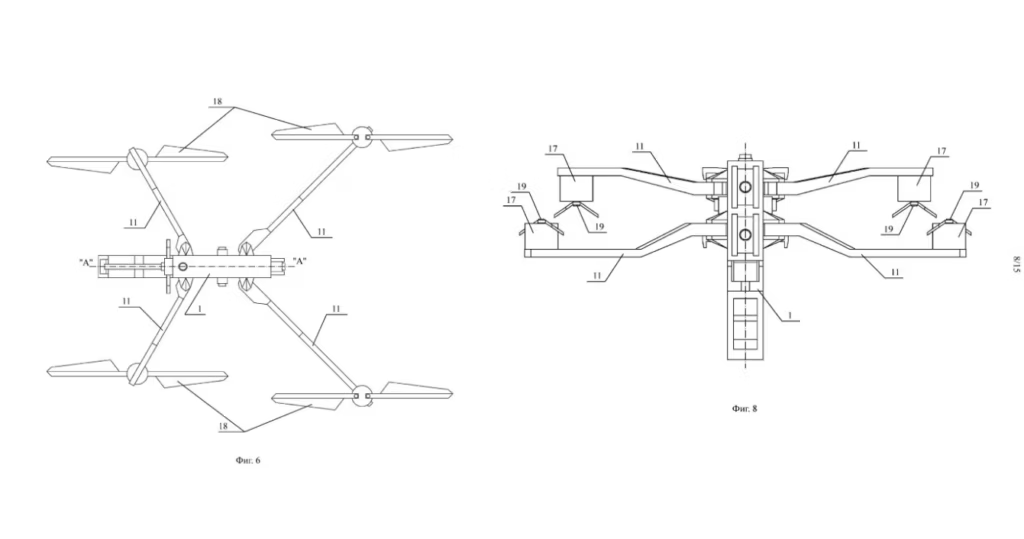
A compact counter-UAV interceptor designed for short-range point defence against small drones has been unveiled in St Petersburg. The assembly includes a carrying handle, foldable motor arms housing electric motors and propellers, optical cameras, a RF module, alongside a modular power pack and munition payload.
The system is engineered for transport in a dedicated hard case or tactical holster. Upon deployment, a single actuator unfolds the motor arms, deploys the propeller blades, and spins up the motors.
Following mission execution, the interceptor can be recovered, fitted with a fresh battery and munition pack, and redeployed.
The designers incorporated a kinetic payload module featuring caseless ammunition with electrical initiation. The overall gross takeoff weight is listed under 2 kg.
Yastreb-1.0 electronic warfare system
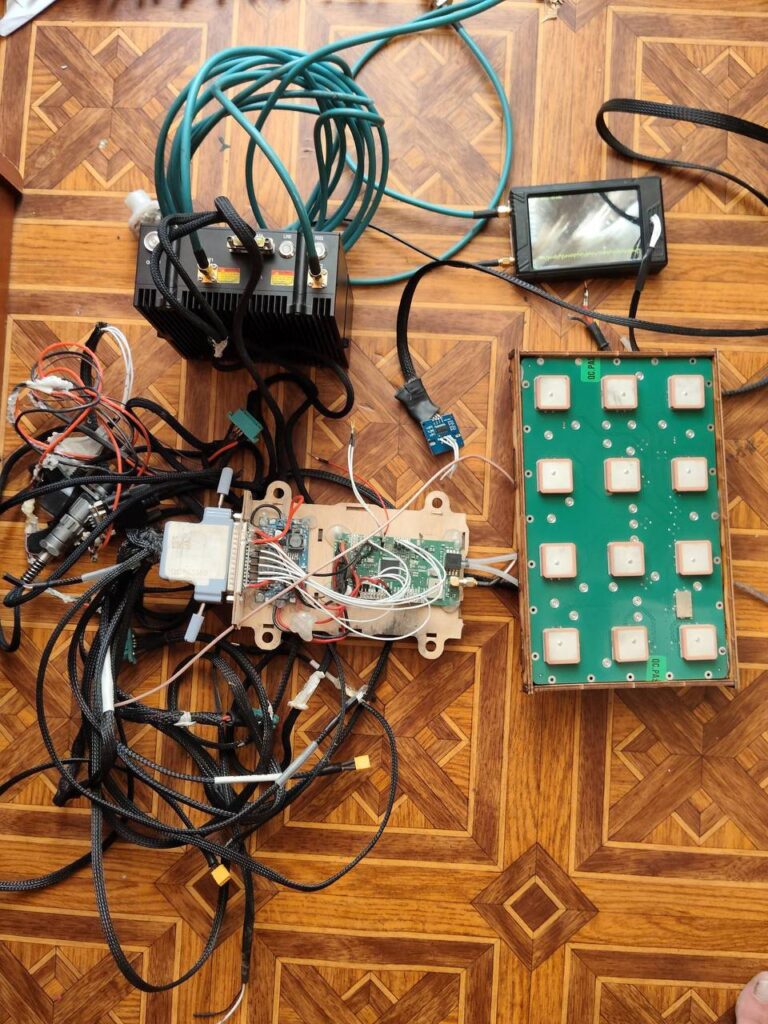
Russian developers have announced the completion of primary field trials for the Yastreb-1.0 electronic warfare system. The suite is engineered for signals intelligence (SIGINT) and directional jamming of UAV control links.
The system covers an operational frequency spectrum from 100 to 6,000 MHz. The developers claim it identifies active control channels and applies targeted signal suppression. According to the design specifications, narrow-band targeted jamming offers superior efficiency over broadband jamming by concentrating RF energy exclusively on active target frequencies.
Reading now
1
F-Drones launches FPV drone simulator, Ukrainians to get free access on August 24
2

British platform Grenadyr has invested in five Ukrainian defence tech startups. Defender is telling its story for the first time
3

60+ new job openings in Ukrainian defence tech: offers from Vyriy, TENCORE, Ukrspecsystems and others
4
Ukrainian company has developed a jet-powered interceptor drone that reaches speeds of over 600 km/h
5
Rise Technologies unveils Nakande digital communications system for drones
By submitting this form, you give Defender Media consent to the processing of personal data.
Надсилаючи цю форму, ви надаєте Defender Media згоду на обробку персональних даних.

Latest news
1
Tencore developed a flamethrower combat module for its TerMIT 2.0 UGV
2
Skyeton has acquired a plot of land in Germany, local media report
3
Norda Dynamics announces partnership with American company Palladyne AI
4
Dutch Tulip Tech developed batteries that can double the flight time of Matrice and Mavic drones
5