Dorozvidka #60: UAV medical evacuation, plus Fedorov, “Madyar”, Vasylchenko, and Berlinska
Key publications on Ukrainian defence tech from other media outlets, blogs, and social media over the past week
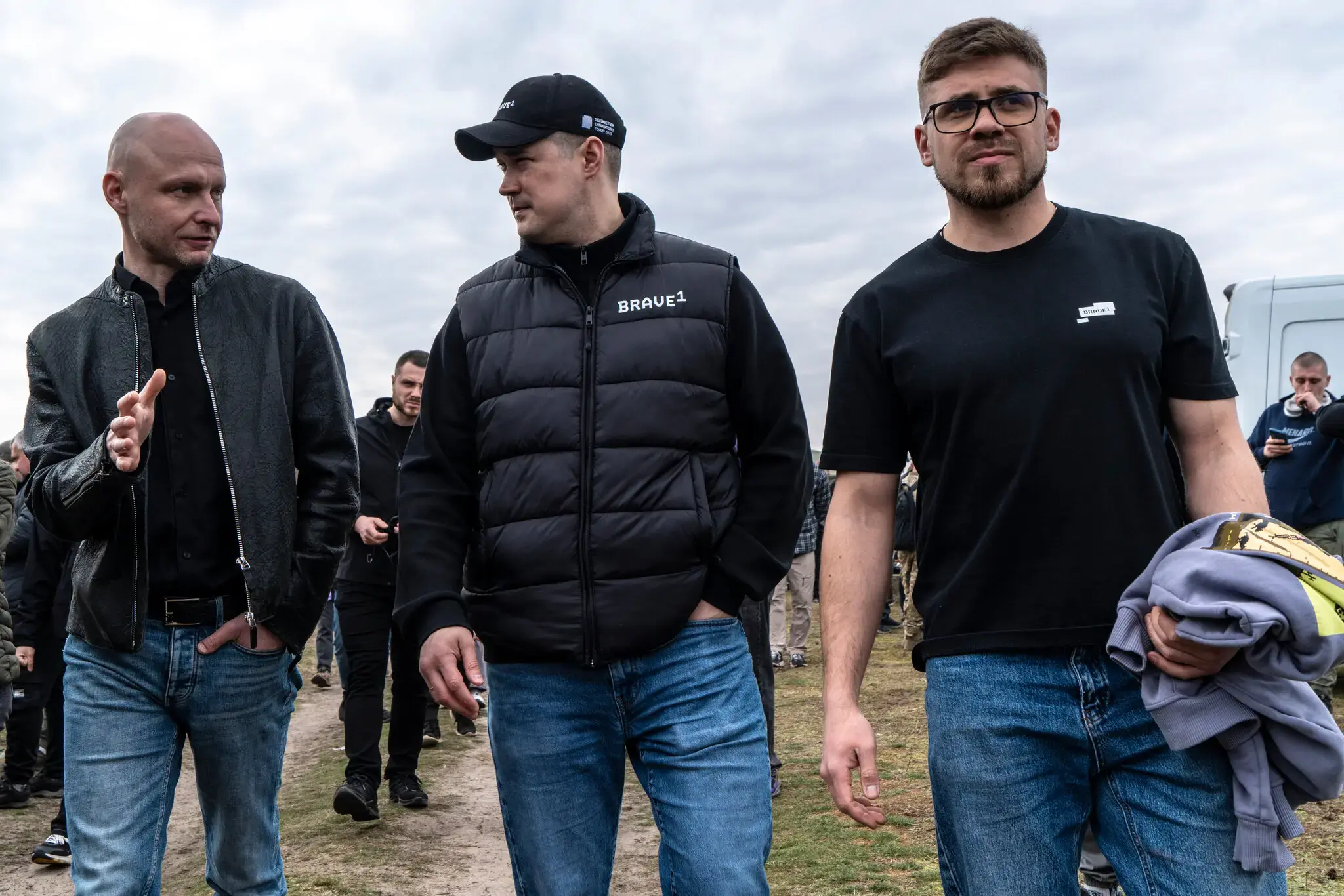
Mykhailo Fedorov with Andrii Hrytseniuk / Photo: Brave1
In the latest Dorozvidka:
- The New York Times on Mykhailo Fedorov and his robot war;
- Tencore CEO Maksym Vasylchenko on the company’s next-generation ground robotic systems and autonomy in ground drones;
- Ukraine’s Defence Forces begin testing airborne evacuation using heavy UAVs;
- “Madyar” on the kill zone and the Drone Line initiative;
- BlueBird Tech’s Chuika drone detector receives a mobile app with offline updates;
- Maria Berlinska on Shtilerman, Fire Point, and arms exports.
The Ukrainian shaping the future of war: New York Times profile of Mykhailo Fedorov
The New York Times writes that the future of warfare is being shaped in Ukraine — and Defence Minister Mykhailo Fedorov is one of its architects.
Fedorov believes warfare is ready for technological transformation. According to him, that means shifting as much combat activity as possible onto machines — including systems that may one day independently make lethal decisions.
“The world needs security, and only autonomous weapons can ensure it,” Fedorov said in an interview with the newspaper. “Autonomous weapons are the new nuclear weapons. Countries that possess them will be protected.”
Tencore CEO Maksym Vasylchenko on the company’s next-generation UGVs and autonomy in ground drones
The first guest of the new Zbroya podcast series on Militarnyi was Maksym Vasylchenko, co-founder and CEO of Tencore — Ukraine’s largest manufacturer of ground robotic systems.
Vasylchenko spoke about the company’s next-generation TerMIT 2.0 ground drone platform, cooperation with state defence companies, procurement and regulatory synchronisation, autonomous solutions for ground robotic systems, and partnerships with foreign firms.
Among the announcements made during the podcast, Vasylchenko revealed that Tencore has increased the engine power of its upgraded TerMIT 2.0 robotic system and is developing a Ukrainian-made electric motor together with another company.
“Our goal was not to copy existing solutions, but to develop our own motors for ground robotic systems that would be more efficient than Chinese ones,” he said.
Vasylchenko also said that the TerMIT 2.0 platform will be equipped with a Ukrainian automatic grenade launcher mounted in a turret system. According to him, Frontline Robotics is currently cooperating with Ukroboronprom to strengthen the firepower capabilities of ground robotic systems.
Ukraine’s Defence Forces testing airborne medical evacuation using heavy UAVs
Ukraine’s Defence Forces have started testing the aerial evacuation of wounded soldiers from the battlefield using heavy UAVs. The development was highlighted in a video published on Telegram by TSN correspondent Yuliia Kyriienko.
The footage shows a heavy multicopter lifting into the air a person simulating a wounded serviceman. This method is being considered as an alternative to ground robotic systems and other evacuation vehicles, which are finding it increasingly difficult to reach the front line because of Russian drone strikes.
“Evacuation by multicopter could radically transform battlefield medical support,” Kyriienko wrote. However, implementing such a concept requires not only highly trained UAV operators, but also protection for the capsule carrying the wounded person during flight.
“Madyar” on the Kill Zone and the Drone Line
Robert Brovdi, widely known by his callsign “Madyar”, is one of the key architects of Ukraine’s drone warfare. Over the past four years, he has gone from founding and commanding one of the country’s most successful UAV units to leading the Armed Forces’ Unmanned Systems Forces.
In an interview with Ukrainska Pravda, Madyar discusses how drones have turned the front line into a continuous kill zone, why Russia is rapidly copying Ukraine’s experience, how the Drone Line initiative works, why a single UAV brigade can “grind down” two Russian brigades within a month, and why the war’s main battle is now being fought not for kilometres of territory, but through the mathematics of losses.
BlueBird Tech’s Chuika drone detector receives mobile app with offline updates
The application allows users to connect the Chuika drone detector to a smartphone, manage devices, and install free updates for one or multiple detectors at once.
The main screen displays all connected devices and enables users to manage them from a single smartphone. One of the key features is the ability to simultaneously update several Chuika detectors even without internet access.
Each device also has a dedicated interface where users can monitor the detector’s operational status and access additional technical information. The app further includes a user manual and a News section covering product updates and newly introduced features.
Maria Berlinska on Shtilerman, Fire Point, and arms exports
Volunteer, founder of the Aerial Reconnaissance Support Centre and the Victory Drones project Maria Berlinska became a guest on Olena Trybushna’s podcast “Ye Pytannia”.
They discussed the possible lobbying activities surrounding Fire Point, the risk of monopoly formation in Ukraine’s arms market, and the story of Fire Point founder Denys Shtilerman.
Other topics covered in the interview included:
- How Ukraine risks losing its global arms export market position;
- Which side currently holds the technological advantage on the battlefield;
- How Ukraine’s Armed Forces plan to disrupt Russian logistics;
- Whether Ukraine could strike Russia’s shadow oil fleet with drones in international waters.
Reading now
1
SkyFall officially unveils Thor Hammer mid-strike and announces 1,000+ km version
2

260+ vacancies in Ukrainian defence technology at BlueBird Tech, Sine Engineering, Buntar Aerospace and more
3
British-Ukrainian Occam Industries raises €3.8m. The funds will go towards scaling drone autonomy software
4
Terra Drone acquires 50% of Ukrainian Kurin Technologies for $3.5 million
5

Autonomous interceptor drones need radars to work. Why is there still a lack of them
By submitting this form, you give Defender Media consent to the processing of personal data.
Надсилаючи цю форму, ви надаєте Defender Media згоду на обробку персональних даних.

Latest news
1
Forbes: Airlogix plans to raise $100m at a $2bn valuation
2
Tencore launches an ecosystem to bring together UGVs and components from several manufacturers
3

Defense companies may see staff deferrals cut from 100% to 85%
4
Japan signs contract with Ukrainian company SkyFall to procure interceptor drones
5