Deftak raises investment for mass production of “smart” drone munitions. Here is startup’s story
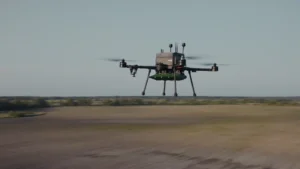
In late 2025, Deftak began testing the munition with “one of the most popular multirotors in Ukraine”

Deftak munition (Photo: Mykhailo Zaitsev)
Ukrainian engineers with experience at Google, Facebook, Megogo, and EPAM have been working on guided drone munitions for several years. The product concept emerged in 2022, and in 2024 the founders registered the company Deftak. The following year, the startup raised investment from Darkstar, and last week from Angel One.
The distinctive feature of the Deftak munition is its ability to strike with precision from high altitudes, keeping the drone itself undetected. It can be mounted on both multirotor and fixed-wing platforms. This potentially allows even a reconnaissance drone to be converted into a strike asset.
Defender Media spoke to Deftak CEO Andrii Romanenko and the company’s investors about the project’s evolution.
A failed trip to Bukovel and a 400,000 UAH hackathon
The Deftak story began in late summer 2022 at the Drone Hackathon 1.0 competition. The company’s founder had little intention of attending, but was inspired by a volunteer friend he had once met on Facebook.
“We were in a group chat, planning a trip to Bukovel. We didn`t make it there, but after the full-scale invasion, we started communicating more closely and sharing information,” Romanenko recalls.
Together, they developed the concept for a bomb within a week, and at the event itself, met two more engineers – and won the hackathon.
The prize was 400,000 UAH, and the team pursued development more actively thereafter. They studied aerodynamics, launched scale models fitted with sensors, and collected data from them to refine the design. Development was funded through grants and the founders’ personal funds. Before a working prototype was achieved, each had invested several tens of thousands of dollars.

The first version of the bomb used GPS for guidance. In early 2024, the first sales and combat deployments began in cooperation with the military. The startup sold several units, carried out several upgrades, and generated 2 million UAH in revenue during 2024, according to YouControl. It then shifted focus, leaving the company with almost no revenue throughout 2025.
What has Deftak moved on to
After several months of operational use, the strike accuracy of GPS-guided munitions began to deteriorate due to electronic warfare. The team therefore intensified its work on computer vision technology, which would allow the Deftak product to guide itself in environments where GPS is unavailable.
In May 2025, venture fund Darkstar invested €600,000 in the startup. Fund co-founder Ragnar Saas wrote at the time that the startup was effectively creating a new niche in the weapons sector: “The electronic warfare realities in Ukraine change every three months. Deftak is an example of a team and product capable of delivering a critical advantage for Ukraine and NATO under such conditions.”
With the investment, the team scaled to around 20 people, the majority of whom are engineers. Development is divided across several departments working on munition guidance, manufacturing, machine vision, electronics, and more.
For developers working on machine vision, the team created a dedicated game for algorithm testing. The system runs the model against a set of 20 or 50 test videos collected at a testing range, and awards points for recognition accuracy, quality, and speed. Scores were accumulated within the system, with results then verified at the range.
In late 2025, the startup began testing the munition with “one of the most popular multirotors in Ukraine and one of the largest units.”
How it works: the munition is attached to a drone, which then flies towards the target at a safe altitude where it is harder to shoot down or jam. As it approaches the target, the pilot activates the munition, selects the target via a dedicated interface, strikes it, and returns. Machine vision technology allows the munition to automatically track the enemy in real time. The target acquisition process is also planned to be automated in future via a dedicated module.
The munition can be mounted on both multirotors and fixed-wing UAVs. This potentially allows even a reconnaissance drone to be converted into a strike asset, enabling engagement of a target immediately upon detection.
The system was developed to be compatible with the majority of UAVs already on the market, says Romanenko. The startup has several completed integrations with multirotors and fixed-wing platforms, with others still in progress.

New munition versions
During Q2 2026, the team is finalising the product and preparing it for mass production. “Right now, mostly everything works smoothly,” says Romanenko. “But occasionally small engineering challenges come up: a connector that is awkward to plug in, an uncomfortable grip, a structural element that wasn’t fully thought through.”
In particular, feedback from the military is divided on size – some want a smaller munition, others a larger one. But rather than changing the dimensions of the current version, the startup will most likely expand the munition line: “We are now compiling a list to prioritise new features – whether that will be a version with a different weight, a different guidance system, with propulsion, a different warhead design, and so on.”
The startup is already working on a laser-guided version of the munition. It is one readiness level behind the machine vision bomb. The technology works by equipping the munition with a sensor that detects laser radiation and steers towards wherever it is directed.

The guidance system was developed by another company, and Deftak is adapting it for its own product. “Getting two systems to work together and organising joint trials is a challenging task, but we are managing it successfully,” says the co-founder.
Laser guidance systems in Ukraine are being developed by, among others, M-Fly. The company previously introduced the RB-220, a multifunctional camera that illuminates targets with a laser at a range of 2–3 km. Manufacturers from FRDM Group have also introduced their R-34-T UAV, which primarily serves as a laser target designator.
The startup is only beginning to generate revenue
According to the source, there are currently three or four competing companies in Ukraine that have also reached combat trials. If manufacturers of “smart” munitions with lower TRLs are included, the number rises to around 10.
In 2024, Ihor Fedirko, CEO of the Ukrainian Council of Defence Industry, said that almost all drone and UAV munition manufacturers were actively working on guided munitions. Guidance technologies in use include optical, laser, thermal imaging, fibre-optic data links, wire-guided, GPS, and combined systems.
Abroad, guided munitions are produced by Turkish company Roketsan – the munitions with which the Bayraktar UAV is equipped. American company Northrop Grumman has also introduced its Hatchet, a bomb that attaches to UAVs and uses GPS/INS guidance at the mid-course stage and semi-active laser guidance in the terminal phase.
Another American company, Aeon, has already partnered with a Ukrainian UAV manufacturer and is integrating its Zeus guided rocket into the latter’s multirotors. The competitive disadvantage of Western systems is traditionally their price. Zeus costs $50,000, while Roketsan’s MAM-L bombs are priced at $60,000–100,000.
The price of the Deftak munition is in line with the average price of an FPV drone, says Romanenko – typically $400–600. The company continues to be funded through investment and grants, and is gradually growing sales through test batches.
In late April 2026, the company raised another investment round, this time from venture fund Angel One. Managing partner Ivan Petrenko says it was not simply the technology that caught their attention, but the approach to the problem.
“Deftak effectively removes one of the key bottlenecks of modern warfare – the time and complexity between target detection and engagement. This is not about a “better weapon”, but about changing the logic of how existing platforms are used,” Petrenko adds.
The fund says that today, the solutions which prevail are those that operate under EW conditions, do not depend on infrastructure such as GPS or communications, and scale through integration with mass-market platforms. Deftak, in turn, meets all three criteria.
“In short, this is not a niche solution, but part of a new standard for what modern warfare will look like,” the investor concludes.
Deftak has also established a legal entity in Estonia to simplify working with foreign partners, investors, and potential clients. The company is also exploring civilian applications – for example, precision firefighting through the aerial delivery of specialist agents from a drone.
Reading now
1
Ukrainian Skyeton secures $10.6M US army contract
2
SkyFall officially unveils Thor Hammer mid-strike and announces 1,000+ km version
3
Pentagon to hold Drone Dominance trials for bomber drones, with UFORCE, Gurzuf Defence, Grim Tech and others taking part
4

Frontline Robotics CBDO Mykyta Rozhkov: Ukraine and Norway are working on an autonomous system to protect maritime infrastructure
5
Terra Drone acquires 50% of Ukrainian Kurin Technologies for $3.5 million
By submitting this form, you give Defender Media consent to the processing of personal data.
Надсилаючи цю форму, ви надаєте Defender Media згоду на обробку персональних даних.

Latest news
1

120+ vacancies in Ukrainian defence tech companies: Osavul, M-Fly, Occam Industries and more
2

Tencore CEO Maksym Vasylchenko to head the board of Ukrainian Council of Defence Industry, replacing Oleksandr Kamyshin
3
THOR’S HAVEN presents mobile modules for command and medical posts on the front line
4

Lithuania deploys Ukrainian SkyFortress air target detection system
5