Dorozvidka #52: Ukraine and the Middle East, Magura and NATO, plus Boyle, Vandier, Biletskyi, Hryshyn, Berezhnyi and Yarmak
What other media covered on Ukrainian defence tech last week

Carrier drone Sparta. Source: Quantum Systems
Dorozvidka is a weekly digest of the most notable coverage on Ukrainian and global defence tech. In issue #52:
- First interceptions of Shahed drones by Ukrainian interceptor drones in the Middle East;
- Ukrainian Magura V7 naval drones by UForce “sink” a NATO frigate during exercises;
- A column by MITS Capital CEO Perry Boyle on Ukraine’s defence tech window of opportunity;
- An interview with 3rd Army Corps commander Andrii Biletskyi on the role of ground robots;
- A video podcast featuring Oleksandr Yarmak, company commander in the 412th NEMESIS brigade;
- A long-read interview with Quantum Systems Ukraine managing director Oleksandr Berezhnyi.
Ukrainian Magura V7 naval drones “sink” NATO frigate during exercises
A multinational naval group led by the Ukrainian Navy used Magura V7 USVs during the NATO REPMUS/Dynamic Messenger 2025 exercises to “sink” at least one Alliance frigate, according to F.A.Z. A Ukrainian participant told the outlet that five scenarios conducted in September 2025 off the coast of Portugal included port defence, convoy escort, and attacks on those convoys.
In all five scenarios, the “red” team defeated the “blue” NATO forces. They used several versions of Ukrainian Magura V7 drones, including one equipped with reconnaissance payloads and an explosive charge, and another fitted with a machine gun. Other participating countries also deployed unmanned surface vessels.
The exercises showed that unmanned systems, combined with combat experience and planning, pose a “real threat” to NATO navies — largely because the Alliance is not yet sufficiently prepared for such attacks.
What’s new at Quantum Systems
Militarnyi published a wide-ranging interview with Oleksandr Berezhnyi, managing director of Quantum Systems in Ukraine. He spoke about localisation in Ukraine, the global impact of Ukrainian developments, the evolution of the Vector UAV, timelines for Twister deployment, the status of the Sparta carrier drone, and cooperation with Frontline. The company is currently developing three versions of the Sparta carrier: Sparta ASR, Sparta Light and Sparta Heavy.
Quantum Systems has also developed a Shahed-like decoy UAV, RAT, for training interceptor drone crews. In parallel, the team is working on a loitering munition version based on the same platform.
Ukrainian specialists and interceptor drones in the Middle East
On 17 March, President Volodymyr Zelensky said Ukraine had deployed 228 specialists to counter Shahed drones in Qatar, the UAE, Saudi Arabia, Kuwait and Jordan, in an address to the UK Parliament, as cited by RBC.
On 21 March, BBC News Ukraine reported, citing its own sources, that Ukrainian specialists deployed in the Middle East have already downed several Iranian Shahed drones using interceptor UAVs in one of the countries in the region. Drone manufacturers told the outlet they had already received dozens of commercial inquiries from Gulf and Middle Eastern countries and intermediaries, all interested in purchasing tens of thousands of Ukrainian interceptors — often at higher prices than on the domestic market.
At least two major interceptor drone manufacturers have already submitted export applications to the interagency commission on military-technical cooperation and export control.
Perry Boyle on Ukraine’s defence tech window of opportunity
Historically, Ukraine was among the world’s major arms exporters but had virtually no private defence sector before 2022. In a Forbes column, MITS Capital co-founder and CEO Perry Boyle argues that regulating a new market with old rules risks losing everything.
He notes that 70% of Shahed drones over Kyiv are already being downed by low-cost interceptor UAVs — a capability that could underpin a new tech sector. Since 2022, a powerful private defence tech ecosystem has emerged, with billion-dollar potential and global demand. But the risk remains: the market still operates under outdated rules.
Biletskyi: ground robots could replace a third of Ukraine’s infantry
Andrii Biletskyi, commander of the 3rd Army Corps, told TSN that ground robotic systems could replace up to a third of Ukrainian infantry on the front line, potentially reaching 80% in the future.
Exporting security, not hardware: Ukraine’s real advantage
In a blog on Militarnyi, General Cherry founder Yaroslav Hryshyn argues that the effectiveness of drones depends not only on technology, but on people, tactics and real combat experience. Ukraine’s key export potential, therefore, lies not in hardware but in knowledge and expertise gained on the battlefield.
Yarmak — the rapper shooting down Shaheds
Oleksandr Yarmak, a company commander in the 412th NEMESIS brigade, featured in the latest Dignitas podcast. Topics included:
- Why human operators remain central in a “war of robots”;
- Whether robots can fully replace humans on the battlefield;
- How five FPV drones can stop 30 assault troops;
- How individuals can help make the next winter easier.
NATO Supreme Allied Commander meets Ukrainian manufacturers
This week, the state-backed cluster Brave1 brought together Ukrainian defence innovators for a meeting with Admiral Pierre Vandier, one of NATO’s key commanders responsible for the development of future capabilities. Representatives from Skyeton, Airlogix, SkyFall, Tencore, Ratel, December1, Farsight Vision and Fire Point attended.
Reading now
1
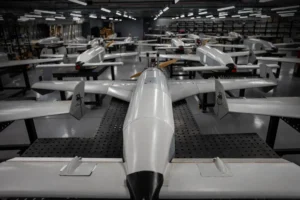
SkyFall officially unveils Thor Hammer mid-strike and announces 1,000+ km version
2

260+ vacancies in Ukrainian defence technology at BlueBird Tech, Sine Engineering, Buntar Aerospace and more
3
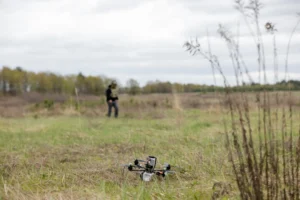
British-Ukrainian Occam Industries raises €3.8m. The funds will go towards scaling drone autonomy software
4
Terra Drone acquires 50% of Ukrainian Kurin Technologies for $3.5 million
5

Autonomous interceptor drones need radars to work. Why is there still a lack of them
By submitting this form, you give Defender Media consent to the processing of personal data.
Надсилаючи цю форму, ви надаєте Defender Media згоду на обробку персональних даних.

Latest news
1
Forbes: Airlogix plans to raise $100m at a $2bn valuation
2
Tencore launches an ecosystem to bring together UGVs and components from several manufacturers
3

Defense companies may see staff deferrals cut from 100% to 85%
4
Japan signs contract with Ukrainian company SkyFall to procure interceptor drones
5