Dorozvidka #39: Fire Point, HIMERA, Ukrainian Armor, Hryshyn, Zelensky, and Khrapchynsky
Pre-Christmas roundup of notable publications about Ukrainian defence tech

Фото з заводу Fire Point, де виробляються ракети FP-5 "Фламінго". Джерело: Moose Campbell/BBC
The lion’s share of mentions in coverage of Ukrainian defence tech over the past week went to two companies:
- Fire Point, which once again allowed journalists into its production facilities and shared details of its story;
- HIMERA, which raised $2.5 million in investment.
We review the most interesting of these publications in the new issue of Dorozvidka, together with a column by Stanislav Hryshyn, co-founder of General Cherry, an interview with Vladyslav Belbas, CEO of Ukrainian Armor, and insights from well-known defence tech expert Anatolii Khrapchynskyi.
Ukraine and Portugal to jointly produce maritime drones
On 20 December, Ukraine and Portugal signed an agreement establishing a strategic partnership in the production of maritime unmanned systems. This was announced on 20 December by President of Ukraine Volodymyr Zelenskyy, who signed the relevant documents together with Portuguese Prime Minister Luís Montenegro during his first official visit to Kyiv.
The parties have not disclosed details of the agreement. It is likely to involve localisation of Ukrainian maritime drone production in Portugal for the needs of Ukraine and the Portuguese Navy.
Why data is becoming a weapon — a column by Stanislav Hryshyn of General Cherry
“A quiet but fundamental rethinking of what combat effectiveness means is taking place within Ukraine’s Security and Defence Forces. At the centre of this transformation is operational data — specifically the speed of its delivery, its objectivity, and the ability to turn it into decisions,” writes Stanislav Hryshyn, co-founder of drone manufacturer General Cherry, in his column for Militarnyi.
In his view, one of the clearest examples of this revolution is the motivation system for Ukrainian servicemen informally known as “E-points”. Hryshyn argues that this marks the beginning of a new game with its own rules and players — one that combines the speed of small teams with the resources of a large structure and the ability to leverage business-style potential.
Interview with Ukrainian Armor CEO Vladyslav Belbas
Censor.NET spoke with Vladyslav Belbas, CEO of Ukrainian Armor, about challenges in the defence industrial base, market competition, export prospects, and why low-cost battlefield-proven military engineering solutions have turned out to be more effective than Western developments that absorbed trillions of dollars in investment. Among other topics, they discussed the Protector UGV with its integrated remotely operated combat module Tavriia-12.7.

“Our system offers a one-tonne payload capacity, which makes it quite unique — almost the only one in its category. One of the Protector’s tasks may be to deliver other, smaller UGVs closer to the line of contact to carry out specialised missions. In addition, it can be equipped with counter-UAV laser systems, remotely operated machine-gun modules, or other unmanned systems such as interceptors,” Belbas said.
Fire Point again: new articles and production photos
Fire Point once again opened its production facilities to several journalists, who also spoke with the company’s management:

A new ZBROYA episode on communications
The latest episode of the video project Zbroya, produced by Militarnyi in cooperation with the Ukrainian Council of Gunsmiths, focuses on how communications are organised on the Ukrainian battlefield, the current challenges in this area, and the role of Ukrainian radios produced by HIMERA. In the studio: Misha Rudominski, co-founder of HIMERA and board member of the Techosystem Defense association.
Anatolii Khrapchynskyi on Channel 24
Anatolii Khrapchynskyi, business development director at a defence enterprise and reserve Air Force officer, has no illusions about 2026. In his view, the year will mark a stage when Russian strike drones and missiles finally evolve from “isolated threats” into elements of a large-scale networked war, while Europe continues to lag behind in forming a coordinated response.
“Russia already lives in a state of war as a norm. The question for us is whether we will manage to shift into the same mode before it uses its weapons stockpiles — not only against Ukraine,” Khrapchynskyi says. In his interview with Channel 24, the expert discussed how Russian weapons are being modernised and increasingly aimed not only at Ukraine, but at Europe as well.
Reading now
1

260+ vacancies in Ukrainian defence technology at BlueBird Tech, Sine Engineering, Buntar Aerospace and more
2
Forbes: Airlogix plans to raise $100m at a $2bn valuation
3
US Buys 1,320 more FPV drones from Ukraine’s F-Drones for $6.5M
4
Japan signs contract with Ukrainian company SkyFall to procure interceptor drones
5
Phantom Defense provided EW systems for UAV tests under Drone Dominance
By submitting this form, you give Defender Media consent to the processing of personal data.
Надсилаючи цю форму, ви надаєте Defender Media згоду на обробку персональних даних.

Latest news
1
General Cherry says it cannot deliver drones under the tenders it has won. What is the DPA’s response
2
Quantum Tencore Industries plans to produce first TerMIT UGVs in Germany by end of 2026
3
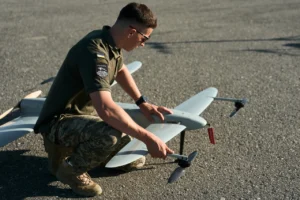
ANT upgrades Mercury reconnaissance UAV system: flight time increased to five hours
4
DevDroid and Norway’s Inission Norge AS to cooperate on the production of UGV remote control systems
5