Black Mirror #33. The new Herbera, Archangels in the Kursk region, Knyaz Veshchiy Oleg and other novelties of Russian miltech
Overview of Russian military technology developments for the second week of November

The Russian Knyaz Veshchiy Oleg drone
The Russians are beginning to use a new fibre-optic reconnaissance drone, Knyaz Veshchiy Oleg, testing the Posokh laser installation designed to hunt Ukrainian deepstrikes, equipping UGVs with flamethrowers, and fitting Gerbera drones with delayed-action detonators. These and other new developments in Russian miltech are covered in Defender Media’s weekly review.
The reconnaissance drone Knyaz Veshchiy Oleg is already on the frontline
Russian sources report the frontline deployment of a new fibre-optic UAV, the Knyaz Veshchiy Oleg”. The drone is said to have a reconnaissance range of up to 45 km and resembles Ukrainian equivalents in appearance — a feature which, according to the manufacturer, increases its survivability in the air.
Alexei Chadayev, director of the Ushkuyinik Research and Production Centre, stated that the system was designed as a more affordable alternative to the more expensive reconnaissance UAVs used by the Russian army. He claims the aircraft has already been used over Sumy and Kharkiv, and that damaged components can be 3D-printed in the field.
The drone is integrated with another product developed by the centre — the FPV aircraft Knyaz Vandal Novgorodsky. The operator of the strike drone can receive imagery not only from their own camera but also from the Veshchiy Oleg, providing additional reconnaissance data for target acquisition. The centre says the new UAV is intended to replace commercial drones such as Mavics in long-range reconnaissance at distances of 30–40 km.
In early November, soldiers of the 63rd Separate Mechanised Brigade of the Ukrainian Armed Forces reported the first downing of the Knyaz Veshchiy Oleg.
Russia increases deliveries of Strelets drone-interceptors
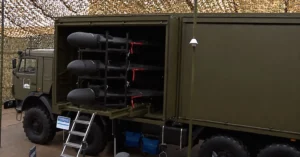
Russia expects deliveries of Strelets interceptors equipped with five 12-gauge barrels. These systems are intended to destroy small airborne targets, including FPV drones.
The developer is listed as Orda-Pilot. The company claims the system can engage up to five targets in a single sortie. It utilises machine vision, enabling automatic detection, targeting, and firing at drones without requiring continuous operator involvement. In the latest version of the Strelets, the plastic barrels have been replaced with metal ones, allowing shots to be fired without damaging the barrel.
The UAV’s cruising speed is stated as 120 km/h, with a flight range of up to 7 km. Its effective engagement radius is 5–15 metres.
Field kits for assembling heavy UAVs from plywood frames
Due to a shortage of heavy strike drones, Russian volunteer and commercial groups have begun promoting a DIY approach: large plywood frames built for 2–4 FPV aircraft with 10-inch propellers. These products are presented as a base for constructing a heavy UAV capable of performing combat or logistical tasks.

Popular models include the Vobla, Teshcha and Driada. The idea is that soldiers can quickly assemble a heavy drone from available FPV components without waiting for mass production of industrial models. The payload capacity is claimed to be 7–15 kg. The frames are sold through a specialised website, fpv-frame.ru.
Russia tests the Arkhangel interceptor drone in the Kursk region
Russian sources have reported tests of the Arkhangel interceptor system in the border region of Kursk. The project is being implemented by the Kalashnikov Concern, and project lead Mikhail Filippov claims the interceptor can reach speeds of up to 360 km/h and has an operational radius of up to 50 km.

According to the media, the Arkhangel has also been tested in Crimea, where it demonstrated a top speed of around 340 km/h. The drone can be launched from the ground or from an aircraft, and its warhead options range from 700 grams to 7 kg, depending on purpose. Developers claim that the Arkhangel is compatible with existing radar systems; during tests in Crimea, no radar modifications were required — the drone operated with the standard detection network.
Despite the stated specifications, sources caution that information about the Arkhangel comes mainly from developer and volunteer claims, and there is no independently verified confirmation of all parameters.
TOS-1A Solntsepyok systems upgraded with anti-drone protection
The Uralvagonzavod Concern has announced the delivery of a new batch of TOS-1A Solntsepyok heavy flamethrower systems. The report states that the vehicles have been equipped with an upgraded anti-drone suite. The developer states that the machines have undergone a range of tests under various conditions before being cleared for operational use. In addition, the flamethrowers are being modernised on the T-80 tank chassis, which is expected to provide greater range, improved accuracy and more automation of key processes.
Unboxing the upgraded Gerbera with warhead and UZ-2 detonation mechanism
Ukrainian analyst Serhii “Flesh” Beskrestnov has dismantled and examined the updated Gerbera variant. He identified an OFBCh-2 fragmentation-high-explosive warhead and a UZ-2 detonator. According to his description, a signal from the flight controller is sent to a relay that arms the detonator under a specific criterion — likely altitude.
This signal does not detonate the warhead but simply arms the detonator. Upon impact with the ground, it triggers automatically. Moreover, if the drone lands gently, the detonator may not activate but will remain armed, posing a lethal hazard.
Posokh laser complex demonstrates 0.25-second FPV interception
Russian Telegram channels have published footage of the Posokh combat laser system in operation. It is claimed that the installation, equipped with gearless drives and an automated turret, destroyed an FPV drone in under 0.25 seconds during range tests.
According to Russian MP Alexei Zhuravlyov, the Posokh can destroy UAVs at a distance of 1.5–2 km. In June 2025, the system underwent trials at a range in the temporarily occupied part of Kherson region, where, according to the developers, the laser “burned” both FPV drones and their batteries and motors.
The laser’s power has not been disclosed, but authors speculate it may be 5–7 kW. It is also reported that the system can damage the airframe skin of the “Liutyi” UAV within seconds.
Russia showcases the Su-57 with Kh-58USHK anti-radiation missiles ahead of Dubai Airshow 2025
During preparations for the Dubai Airshow 2025, a Su-57 fighter jet was spotted carrying mock-ups of Kh-58USHK anti-radiation missiles capable of reaching speeds of up to Mach 4. Sources note that the missile has a range of up to 250 km and may be upgraded into an aeroballistic variant with a 300–350 km range.
During the demonstration flight, the aircraft showcased its forward internal weapons bay with open doors for the first time, revealing space for two R-77M air-to-air missiles with a range of 160–190 km, or two R-37M missiles with an effective range of 230–250 km, or two low-observable Kh-69 long-range tactical cruise missiles.
On the external hardpoints beneath the leading-edge extensions at the wing roots, mock-ups of highly manoeuvrable short-range R-74M2 air-to-air missiles were mounted as demonstrators.
In total, Russia will exhibit around 30 of its aviation developments at the Dubai show.
The Kurjer RCV tested on the frontline in flamethrower configuration
The KB Kulibin-group design bureau has begun trials of a new version of the Kurjer robotic platform in the combat zone. This is a tracked, remotely operated vehicle now equipped with a pack of Shmel infantry flamethrowers, turning it into a miniature analogue of a heavy flamethrower system. According to Russian sources, the Kurjer can also be fitted with grenade-launcher or machine-gun modules, reaches speeds of up to 25 km/h, and is already being delivered to the frontline in small batches.
In October 2025, the first Kurjer was destroyed near Pokrovsk: the robot had a tracked chassis, electric motors, an AGS-17 automatic grenade launcher, and remote control via a radio channel with a 3–10 km range.
Reading now
1

260+ vacancies in Ukrainian defence technology at BlueBird Tech, Sine Engineering, Buntar Aerospace and more
2
Buntar Aerospace raises $16M to scale up and enter foreign markets
3

6,000 lives saved by replacing people with robots. “Makar” on the ground strike drone unit NC13 and its role in Operation Vivaldi
4
Forbes: Airlogix plans to raise $100m at a $2bn valuation
5
Ratel Robotics and General Dynamics Mission Systems to jointly produce UGVs for Ukraine in Canada
By submitting this form, you give Defender Media consent to the processing of personal data.
Надсилаючи цю форму, ви надаєте Defender Media згоду на обробку персональних даних.

Latest news
1
Ukrainian anti-drone manufacturer December1 to set up joint venture with Lithuania’s Pekkla
2

A new Ukrainian fund, WildField Ventures, plans to invest $10-15 million in 20 dual-use startups. What areas is it interested in
3
Ukrainian amphibious UGV Tonі can carry up to 380 kg
4
389 foreign manufacturers have applied for access to TrophyLab platform for studying captured weapons
5