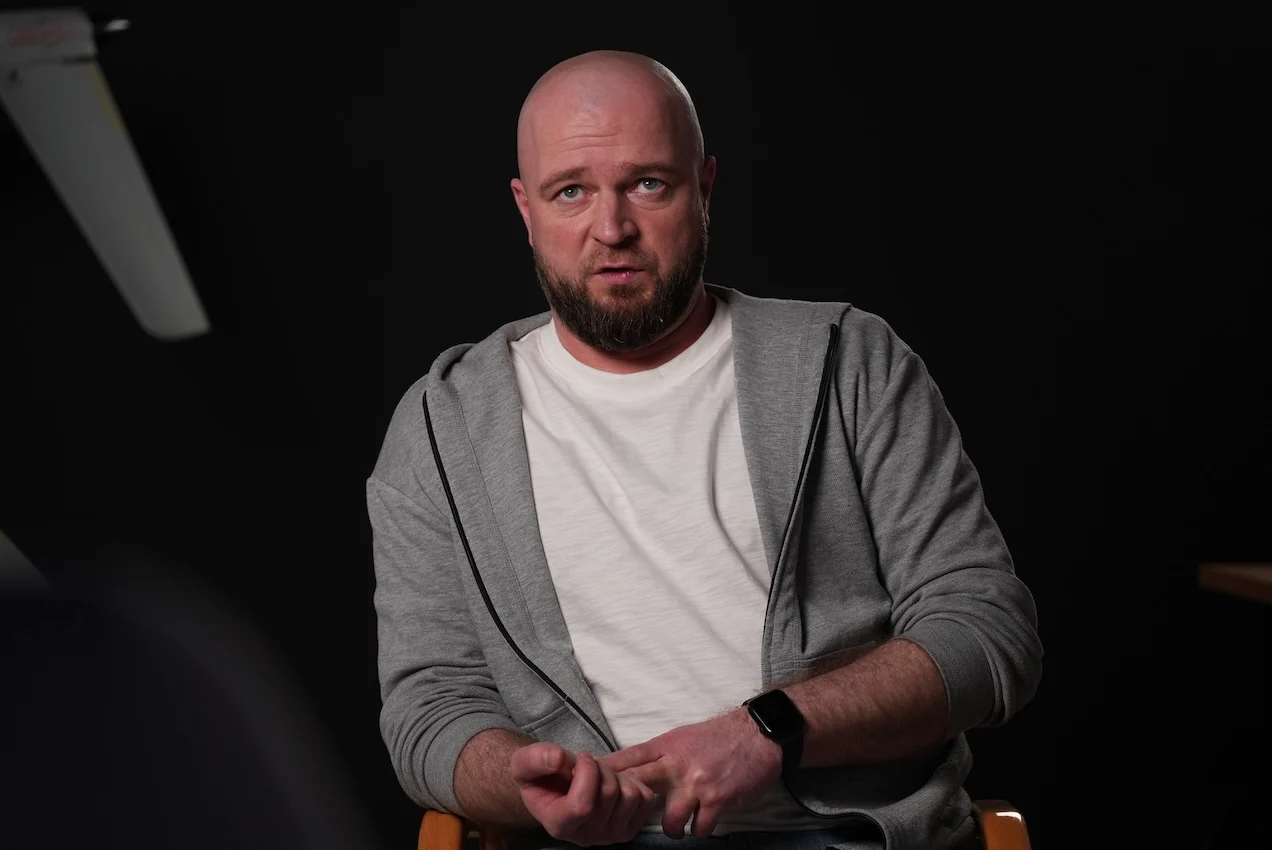
Ukrainian and European defence tech through the eyes of an Austrian at the London forum
Robert Schuett on how to bridge the gap between Ukrainian and European defence tech

Ukraine’s wartime tech acceleration meets Europe’s defence innovation inertia. Renowned Austrian political scientist and defence expert Robert Schuett, who recently participated in the UK-UA Defence Tech Forum, shared his thoughts with Defender Media columnist Viktor Kharyton on how to bridge the gap between Ukrainian and European defence tech—and what specific steps should be taken to get started.
The UK-UA Defence Tech Forum was recently held in London’s Royal United Services Institute (RUSI) with the official support of the Embassy of Ukraine in the United Kingdom. This forum marked the third in a series of conferences aimed at strengthening cooperation between Ukrainian, British, and international defence companies, as well as venture investors. The goal is to expand production and accelerate R&D to implement innovations.
Forum participants discussed how to accelerate technology adoption, the role of venture capital in scaling defence solutions, and deepening tech collaboration between the UK and Ukraine. Over twenty Ukrainian startups displayed cutting-edge technologies — from drone swarms and robotic systems to electronic warfare and AI-driven battlefield tools — clearly reflecting frontline-driven innovation.
Among the participants was Dr. Robert Schuett — a prominent Austrian political scientist and senior security advisor with a distinguished record of service in the Austrian Ministry of Defence, the Ministry of the Interior, and the Office of the President of the Republic of Austria. Dr. Schuett currently chairs the Austrian Political Science Association and is a long-standing Honorary Fellow at the University of Durham.
Dr. Schuett shared his insights from the forum and personal reflections on defence cooperation between Ukraine and its Western partners with Defender Media columnist Viktor Kharyton.
It is a new reality. And most of Europe is not ready for it
Few soldiers or analysts would dispute that on Ukraine’s frontlines, new technologies are designed, tested, and deployed in weeks, sometimes days and hours. This pace of innovation is almost unthinkable elsewhere, not just because of its speed, but because it emerges from the harsh necessity of war. Ukraine is not just defending its sovereignty. It is building a defense-tech ecosystem defined by bottom-up iteration, ruthless pragmatism, and battlefield-driven feedback loops.
This has redefined what military relevance looks like. As General Valerii Zaluzhnyi, Ukraine’s former Commander-in-Chief, now serving as Ambassador of Ukraine to the UK, put it: “Ukraine is no longer a passive recipient of international aid. It is a strategic contributor. The country is exporting not only battlefield-proven hardware, but operational knowledge, tactics, and innovations with real relevance across NATO. Ukraine is not just holding the line against a revisionist power. It is shaping the next generation of European security.”
The rest of Europe has yet to fully internalize what Ukraine is learning the hard way. Military power is no longer about scale and legacy platforms. It is about adaptability. Traditional hard power — tanks, jets, ships — is being outpaced by smaller, smarter systems. Drones are eliminating soldiers with centimeter precision. Electronic warfare is deployed at platoon scale. AI-enhanced targeting and sensor fusion are emerging faster than any centralized doctrine can keep up with. Commanders no longer wait for new manuals. They iterate live in combat.
This is not a theory. It is a new reality. And most of Europe is not ready for it.
Faced with existential threat, Ukraine has embraced a brutal imperative: “what works stays, what doesn’t goes.” There is no time for overregulation, no space for inertia. Meanwhile, European defense programs continue to operate on multi-year timelines, paralyzed by bureaucracy and risk aversion. The Ukrainian battlefield is showing, daily, that effectiveness is measured not by platform prestige, but by integration speed, sensor-network density, and the ability to re-task assets on the fly.
Many NATO procurement offices treat Ukraine as a junior partner, if not a liability, despite its real-time, frontline innovation advantage.
This should be a wake-up call. Much of Europe’s existing inventory has declining relevance under modern conditions. What matters now is connectivity, modularity, and software-defined capabilities that can evolve mid-conflict. The war has rewritten the playbook. But Europe still acts as if the old one applies.
Worse, structural and cultural barriers persist. Ukrainian systems, even after combat validation, face skepticism and roadblocks across NATO. Licensing delays, certification bottlenecks, and a deep-seated bias in favor of U.S. or Western European platforms continue to block Ukrainian tech from serious adoption. Many NATO procurement offices treat Ukraine as a junior partner, if not a liability, despite its real-time, frontline innovation advantage.
Legal frameworks exacerbate the problem. Export controls, liability questions, and lack of standardized NATO certifications stifle adoption and scale. Europe has no equivalent of the U.S. Defense Innovation Unit (DIU), no fast-track model to integrate wartime technology into procurement pipelines. Nor has it treated Ukraine as an R&D peer. The result is a missed opportunity to break free from reliance on slow-moving primes and build a more resilient, adaptive defense ecosystem.
This is not merely a procurement issue. It is a failure of imagination. The decisive factor in future wars will not be spending, but speed. The side with the tightest feedback loops, the fastest ability to learn, iterate, and redeploy, will win. On that front, Ukraine is ahead. Europe must catch up.

At the same time, those operating out of Ukraine — no matter how capable or battle-proven — must come to terms with a hard truth: they cannot bypass entrenched strategic interests and defense cultures in Europe’s major capitals. Politics and business practices do not change overnight in places as diverse as Portugal to Poland, Ireland to Italy — let alone in Paris or Berlin. What’s needed is a mutual understanding of where everyone stands, and an unrelenting focus on a shared objective: to make Europe secure, as fast as possible.
Supporting Ukraine, then, is not enough. Europe must learn with and from it. That means designing interoperability from the outset, co-developing systems that can operate seamlessly across NATO and Ukrainian forces. It means building procurement pipelines that can test and scale Ukrainian innovations quickly, rather than burying them under layers of red tape. It also means treating Ukraine as a co-laboratory for defense development, not as a case study to be analyzed after the fact.
There are encouraging signs. Poland, the Baltics, and parts of the UK are showing openness to Ukrainian tech and doctrine. But these are still outliers. The EU as a whole continues to treat Ukraine as a recipient, not a partner. That must change.
It also requires a cultural reset; and it is surprising — if not also shocking or even tragic — just how deep the biases and misunderstandings run between supposed partners. Ukraine is not a charity case. It is a crucible of next-generation military thinking. In swarm tactics, rapid electronic warfare deployment, and data-driven decision-making, it is leading, not lagging, many NATO members. Europe must stop looking down and start looking across.
The war has also obliterated the old civilian-military divide. Ukraine has built flexible networks that fuse startup talent, diaspora expertise, and informal innovation channels. Europe should learn from that playbook, not dismiss it.
Because if Europe fails to integrate these lessons, it will not only risk marginalizing Ukraine. It will marginalize itself. Strategic relevance today is not measured by parade-ground hardware or spreadsheet budgets. It is measured by the capacity to adapt under fire.
On that metric, Ukraine is in the lead. The rest of Europe must move faster — and only if both sides are willing to see themselves, and act, as one political, security, industrial, and defense-tech sphere, united in good faith, will Europe be able to navigate the slaughter of Ukraine and whatever comes next.
There Are Action Points for Both Sides
What should be the practical roadmap:
Step 1: Cultural Recognition: NATO and European nations must actively recognize Ukraine’s status as a peer in innovation, not merely an aid recipient.
Step 2: Rapid Integration: Develop agile regulatory frameworks to accelerate the adoption and certification of battlefield-proven Ukrainian technologies.
Step 3: Structural Reform: Learn from Ukraine’s dynamic innovation processes by embracing rapid iteration, real-time feedback, and adaptability in European defence institutions.
Step 4: Collaborative Innovation: Foster direct, collaborative R&D partnerships between European entities and Ukrainian innovators, ensuring interoperability and rapid deployment.
The 3rd UK-UA Defence Tech Forum was not merely a gathering — it was a crucial moment of reflection and potential transformation. Europe’s future security and strategic relevance depend significantly on its ability to rapidly embrace lessons learned on the Ukrainian frontline.
Adaptability under pressure is now the ultimate measure of strategic capability. Ukraine stands at the forefront of this shift.
Europe must swiftly follow suit.

Dr. Robert Schuett
Dr. Robert Schuett is the Chairman of the Austrian Political Science Association (ÖGPW) and has over 20 years of experience in academia and government, specializing in national security and foreign affairs. Dr. Schuett has served in the Austrian Ministry of Defence, the Ministry of the Interior, and the Office of the President of the Republic of Austria and is the author of several works on international relations and political realism.

Viktor Kharyton
Viktor Kharyton is a columnist at Defender Media, who writes about Ukrainian defence tech at the intersection with European and international affairs, strategic communications and AI. Viktor consults for organizations spanning defence and security, energy, agriculture, and healthcare sectors.
Reading now
1
SkyFall officially unveils Thor Hammer mid-strike and announces 1,000+ km version
2
Pentagon to hold Drone Dominance trials for bomber drones, with UFORCE, Gurzuf Defence, Grim Tech and others taking part
3

Terra Drone acquires 50% of Ukrainian Kurin Technologies for $3.5 million
4
British-Ukrainian Occam Industries raises €3.8m. The funds will go towards scaling drone autonomy software
5

Frontline Robotics CBDO Mykyta Rozhkov: Ukraine and Norway are working on an autonomous system to protect maritime infrastructure
By submitting this form, you give Defender Media consent to the processing of personal data.
Надсилаючи цю форму, ви надаєте Defender Media згоду на обробку персональних даних.

Latest insights
1
Everything about the RAM-2X mid-strike drone: interview with Ukrspecsystems deputy director Andrii Rymaruk
2

A demo is not demand: How to prove the value of a defence tech product. Column by Tekever Ukraine Director Kateryna Bezsudna
3
How to choose the right video link for an FPV drone: analogue, digital, or fibre-optic?
4

How a frontline signal becomes an engineering task. A column by Defence Builder Accelerator Director Yana Shkvarovska
5