Ukrainian defence tech innovators tap into western dual-use markets
Key takeaways from the Dual-Use Invest Demo Day in Kyiv

In March 2025, Kyiv hosted the Dual-Use Invest Demo Day co-organised by the Ukrainian Startup Fund (USF) and the government-backed Brave1 defence tech cluster. The goal: to attract Western capital and partnerships for Ukraine’s “dual-use” tech — solutions battle-tested on the frontlines and now poised for public markets. At this first-of-its-kind event, nine Ukrainian startups pitched innovations with both civilian and military applications. Representatives from Avellum, Rovertech, D3, and Green Flag wrapped up the event with a panel discussion on dual-use definition, opportunities, and the potential for Ukrainian innovations in this sector. Defender presents the key takeaways.
Startups bridging civilian and military
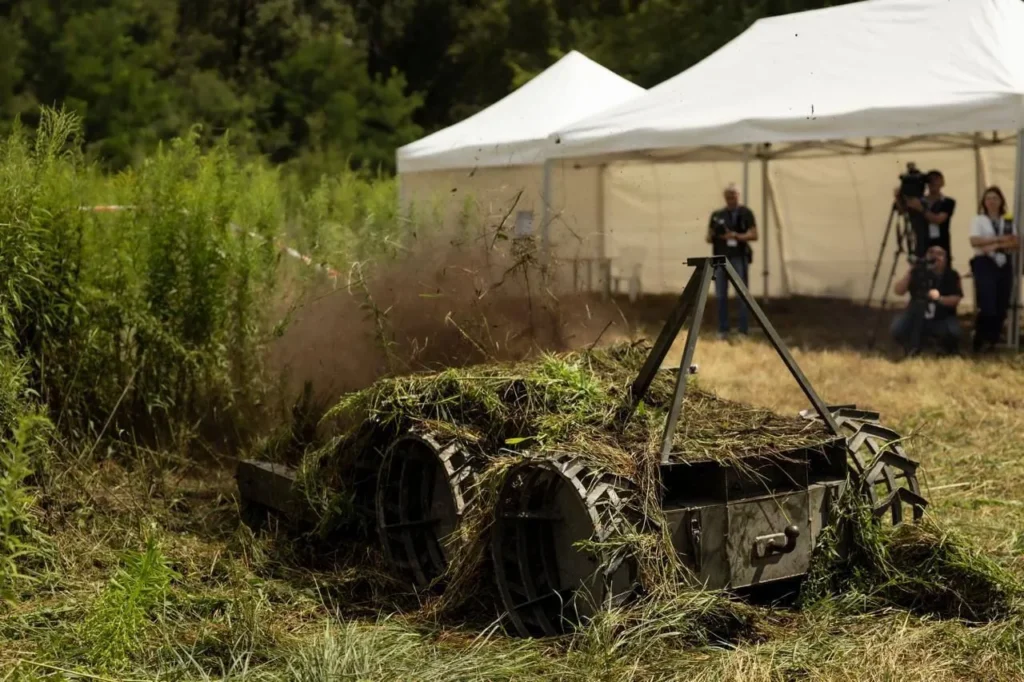
Among the most promising vectors of Ukrainian dual-use tech development are unmanned ground vehicles designed to “sniff out” and clear landmines. Ukraine’s territory is now one of the most mined in the world, and these rovers have been saving soldiers’ lives by performing dangerous clearance tasks remotely. But its value isn’t confined to the battlefield. With an estimated 174,000 square kilometres of Ukrainian land contaminated with mines and countless more in post-conflict zones globally, where the dynamics between ceasefire and active combat vary from day to day. In such conditions, demining robots could play a major role in humanitarian demining and agricultural revival.
One of such projects is Ukrainian Rovertech, which develops unmanned ground systems. “In the beginning, we started with the idea of a battlefield demining machine, but then we saw a community purpose,” said the founder, Borys Drozhak. Remote demining system “Zmiy,” which is actively used by the Armed Forces of Ukraine (AFU) and has recently been spotlighted by The Telegraph, can help farmers and construction crews safely reclaim their job sites in the future. This dual mission of military safety in combination with civilian rebuilding made Rovertech a textbook dual-use venture.
Not every project, however, neatly fits the peaceful side of dual-use. The panelists also noted that many of the military-only projects are using dual-use framing as a disguise, and urged closer vetting for compliance. But the overarching message from Ukraine’s innovators was that dual-use isn’t about diluting military tech for civilian palatability — it’s about recognising that modern inventions can wear two hats.
Redefining “Dual-Use” in a time of war
One of the liveliest discussions was: what does “dual-use” even mean nowadays? Historically, dual-use referred to commercial tech that also had defence applications – a way to keep startups afloat until the realization via military procurement. Dual-use can be a survival strategy, panelists explained, as in some countries defence procurement can drag on so long that “by the time the [military buys] you, you will be dead three times” – hence startups are sometimes advised to find civilian customers first.
But with Ukraine’s wartime demand, that dynamic flipped. The Ministry of Defence, and especially the selected AFU units, became fast-moving customers. For the past year alone, Ukraine’s spending on drones surged to above $2.5 billion. The war created a strong domestic market – a startup making battlefield drones or sensor systems could quickly find a buyer in the Ukrainian Armed Forces, with no dual-use pivot required (at least initially).
“So, we do not see [Ukrainian] companies pursuing a dual-use or civilian-only strategy first and then building a defence use case. Because there is a real market with relatively fast processes, where you don’t need to wait for years and years to be procured. There is a market, where the speed of innovation is absolutely incredible,” underlined Anton Verkhovodov from D3 VC.

At the same time, he also noted how the appetites for defence are growing very rapidly in Europe. “You know, a once peaceful alliance is now deciding how to spend 800 billion euros on defence,” Verkhovodov reminded, illustrating how NATO and EU countries are boosting defence budgets to record levels. In this climate, the old ethical line around dual-use is blurring.
Some institutional funds still outright ban investing in anything intended to kill — leading to what Verkhovodov called “ridiculous… ‘vegetarian’ tech” preferences, where VCs say they’ll back defence projects only if they’re non-lethal. While others see supporting Ukraine’s defence as a moral imperative. The Ukrainian founders navigating this landscape are having to balance perception and purpose.
“Frankly, now these definitions have become really harmful. What started as a very good strategy for startups to survive years [of waiting] for the contract, because this is what it takes in the United States for the government to approve the new budget, has now turned into a forest of definitions,” stressed Verkhovodov.
Many have to learn not to water down a clearly military product just to appease skittish investors. “This is your company, not the investor’s. Don’t change your strategy based on investors who aren’t even on your cap table. Be yourself,” he concluded. For Ukrainian innovators, his thesis is simple — authenticity is a part of the pitch. Whether the tech is lethal, non-lethal, or somewhere in between, own it and then highlight any broader benefits for society.
The long road to international procurement
Even as Western interest grows, Ukraine’s miltech startups face practical hurdles in reaching global markets. One major challenge is regulatory bureaucracy – an area where Ukraine is learning to streamline procurement for faster deployment of new technologies. On one hand, the government has dramatically fast-tracked some processes. For example, defenсe startups in Ukraine are required to obtain a NATO Stock Number (NSN) – a crucial cataloging code that lets NATO militaries buy their product. Getting an NSN often takes up to three years in a NATO country, but in Ukraine it can now take as little as 3 months (or even 3 weeks). That means a Kyiv-based company can more quickly integrate into NATO supply chains, smoothing the path to export.
The final advice: listen to the requirements, grind through them, and embrace the process as a mark of legitimacy. After all, a NATO country or Western clients will expect nothing less.
Ukraine’s dual-use tech on the world stage
Founding Partner at Green Flag Ventures Deborah Fairlamb reminded that a significant number of defenсe startups eventually get acquired by the big companies. That isn’t viewed by Fairlamb as something bad. On the contrary, as a likely path to scale up production and distribution globally.
Such opportunities for the Ukrainian miltech startups, in her opinion, will depend on the war’s trajectory and government policies. At the same time, Fairlamb points out that civilian uses of Ukrainian wartime innovation will proliferate too. At the end of the day, she reminds that even the microwave oven was famously born from WWII radar research:
“You know, if you look at a lot of the amazing technology that’s come out of Israel in the last, say, 15 or 20 years, all of the cyber security companies and a number of the products that are out there right now… actually, all came out of things that have been developed within the IDF [Israel Defence Forces]. So, it’s just a sort of a natural progression in the context of things that were first developed within a military or government contract context. And then there’s applicability outside as well.”
Today’s Ukrainian breakthroughs might similarly become ubiquitous. Dual-use, as a concept, may even fade away. As Fairlamb noted, the time may come when we drop the label because “we’re going to see so much stuff come out of this” that the distinction won’t matter. Military or civilian — it’s just good technology.”
For now, Ukraine’s miltech entrepreneurs are pressing forward with a sense of urgency and purpose. They juggle investor calls in California one day and testing out on the firing range the next. And they’re motivated not only by profit or pioneering spirit, but by something larger — safety and security of their families. Ukraine’s innovators have learned the hard way that the distance from the battlefield to the boardroom can be short – and that technologies proven in battle can help keep families safe in war and in peace times. As Western markets open up to these battle-tested solutions, the world is already finding out what this new wave of Ukrainian dual-use innovators can do.

Viktor Kharyton
Viktor Kharyton is a columnist at Defender Media, who writes about Ukrainian defence tech at the intersection with European and international affairs, strategic communications and AI. Viktor consults for organizations spanning defence and security, energy, agriculture, and healthcare sectors.
Reading now
1
260+ vacancies in Ukrainian defence technology at BlueBird Tech, Sine Engineering, Buntar Aerospace and more
2
Forbes: Airlogix plans to raise $100m at a $2bn valuation
3
US Buys 1,320 more FPV drones from Ukraine’s F-Drones for $6.5M
4
Japan signs contract with Ukrainian company SkyFall to procure interceptor drones
5
Phantom Defense provided EW systems for UAV tests under Drone Dominance
By submitting this form, you give Defender Media consent to the processing of personal data.
Надсилаючи цю форму, ви надаєте Defender Media згоду на обробку персональних даних.

Latest insights
1
TENCORE starts buying up other UGV manufacturers. CEO Maksym Vasylchenko explains the logic behind the deals
2
How to enter Norway’s defence market: an ultimate guide for Ukrainian companies
3
Everything about the RAM-2X mid-strike drone: interview with Ukrspecsystems deputy director Andrii Rymaruk
4

A demo is not demand: How to prove the value of a defence tech product. Column by Tekever Ukraine Director Kateryna Bezsudna
5