
From Artemis II to Ukraine: How space technologies are shaping modern warfare
Integrasys CEO Álvaro Sánchez explains the company’s role in NASA’s breakthrough mission — and how it connects to the war in Ukraine

Humans have never travelled this far: today, April 6, the crew of the Artemis II mission will set a new record for the distance humans have travelled from Earth.
The Orion spacecraft mission, carrying four North American astronauts, involves several partner companies. One of them is Spain’s Integrasys, which is actively expanding its Ukrainian office and collaborating with the HUR, Skyeton, Infozahyst, and other players in Ukraine’s defence tech ecosystem. In a partner column for Defender Media, Integrasys CEO Álvaro Sánchez explains the company’s role in NASA’s breakthrough mission — and how it connects to the war in Ukraine.
NASA’s Artemis II mission has successfully launched and is now executing a historic 10‑day crewed flight around the Moon – the first time humans have ventured beyond low Earth orbit in over 50 years. The four astronauts aboard the Orion spacecraft are currently completing their lunar flyby and are on track to set a new distance record before returning to Earth.
This milestone isn’t just about rekindling human exploration of deep space. It also underscores how the advanced technologies developed for missions like Artemis II intersect with capabilities that are reshaping terrestrial conflicts.
Spanish company Integrasys, one of the commercial contributors to NASA’s effort, is supporting Artemis II trajectory tracking with its Mission Track system – a capability that parallels tools used in defense for monitoring fast‑moving objects. The same precision in tracking spacecraft can be applied to missiles, drones, and other aerial systems, especially in environments where communications are degraded or contested.
Nowhere is this cross‑domain relevance more evident than in Ukraine.
Electronic dominance on the modern battlefield
Since Russia’s full‑scale invasion began in 2022, Ukraine has been operating under one of the most aggressive electronic warfare environments in recent history. Russian forces regularly jam GPS, disrupt satellite communications, and interfere with unmanned aerial systems that Ukrainian units rely on for surveillance and targeting.
New space‑derived technologies – such as NAVSHIELD GNSS, which safeguards positioning, navigation, and timing (PNT) signals against interference – have become crucial. In Ukraine, resilient PNT underpins the coordination of drone swarms, artillery fire control, and networked unit operations. Without robust PNT, entire operational chains can fail under heavy jamming. Ensuring these signals remain usable allows Ukrainian forces to maintain precision and cohesion even amid intense electronic attack.
Seeing the battlefield through signals
Tools like GeoSig, which focus on signal geolocation and ISR (intelligence, surveillance, and reconnaissance) constellation design, provide real‑time detection and placement of enemy emitters. Russian jammers, radars, and command systems all produce distinct electromagnetic signatures that can be geolocated from space or aerial platforms.
Once pinpointed, these emitters become actionable targets for strikes from drones or artillery – dramatically reducing the time between detection and engagement. In modern high‑intensity conflicts, this is the equivalent of spotting an enemy armored column in past wars.
Sustaining the network under fire
Ukraine’s forces have built a networked approach to warfare, linking drones, long‑range fires, recon units, and command centers. Maintaining this network amid electronic interference is a constant struggle. Technologies such as digital antenna array optimizers (e.g., Beam Former) help communications resist jamming by enhancing signal gain and rejecting noise, while optical solutions like Optilink secure satellite links across land, sea, air, and space platforms.
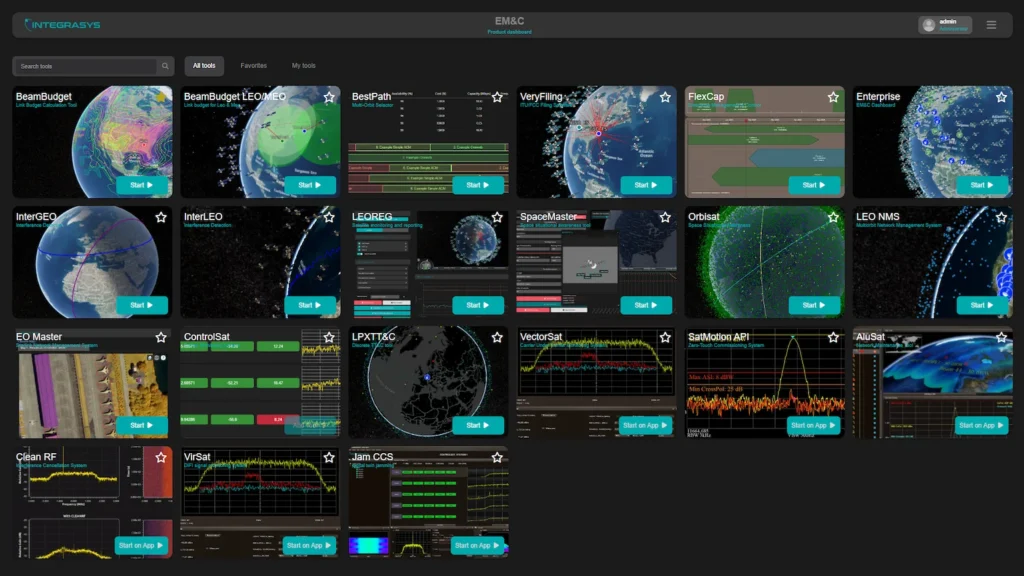
These systems help keep operators, observers, and shooters connected even when adversaries aggressively target traditional networks.
Preparing for GPS‑denied futures
Perhaps the most significant innovation is VeryFilingPNT, which streamlines the design and licensing of alternative satellite constellations to deliver resilient PNT services. The war in Ukraine has exposed a vulnerability in modern militaries’ reliance on a small set of navigation satellites like GPS – systems that adversaries are actively targeting. Diversified PNT constellations promise redundancy so that navigation and timing services remain available even when primary systems are compromised.
For Ukraine, access to such alternatives would boost the robustness of drone operations, guided fires, and autonomous systems.
From Lunar orbits to Earth’s front lines
At first glance, Artemis II and the battlefield in Ukraine may seem worlds apart. Yet the underlying technologies – precision tracking, resilient communications, and sophisticated navigation – are part of the same rapidly evolving ecosystem. Advances driven by deep‑space exploration are already proving indispensable in contested terrestrial environments.
As the Artemis program pushes the boundaries of space exploration, it also accelerates capabilities that influence the character of modern conflict. The lesson of Ukraine’s war is unmistakable: in addition to traditional firepower, control over information, signals, and the electromagnetic spectrum increasingly determines success in combat.
From tracking lunar explorers to empowering soldiers in a jammed battlespace, space technology is quietly shaping the future of war.
Reading now
1
SkyFall officially unveils Thor Hammer mid-strike and announces 1,000+ km version
2
Pentagon to hold Drone Dominance trials for bomber drones, with UFORCE, Gurzuf Defence, Grim Tech and others taking part
3

Terra Drone acquires 50% of Ukrainian Kurin Technologies for $3.5 million
4
British-Ukrainian Occam Industries raises €3.8m. The funds will go towards scaling drone autonomy software
5

Frontline Robotics CBDO Mykyta Rozhkov: Ukraine and Norway are working on an autonomous system to protect maritime infrastructure
By submitting this form, you give Defender Media consent to the processing of personal data.
Надсилаючи цю форму, ви надаєте Defender Media згоду на обробку персональних даних.

Latest insights
1
Everything about the RAM-2X mid-strike drone: interview with Ukrspecsystems deputy director Andrii Rymaruk
2

A demo is not demand: How to prove the value of a defence tech product. Column by Tekever Ukraine Director Kateryna Bezsudna
3
How to choose the right video link for an FPV drone: analogue, digital, or fibre-optic?
4

How a frontline signal becomes an engineering task. A column by Defence Builder Accelerator Director Yana Shkvarovska
5