Black Mirror #35. the Slon lifts a person, thermite charge on FPVs, and upgraded modems in Shaheds
A review of Russian military technology developments from the final week of November

"Oduvanchik" protection kit / Source: Internet
Russia continues to expand and diversify its arsenal of unmanned systems and protective equipment, while simultaneously introducing new technologies to strengthen strike, reconnaissance and defensive capabilities on the battlefield. Open sources have published new information on several such developments, and Defender Media has compiled a review of the latest updates from the last week of November.
FPV drone with a thermite charge for burning through net tunnels
A video has surfaced online showing a Russian FPV drone attempting to destroy a Ukrainian net tunnel over a road using a special mount fitted with a thermite charge. The aim of the attack is to burn through the netting and open the route to other drones.
As net-tunnel structures are made of plastic, polymers or fabric, the combustion temperature of thermite — over 2,000°C — can easily melt through them.
The video does not show the outcome of the strike or whether the drone managed to penetrate the tunnel. It is likely that several drones or several passes are required to destroy the net completely; however, a damaged section can be replaced relatively quickly because only the fabric suffers, not the frame.
New radio modems in Russian Shaheds
Downed Shaheds have revealed new radio modems, different from the previously observed Chinese devices operating in the 1,300–1,500 MHz band. According to analyst Serhii “Flash” Beskrestnov, recent finds contain modems from another manufacturer operating at 3,200–3,400 MHz. Similar modems have also been detected in flight in the 2,700–2,900 MHz band.
These modems enable Russian forces to form an extensive airborne communications network: all devices transmit data in parallel, creating an information system that is difficult to suppress. The objective is to relay reconnaissance data from strike and reconnaissance drones and to maintain the ability to control Shaheds in real time during flight.
S-70 Okhotnik-B UAV enters serial production
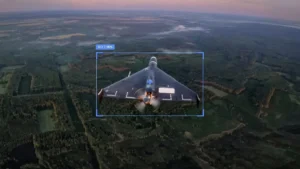
Russia has released new details on the S-70 Okhotnik-B heavy strike-reconnaissance drone, which has now reached the stage of serial production. The drone uses a flying-wing design and is built from composite materials at the Chkalov Novosibirsk Aircraft Plant.
According to Russian media, the drone operates alongside Su-35S fighters and can launch cruise missiles — the Kh-58 anti-radiation missile, the Kh-35 anti-ship missile, the Kh-74M, and KAB-250 guided bombs.
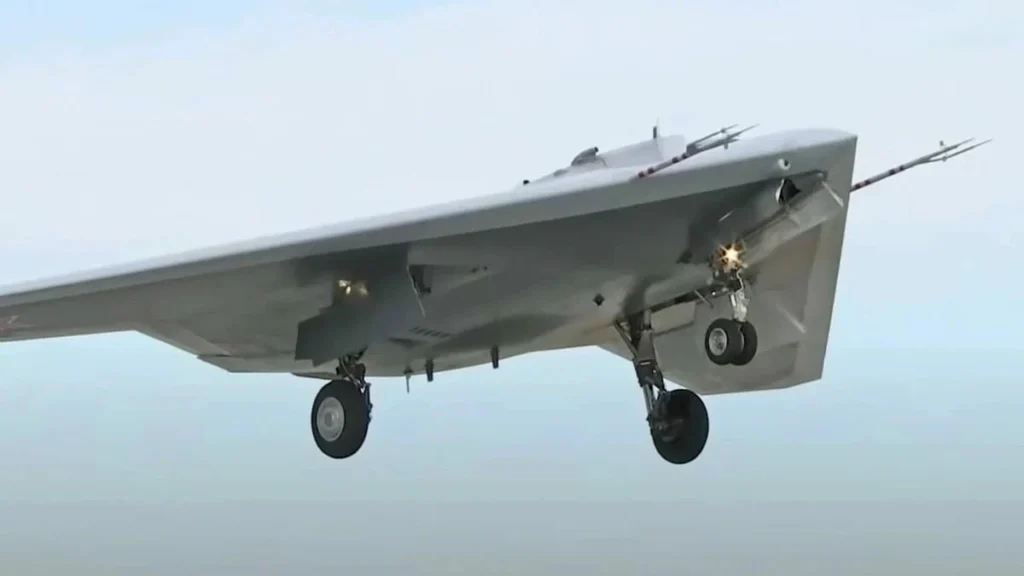
Declared specifications include: length 14 m, wingspan 19 m, payload 2.8–8 tonnes and a maximum take-off weight of up to 25 tonnes. The drone can reach 1,400 km/h at low altitude, climb to 18 km and cover up to 6,000 km.
Oduvanchik passive protection kit
Russia has patented a new passive anti-cumulative and anti-drone protection kit called Oduvanchik (Dandelion). The structure consists of flexible rods connected in a multi-tiered tree-like pattern that creates a spatial barrier for FPV drones.
The upper tiers contain thinner rods, while the lower ones use heavier elements, with the overall number of components increasing from bottom to top. The rods are made of fibreglass reinforcement, and the joints are metal or impact-resistant plastic. A synthetic mesh with small cells is stretched between the upper tiers.
Simplified versions of similar kits are already being fitted to T-80BV/BVM, T-72B3M and T-90M tanks alongside electronic-warfare systems.
Drone Buster barrel-mounted interceptor
Russian forces are testing an improvised UAV interceptor known as the Drone Buster, video of which has been shared online. In essence, it is a strike module attached to a rifle, designed to hit small FPVs at low and ultra-low altitude. The device is fixed directly to a Kalashnikov rifle using a simple 3D-printed mount.
It is loaded from the front of the housing, after which the shooter uses a standard cartridge to generate the impulse. The body is 3D-printed from heat-resistant plastic which, according to the developers in the accompanying video, does not damage the AK barrel.
The Boomerang FPV drone gains expanded functionality

According to a Russian serviceman with the callsign “Guantanamo”, the Boomerang FPV drone is used not only as a loitering munition but also for reconnaissance and mine-laying. He claims that a single such drone “replaces up to ten conventional FPVs” when carrying out missions.
The operator stated that the drone has an automatic target-tracking system that enables it to strike targets even under electronic-warfare interference, and can carry out up to 40 sorties. The drone can carry up to 4 kg of payload and is used to hit Ukrainian armour as well as to deliver ammunition and supplies.
Testing of the Slon heavy quadcopter
During trials, the Russian Slon heavy quadcopter managed to lift a person. Russian media published footage of the experiment. The Slon has completed a series of tests, including dropping loads of up to 50 kg, transporting an 84-kg petrol generator and lifting an 80-kg person — and is therefore being considered as one of the methods for evacuation.
The Slon itself weighs 50 kg, and its stated range with cargo is 15–17 km including the return flight. According to Russian sources, the drone is already in use in four sectors of the frontline.
All previous editions of Black Mirror are available here.
Reading now
1
Ukrainian Skyeton secures $10.6M US army contract
2
Canadian General Dynamics signs agreements with Ukrainian GreenTech
3
The Pentagon has announced the results of Drone Dominance Gauntlet II – announced Ukrainian companies did not make the top 5
4
Korven Systems project: How Teletactica co-founder is building an autopilot for interceptor drones
5
Ukrainian SkyFall again among winners of US Drone Dominance Program
By submitting this form, you give Defender Media consent to the processing of personal data.
Надсилаючи цю форму, ви надаєте Defender Media згоду на обробку персональних даних.

Latest news
1
12 British defence companies to gain access to Ukrainian AI platform Avengers Labs
2

Defence tech startup Zmiyar takes second place at IT Arena Startup Competition 2026
3

Mykhailo Fedorov launches ‘Army of Robots’ project to bring together venture fund, own companies and R&D for frontline robotics
4

Pentagon uses Ukrainian Unwave’s EW to test UAVs in Drone Dominance programme: details of cooperation
5