Dorozvidka #70: 10,000 km drones, Stone Cloak for Ukraine, Iryna Terekh, Rustem Umerov, Lasar’s Group, Marichka and Lynx
What international media wrote about Ukrainian defence tech, plus the stories that flew under Defender Media’s radar
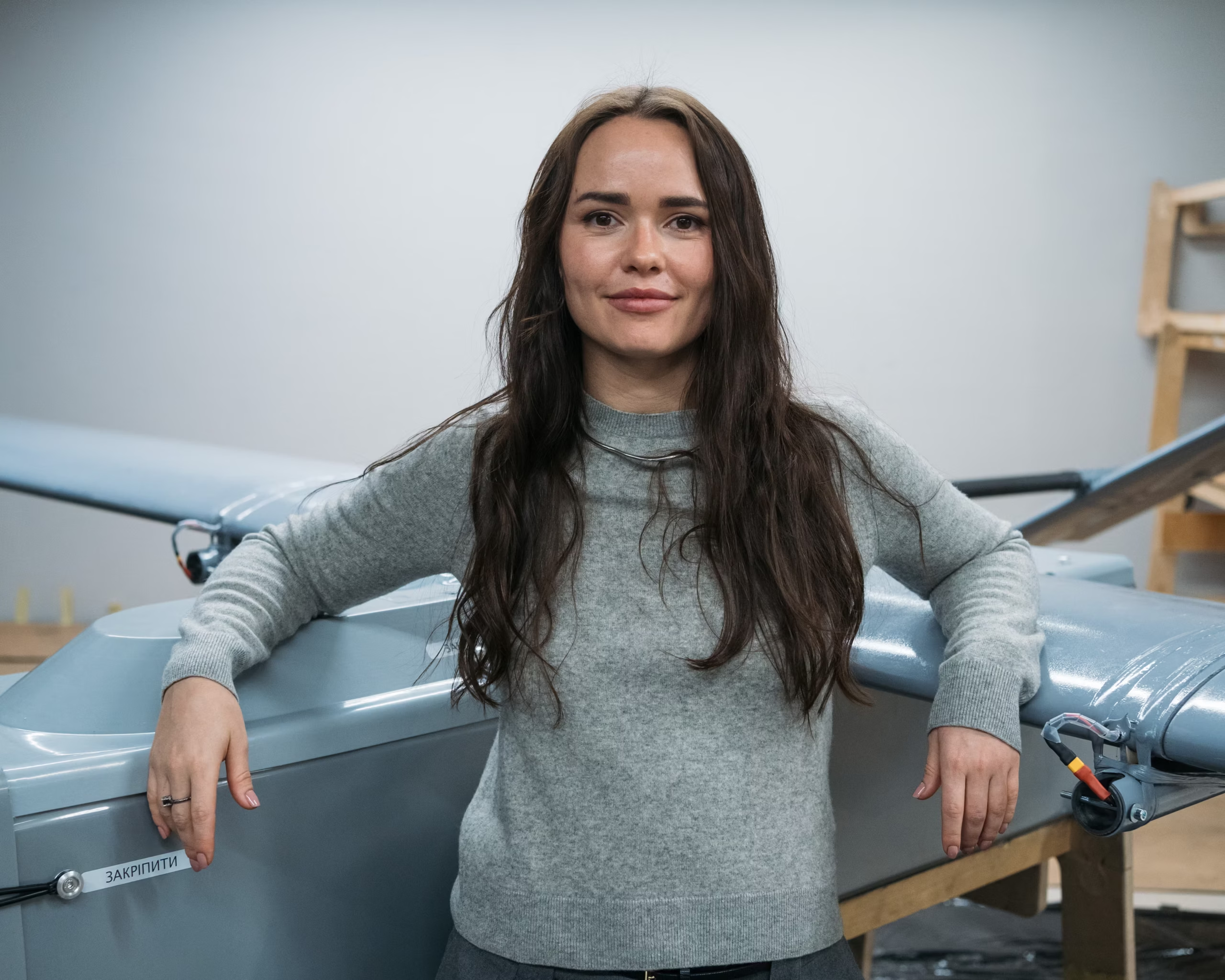
Fire Point CEO and CTO Iryna Terekh. Photo: The Guardian
In this edition of Dorozvidka:
- The right to assemble and safety at public events. Denys Bloshchynskyi’s column for Ukrainska Pravda;
- Zelensky: Ukraine will have drones with a range of 5,000–10,000 km next year;
- Rustem Umerov to lead Drone Deal and FREYJA projects;
- Two European interviews with Fire Point CEO Iryna Terekh;
- How Lasar’s Group operates interceptor drones;
- Ukraine’s Armed Forces develop the Marichka AI system for commanders;
- More than 100 missions with just two UGVs: how the 59th Brigade uses Rys robotic platforms;
- Ukraine to receive a licence to manufacture the UK’s Stone Cloak EW systems.
The right to assemble and safety at public events. Denys Bloshchynskyi’s column
In a column for Ukrainska Pravda, Denys Bloshchynskyi, Director of the From Country to Ukraine Social Innovation Foundation, reflects on the aftermath of the 24 July tragedy in Kyiv region, where eleven people were killed and around one hundred injured during a defence industry event.
Responding to the widespread online reaction — “Who even holds large public events during wartime?” — Bloshchynskyi argues that everyone does. Every week, hundreds of gatherings take place across Ukraine, bringing together dozens or hundreds of people: defence exhibitions and demonstrations essential to the arms industry, business forums, concerts, fairs, sporting events, religious services and school celebrations.
His main argument is that, five years into Russia’s full-scale war, Ukraine cannot remain in permanent lockdown. Yet today, the right to gather is protected by little more than luck and the judgment of individual organisers.
Bloshchynskyi proposes several practical measures, summarised by one principle: the maximum attendance of any event should not exceed the capacity of a shelter that can be reached within the available warning time.
Zelensky: Ukraine will have drones with a 5,000–10,000 km range next year
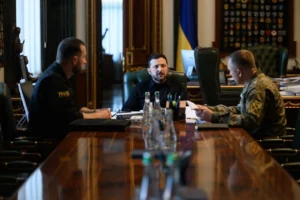
President Volodymyr Zelensky said Ukraine will field drones capable of flying 5,000 to 10,000 km in 2027. He made the remarks during an interview with American political commentator Laura Loomer, published on her X account. The interview was recorded at Mariinskyi Palace in Kyiv.
“Today we have drones with a range of more than 3,000 kilometres. By the end of this year, we will have drones capable of flying 4,000 kilometres. Next year, that range will increase to between 5,000 and 10,000 kilometres,” Zelensky said.
The president discussed future long-range drones in the context of the proposed Drone Deal defence agreement between Ukraine and the United States. According to Zelensky, closer military cooperation would accelerate the development of Ukrainian drone technologies.
Rustem Umerov to lead Drone Deal and FREYJA projects
President Volodymyr Zelensky will appoint former Interior Minister Ihor Klymenko as Secretary of Ukraine’s National Security and Defence Council (NSDC). Klymenko will oversee domestic security and coordination among the country’s security agencies.
Rustem Umerov, who previously headed the NSDC, will remain within the institution and focus on negotiations with international partners, implementation of the Drone Deal, and the FREYJA anti-ballistic missile programme. The president did not specify his new official position.

The presidential decrees appointing Umerov and Klymenko are expected to be signed later this week.
Two European interviews with Iryna Terekh
Fire Point CEO and CTO Iryna Terekh gave an extensive interview to Euronews one day after European leaders signed a joint declaration in Paris establishing the Integrated Anti-Ballistic Coalition. The coalition’s flagship initiative is FREYJA, an anti-ballistic missile programme initiated by Fire Point that has already been joined by nine European countries.
Terekh explained that FREYJA aims to create a lower-cost, modular missile defence architecture, with each participating country contributing its own component — interceptor missiles, radars or command-and-control systems. The new architecture is intended to complement existing air defence assets, including the US-made Patriot system.
She also confirmed that Fire Point is negotiating industrial cooperation with German companies and the German government, under which Ukraine would contribute battlefield expertise while Germany would gain access to affordable, mass-produced weapons.
In a separate interview with The Guardian, Terekh revealed that Fire Point is already producing 100 FP-5 Flamingo missiles per month.
How Lasar’s Group operates interceptor drones
The Wall Street Journal published a video report on Lasar’s Group, a National Guard unit that previously focused on hunting heavy Russian equipment but is now playing an increasingly important role in Ukraine’s “small air defence” network.
WSJ journalists documented the work of the unit’s pilots and highlighted the interceptor drones and autonomous guidance systems they use.
Ukrainian Armed Forces develop the Marichka AI system for commanders
The Central Research Institute of the Armed Forces of Ukraine has unveiled Marichka, a secure AI-powered decision-support system designed to accelerate military planning. Institute director Yurii Kliat presented the system during a briefing, according to Suspilne.
Kliat said brigade and regiment commanders currently spend six to twelve hours reviewing roughly 20 documents before making operational decisions. Marichka is expected to reduce that process to just minutes.
The system collects, processes and verifies battlefield data, automatically calculates force ratios, forecasts resource requirements and losses, models the operational environment on an interactive map, and alerts commanders to changes. Final decisions, however, remain entirely with human commanders.
More than 100 missions with two UGVs: how the 59th Brigade uses Lynx platforms
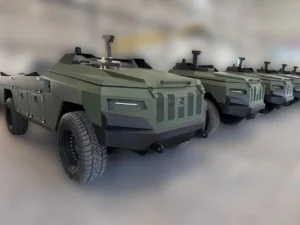
Two Lynx UGVs completed more than 100 logistics missions over two months, delivering over 10 tonnes of cargo to frontline positions. The story was shared by Roboneers Head of Communications Yana Shainiuk in a DOU blog post based on an interview with a serviceman from the unmanned ground systems platoon of the 59th Separate Assault Brigade.
Most operators in the platoon previously flew FPV or Mavic drones rather than operating ground robots. Their understanding of the aerial situation helps them plan routes, as drone reconnaissance provides the most important information about threats along supply routes. Each mission involves four personnel at the command post — the duty officer, an aerial observer and two operators — plus two more soldiers with the ground team.
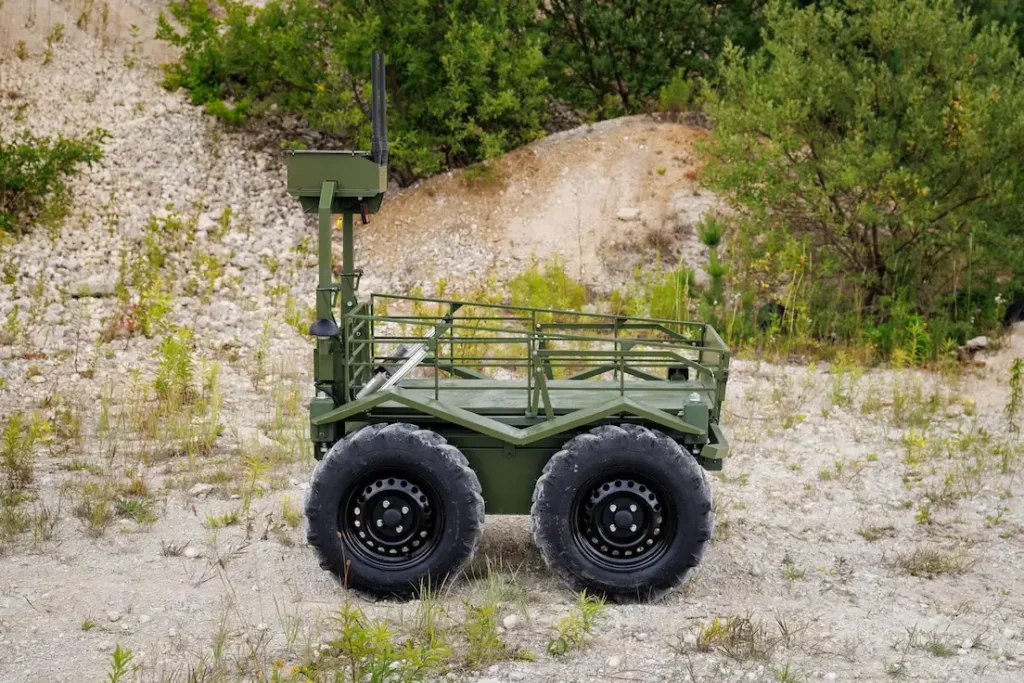
The robots mainly transport ammunition, communications equipment, batteries, food and humanitarian supplies. Their biggest threats include improvised and remotely detonated explosive devices, shrapnel, artillery and FPV drones. Fibre-optic cables and remnants of protective netting that become entangled in the tracks are another persistent challenge.
Ukraine to receive a licence to manufacture the UK’s Stone Cloak EW systems
The United Kingdom will transfer a production licence for its Stone Cloak electronic warfare system to Ukraine, enabling serial production inside the country. Stone Cloak is a compact EW module roughly the size of a tablet that can be mounted on drones to reduce their detectability by Russian radar and electronic warfare systems. The UK Ministry of Defence has already supplied thousands of these systems to Ukraine’s Defence Forces.
Local production is expected to significantly expand Stone Cloak manufacturing capacity, while British developers will receive direct battlefield feedback to further improve the technology. London also plans to integrate Stone Cloak into future British long-range weapons systems.
Reading now
1

70+ vacancies in Ukrainian defence tech at Ukrspecsystems, Strix Air, DoD Solution and other industry leaders
2

Swarmer acquires Ukrainian UGV and UAV manufacturer Ratel Robotics for $224m – and this is just the beginning
3
Ukrainian Skyeton secures $10.6M US army contract
4

Vluchnyk develops interceptor planned for production in Sweden and other countries: what attracted investors and what the team is working on
5
Canadian General Dynamics signs agreements with Ukrainian GreenTech
By submitting this form, you give Defender Media consent to the processing of personal data.
Надсилаючи цю форму, ви надаєте Defender Media згоду на обробку персональних даних.

Latest news
1
KARA UAV can deliver FPV drones behind enemy lines and operate as a relay
2
Come Back Alive fund has launched the RoboBro project to scale up UGV usage
3

Defence Builder accelerator opens applications for 4th batch: which teams are they looking for
4
Ratel H with FPV drone launch platform undergoes obstacle course testing
5