Dorozvidka #64: Ukrainian manufacturers at Eurosatory 2026, plus Denys Gurak, Line Rindvig, Dragon Capital and Prometheus
Key defence tech stories about Ukraine from other media outlets, blogs and social media over the past week
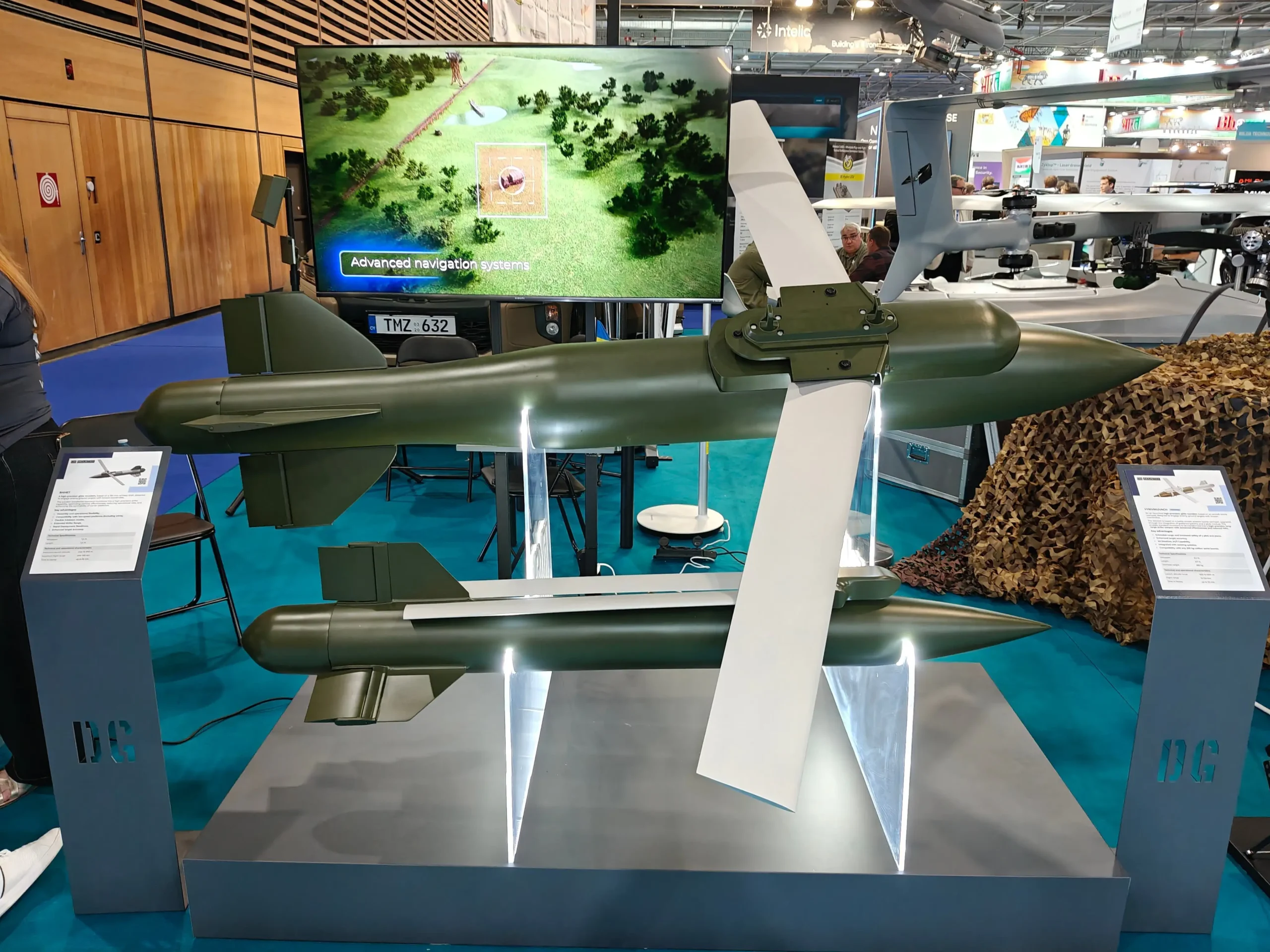
Vyrivniuvach, a Ukrainian guided aerial bomb
In this edition of Dorozvidka, we highlight some of the most notable announcements from Ukrainian manufacturers at the Eurosatory 2026 exhibition in Paris, including:
- The first public appearance of the Vyrivniuvach, Ukrainian guided aerial bomb;
- German radar manufacturer Hensoldt joining Fire Point’s anti-ballistic missile project;
- Ukroboronprom unveiling the UAV-290 jet-powered strike drone with a 100 kg warhead, as well as the Peklo missile-drone;
- Ukrainian MAUL casualty evacuation drones set to be manufactured in Sweden.
The digest also features an interview with Defence Builder CEO Line Rindvig and MITS Capital co-founder Denys Gurak, comments from Dragon Capital founder Tomas Fiala on defence tech investments, and details of the new Prometheus artillery management system developed by Ukraine’s 7th Air Assault Corps.
DG Industries showcases Vyrivniuvach guided bomb at Eurosatory 2026
At Eurosatory 2026 in Paris, the public was shown Vyrivniuvach, a Ukrainian guided aerial bomb developed by domestic manufacturer DG Industries, for the first time. Photos of the munition and its specifications were published on X by Defense Archives analyst Jeff2146.
According to the published information, aircraft can release the Vyrivniuvach from altitudes ranging from 500 metres to more than 10,000 metres. Depending on release conditions, the bomb can strike targets at distances between 10 km and more than 130 km.
German radar manufacturer Hensoldt joins FREYJA anti-ballistic missile project initiated by Ukraine’s Fire Point
German company Hensoldt, one of Europe’s leading radar manufacturers, has joined the FREYJA anti-ballistic missile project. The corresponding agreement was signed at Eurosatory in Paris with Ukrainian company Fire Point, according to Militarnyi.
According to Fire Point co-founder and chief designer Denys Shtilerman, the participation of a major German radar manufacturer moves the FREYJA project into its final stage of development.
💬 @DenShtilierman про підписання угоди з @hensoldt та розвиток проєкту Freya. pic.twitter.com/HYXw1N0QaH
— Мілітарний (@mil_in_ua) June 16, 2026
The core of the FREYJA system is the Ukrainian FP-7.X interceptor missile developed by Fire Point. The company recently conducted successful tests of the missile, demonstrating high manoeuvrability and the ability to operate at altitudes of up to 25 km.
In addition to the Ukrainian interceptor and Hensoldt radar, the system will incorporate several other European-made components. Target illumination and fire-control radar functions will be provided by either the Weibel GFTR-2100/48 or Leonardo KRONOS Land radar. The command-and-control element will be based on Norway’s Kongsberg Fire Distribution Center with Network Access Nodes modules.
Ukroboronprom unveils UAV-290 jet-powered strike drone with 100 kg warhead
At Eurosatory 2026 in Paris, Ukroboronprom presented its UAV-290 turbojet-powered loitering munition, according to Oboronka. The system is capable of striking targets at distances of up to 650 km and carries a 100 kg warhead.
According to the publication, the UAV-290 is launched from a mobile platform using a solid-fuel booster before transitioning to cruise flight. Powered by a turbojet engine, it can reach speeds of up to 800 km/h.

The drone navigates using a combination of inertial navigation and GPS. It is also reportedly equipped with a radar altimeter. Both visually and in terms of specifications, the system resembles a version of the Palyanytsia missile-drone unveiled in late 2024.
Ukroboronprom also displayed a model and technical specifications of the Peklo missile-drone in Paris. The unmanned aerial system is designed to destroy fixed targets at operational depth. It is launched from a mobile platform using a solid-fuel booster and does not require fixed infrastructure.
After launch, the system transitions into cruise flight mode. Peklo has a strike range of 700 km, a speed of 700 km/h and a 23 kg warhead. The manufacturer also claims the system can operate in environments with intensive electronic warfare interference.
Ukrainian MAUL evacuation drones to be manufactured in Sweden
Ukrainian company Aidrones and Swedish firm Njord Technology have signed an agreement to establish production of the MAUL ground robotic system in Sweden under the Build with Ukraine initiative, Militarnyi reports from Eurosatory.
Njord Technology specialises in autonomous systems as well as all-terrain vehicles and snowmobiles. Most jointly produced systems are expected to be supplied to Ukraine’s Defence Forces as casualty evacuation platforms.
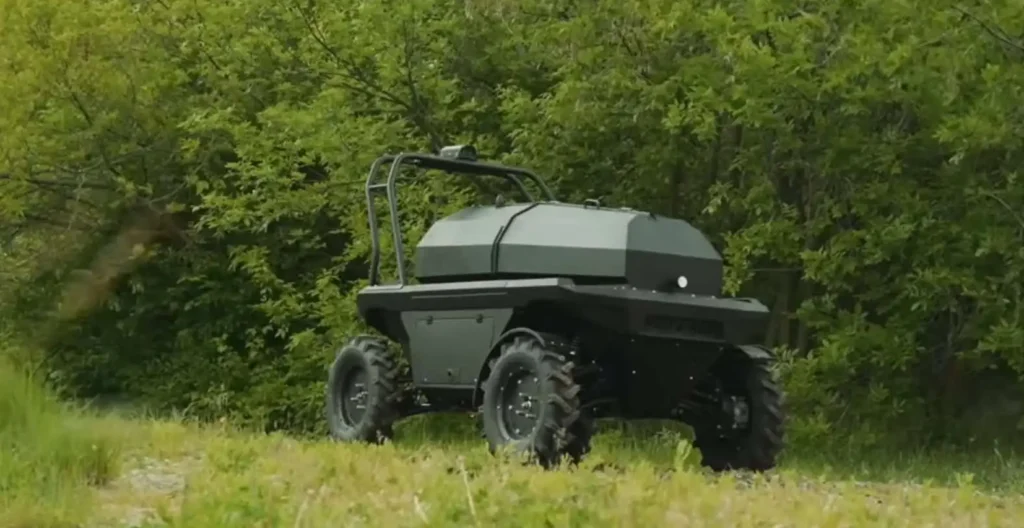
The MAUL project was launched following a request from the First Medical Battalion of the Armed Forces of Ukraine, which required a mobile platform capable of evacuating wounded personnel under difficult battlefield conditions.
The system features an armoured evacuation capsule and a highly durable chassis designed to withstand significant mechanical stress.
The vehicle has an operational range of up to 110 km on paved roads and up to 100 km off-road. Its maximum speed reaches 50 km/h on roads and up to 40 km/h across rough terrain.
Defence Builder CEO Line Rindvig gives an interview to Ukrinform
In September 2025, Danish national Line Rindvig became CEO of the Ukrainian defence tech accelerator Defence Builder. Since the start of Russia’s full-scale invasion, she has been actively involved in volunteer efforts supporting Ukraine.
Her work has included logistics coordination, humanitarian and military aid delivery, development of strategic partnerships and advocacy initiatives aimed at raising international awareness of Ukraine’s defence needs.
In an interview with Ukrinform, Rindvig discussed which drone technologies are likely to be most relevant on the battlefield in the coming months, the role of smaller companies in advancing these technologies, and how the accelerator helps cutting-edge solutions reach Ukrainian defenders as quickly as possible.

Dragon Capital begins investing in defence tech
Investment company Dragon Capital began investing in the defence tech sector in 2025. The announcement was made by Dragon Capital founder Tomas Fiala during the “Prosperity of the Nation” discussion organised by NV media group as part of its Dialogues About the Future series.
“Ukraine will be a leader in this sector. It already is a leader. We ourselves started investing in the sector last year. What has been created in Ukraine over the past four years is something others can only envy,” Fiala said.
He later told Interfax-Ukraine that Dragon Capital had considered entering the sector as early as 2023 but ultimately decided against investing at that time. According to Fiala, Dragon Capital currently invests in defence companies indirectly through several specialised funds established by sector experts.
Is there a defence tech bubble? Company valuations and export prospects discussed by MITS Capital co-founder in Forbes interview
There are currently 20–30 Ukrainian defence companies that require tens of millions of dollars in investment immediately, according to MITS Capital co-founder Denys Gurak.
Foreign investors have committed only around $100 million to the sector, while the actual volume of investment, including domestic capital, may already have reached $300 million.
In an interview with Forbes Ukraine, Hurak discussed which segments MITS Capital is targeting and where investment bubbles may already be emerging within the defence tech ecosystem.

7th Air Assault Corps launches Prometheus artillery management system
Units of Ukraine’s 7th Rapid Response Corps of the Air Assault Forces have begun operating a new artillery management system known as Prometheus.
According to the corps, the digital platform enables real-time coordination of artillery operations, operational command of subordinate units and accurate tracking of ammunition stocks and expenditure. The system was developed by specialists from the 147th Artillery Brigade, which is a part of the 7th Air Assault Corps.
The introduction of the software significantly accelerates data exchange between different command levels. A key feature is its integrated database of artillery units and ammunition types, including automatic compatibility checks.
The system can also calculate and generate safe logistics routes for ammunition delivery and process urgent resupply requests. In addition, Prometheus provides artillery crews with real-time warnings about incoming air threats.
Reading now
1
Ukrainian Skyeton secures $10.6M US army contract
2
The Pentagon has announced the results of Drone Dominance Gauntlet II – announced Ukrainian companies did not make the top 5
3
Korven Systems project: How Teletactica co-founder is building an autopilot for interceptor drones
4
Ukrainian SkyFall again among winners of US Drone Dominance Program
5

Frontline Robotics CBDO Mykyta Rozhkov: Ukraine and Norway are working on an autonomous system to protect maritime infrastructure
By submitting this form, you give Defender Media consent to the processing of personal data.
Надсилаючи цю форму, ви надаєте Defender Media згоду на обробку персональних даних.

Latest news
1

Sights, radar systems and UAV components now available to the military through Prozorro Market
2
SkyFall officially unveils Thor Hammer mid-strike and announces 1,000+ km version
3

Ukrainian developer of AI tools for detecting information threats Osavul raises $10 million
4
TAF Industries plans joint UAV development with Luxembourg’s LUXUAV
5