
September 25, 2026
25 out of 27 companies have open vacancies that take 1–2 months or longer to fill

The Ukrainian Council of Defence Industry, together with CORE Team, has published a study on the staffing situation within Ukraine’s defence industry. The survey covered 27 companies operating in the fields of UAVs, unmanned ground vehicles, electronics, electronic warfare, miltech software, and dual-use technologies.
According to the study, 74% of companies expanded their teams by at least a quarter over the past year, while almost half experienced growth exceeding 50%. All surveyed manufacturers project further hiring within the next 6–12 months. Concurrently, 25 out of 27 companies currently have open vacancies.
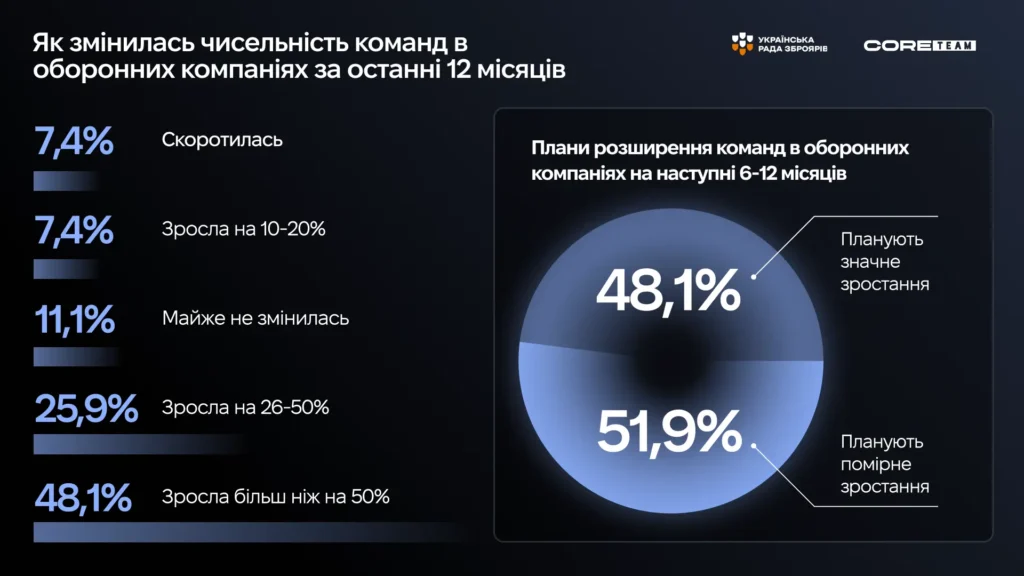
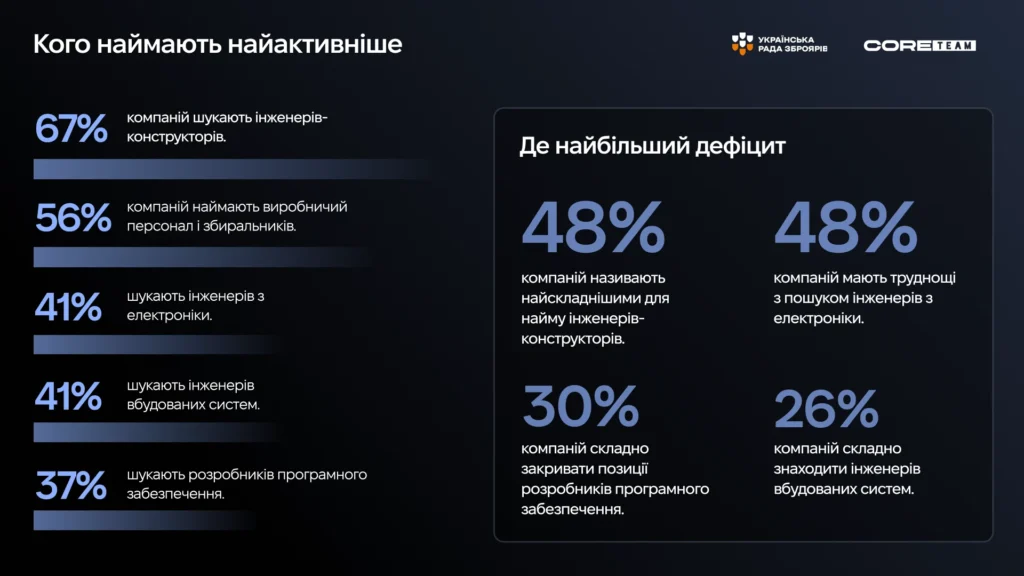
Defence companies are primarily seeking design engineers, production technicians, electronics specialists, embedded developers, and software engineers. Technical specialists remain the most challenging positions to fill. Nearly half of the surveyed companies identified design engineers and electronics engineers as the hardest roles to recruit.
Employers state that the primary challenges stem from a shortage of candidates with the required qualifications and fierce competition between companies for the same talent pool. On average, filling a technical vacancy takes 1–2 months, while some positions remain open for considerably longer periods.
Furthermore, 89% of companies indicated that they had increased salaries over the past year, most commonly by 10–20%. However, manufacturers noted that these adjustments had not resolved the systemic staffing shortage.
The study also demonstrated that the defence sector does not consistently offer higher remuneration than the broader market. Specifically, 42% of companies stated that their compensation aligns with, or falls below, other sectors. Higher salaries are predominantly concentrated in niche technical fields, including electronic warfare, avionics, embedded development, and RF technologies.
Another instrument for securing talent remains mobilisation deferment, with 74% of companies utilizing it as an additional employment benefit.
Among the primary market needs for the coming years, companies highlighted an increase in the engineering talent pool and more predictable state procurement cycles. Manufacturers also emphasised the necessity for closer cooperation with universities and the expansion of professional retraining programmes.




By submitting this form, you give Defender Media consent to the processing of personal data.
Надсилаючи цю форму, ви надаєте Defender Media згоду на обробку персональних даних.