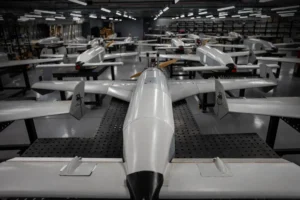
Fixed-wing interceptor Vidun codified: can reach 6 km altitude and stay airborne for over two hours
In 2025, Vidun ranked among the top 10 interceptors by operational effectiveness

Перехоплювач "Відун". Фото Brave1
The Ministry of Defence of Ukraine has codified and approved the Vidun unmanned aerial system for operational use by the Armed Forces. The fixed-wing interceptor, constructed from composite materials, is engineered to engage strike UAVs such as the Shahed, Geran, and Gerbera.
As Defender Media learned from the manufacturer, initial iterations of the Vidun were developed to intercept slow-moving targets, including enemy reconnaissance drones and relay platforms. In collaboration with combat units, the manufacturer refined the design. The current version can reach speeds of up to 250 km/h, climb to altitudes of up to 6 km, and boast an endurance of over two hours.
The system’s tactical range exceeds 70 km. One of Vidun’s key advantages is its ability to pursue targets across extensive forested massifs, along coastlines, and over open water.
The aircraft supports manual guidance as well as radar-based targeting. It is deployed via catapult, while its low take-off and landing speeds facilitate airframe recovery and reuse if a target is lost.
In 2025, the Vidun ranked among the top 10 interceptors by kill rate. Notably, in December, when adverse weather conditions restricted the deployment of other interceptor types, the Vidun demonstrated an effectiveness of approximately 70% and successfully intercepted 50 Shahed drones.
According to the manufacturer, the majority of the onboard electronics are produced in Ukraine. The unit cost of the aircraft on the Brave1 state defence marketplace is 160,000 UAH.
Defender Media has learned that despite the system’s codification, the finalisation of state procurement contracts has been significantly delayed, forcing the company to reduce its operating hours.
Earlier, Defender Media reported on an upgrade to the LITAVR interceptor, which received automatic terminal guidance and is currently undergoing remote-control trials.
Reading now
1
SkyFall officially unveils Thor Hammer mid-strike and announces 1,000+ km version
2
Pentagon to hold Drone Dominance trials for bomber drones, with UFORCE, Gurzuf Defence, Grim Tech and others taking part
3
British-Ukrainian Occam Industries raises €3.8m. The funds will go towards scaling drone autonomy software
4
Terra Drone acquires 50% of Ukrainian Kurin Technologies for $3.5 million
5

Frontline Robotics CBDO Mykyta Rozhkov: Ukraine and Norway are working on an autonomous system to protect maritime infrastructure
By submitting this form, you give Defender Media consent to the processing of personal data.
Надсилаючи цю форму, ви надаєте Defender Media згоду на обробку персональних даних.

Latest news
1
Ukraine’s Defence Forces hit a record number of Russian air defence systems and radars in September
2
Nataliia Mykolska to become VP of Growth and Affairs at Sine Engineering
3
Black Mirror #79: What’s inside Geran-4, unmanned tanks, balloon barrages and more of a new russian miltech
4

6,000 lives saved by replacing people with robots. “Makar” on the ground strike drone unit NC13 and its role in Operation Vivaldi
5