UGVs in action: The “Da Vinci Wolves” experience
Scenarios for the use of ground robots from an interview with Oleksandr Yabchanka

Photo: Forces of Unmanned Systems
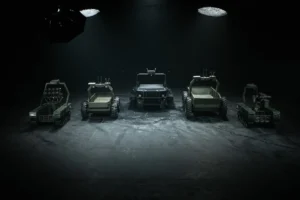
By 2025, the role of unmanned ground vehicles (UGVs) on the front lines has significantly expanded, becoming an increasingly critical component in combat operations. Oleksandr Yabchanka, head of the robotic systems service of the “Da Vinci Wolves” unit of the 59th “Steppe Predators” Brigade, discussed their deployment in an interview with the YouTube channel of the Ukraiinian Forces of Unmanned Systems.
“My area of responsibility is UGVs and everything that supports their operation,” the serviceman notes. According to him, UGVs have the potential to perform several combat functions: logistics, evacuation, mining, demining, enemy surveillance, and fire support. The “Da Vinci Wolves” unit has successfully implemented at least four of these functions.
Specific cases: logistics, evacuation, kamikaze
The UGVs have already shown consistent results in logistics and are regularly employed when the situation requires it. Evacuation is a less common but equally vital function.
“There are situations where you simply can’t send anyone in. For an evacuation group, it’s a one-way trip. But a UGV has a chance. No UGV is more valuable than the life of our soldier,” explains Yabchanka.
With the help of a UGV, the Da Vinci Wolves managed to evacuate a fallen comrade. In other cases, ground robots rescued wounded soldiers, literally pulling them out from under enemy fire. One such example was the evacuation of a wounded man from a forest strip. According to Yabchanka, the roads were blocked by the enemy and there was no other way to save the soldier. “But the GRS with the evacuation trailer managed to do it,” says the commander.
Among the successful functions of UGVs, Yabchanka also mentions their use as kamikaze drones. In one case, a ground robot destroyed an enemy dugout in response to the wounding of two Ukrainian soldiers. Both survived and are now recovering.
Engineering work and fire support
Another area is engineering and sapper tasks. Turrets are also actively used — stationary GRSs designed for fire support. “There are already successful cases. They’re not widespread yet, but I believe they’re the future,” Yabchanok says.
In one battle, the Shablya turret, equipped with a 12.7 mm machine gun, stopped an enemy assault, destroying at least two occupiers and an FPV drone.
“It was a brilliant piece of work. We didn’t let them approach our dugouts,” recalls the commander.
Decoys and plans for the future
A separate application involves using UGVs as decoys. These drones force the enemy to waste resources — surveillance, FPV drones, and munitions. Even if the GRS is destroyed, the effort is worthwhile, as it saves Ukrainian lives and exhausts Russian capabilities.
Looking ahead, the unit plans to combine the decoy concept with strike capability — to turn GRSs into “mobile bombs” carrying large charges to target enemy rear positions. This project has not yet been implemented, but the commander sees great potential in it.
So far, examples of GRS use remain isolated rather than standard practice. The Da Vinci Wolves operate as an experimental unit, testing new technologies and attempting to scale the knowledge gained as soon as conditions allow. This approach enables them to stay one step ahead of the enemy — if only briefly. According to Yabchanok, the Russian military quickly adopts Ukrainian innovations due to its greater resources and centralised system.
“We innovate — they rapidly adopt our experience and try to catch up. That’s why our window of opportunity is very narrow. We have to invent, scale — and invent again,” he says.
Reading now
1
SkyFall officially unveils Thor Hammer mid-strike and announces 1,000+ km version
2

260+ vacancies in Ukrainian defence technology at BlueBird Tech, Sine Engineering, Buntar Aerospace and more
3
British-Ukrainian Occam Industries raises €3.8m. The funds will go towards scaling drone autonomy software
4
Terra Drone acquires 50% of Ukrainian Kurin Technologies for $3.5 million
5

Autonomous interceptor drones need radars to work. Why is there still a lack of them
By submitting this form, you give Defender Media consent to the processing of personal data.
Надсилаючи цю форму, ви надаєте Defender Media згоду на обробку персональних даних.

Latest news
1

Acoustic sensor developer Zvook raises investment from new Czech fund managed by DEPO Ventures
2

Denmark to hold first-ever Danish Defense Tech Week in four cities: what to expect
3
Forbes: Airlogix plans to raise $100m at a $2bn valuation
4
Tencore launches an ecosystem to bring together UGVs and components from several manufacturers
5