How to create an effective combat product: the experience of Delta developers, the Nemesis regiment and a former CFO “Chicago”
Highlights from the panel discussion at DOU Day 2025

How do combat units create their own technological solutions, where does such development begin, and how is internal technical work organised? These issues were discussed at one of the panel discussions of the DOU Day 2025 conference by Artem Martynenko from the Centre for Innovations of the Ministry of Defence, Artem Belenkov from the Nemesis unit, a former IT specialist and special forces officer “Chicago”, and the CEO of the Defence Builder accelerator Kateryna Bezsudna. Defender Media shares the most interesting insights.
About the speakers
Artem Martynenko is the Deputy Head of the Centre for Innovation and Development of Defence Technologies of the Ministry of Defence. One of the centre’s main projects is the Delta situational awareness system. The history of the system begins in 2015–2016, when a military unit was established on the basis of the volunteer association “Aerorozvidka”, which became one of the first to use civilian drones in combat conditions in eastern Ukraine.
The next step was to build a network of stationary surveillance cameras. In response to the active use of electronic warfare equipment that disabled drones, such cameras became the only effective means of surveillance in some areas of the front. When civilian initiatives began to transfer experience to regular military units, there was a need to form a special technological structure within the Ministry of Defence. A team of developers was involved in the work, who not only continued to develop existing solutions but also received a new task – the creation of full-fledged information systems.
“With the advent of numerous sensors — cameras, drones, and other data collection tools — it became clear that it was no longer possible to process information manually. A digital system was needed that could collect, manage, and distribute data in real time,” Martynenko describes the emergence of Delta.
The main task of the unit where “Chicago” served is to detect enemy crews, electronic warfare equipment, and radar systems. However, it is impossible to carry out such work without technology — which is why the team is actively developing its own set of sensor solutions. These technologies are created in-house, with the participation of volunteers and specialists with experience in the field of electronic warfare, engineering, and IT.
The unit operates in a mixed format: it includes both combat crew operators and engineers from civilian structures, former military personnel, IT specialists, and volunteers who participate in development and testing. At the same time, Ukrainian products are actively used — from startups to well-known developers.
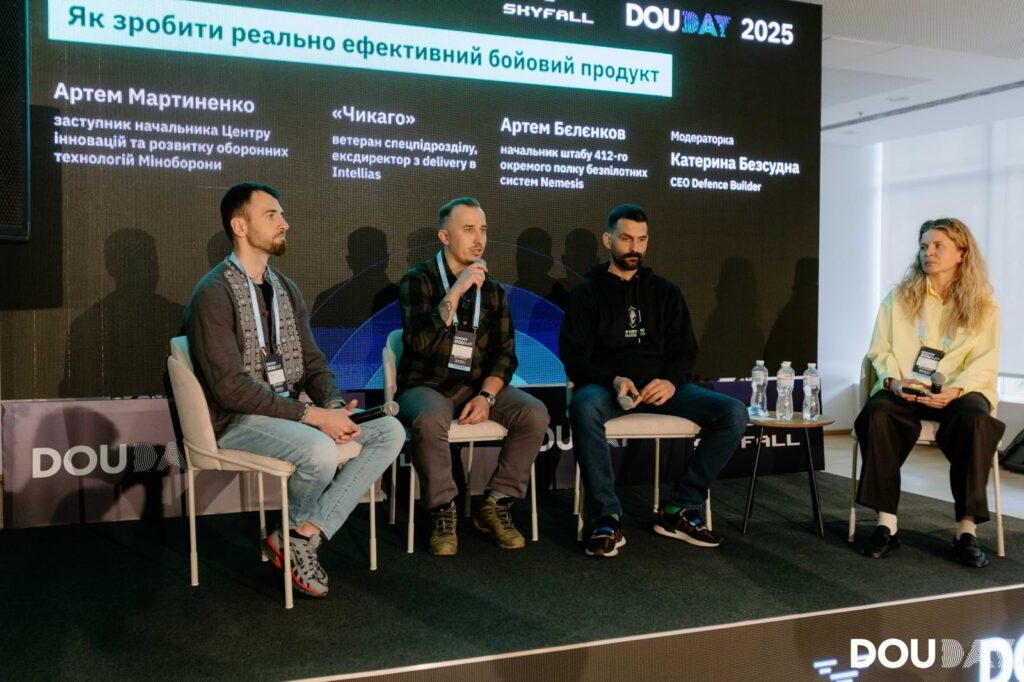
Artem Belenkov is the Chief of Staff of the 412th Separate Regiment of the Unmanned Systems Forces of the Armed Forces of Ukraine Nemesis. This unit is one of the most effective in the USF; in particular, the regiment is known for its high performance in shooting down “Shaheds”.
Belenkov divides the activities of the Nemesis unit into three key areas: reconnaissance and destruction means, combat control systems, and IT components for internal support. The team does not manufacture its own weapons, but works closely with manufacturers. In some cases, finished products are refined directly at the unit’s base — for example, by modernising individual components.
The second area is combat control systems, the main ones of which are the Delta system and its “Vezha” component, supplemented by other solutions developed by individual units of the Armed Forces of Ukraine. The main role of the division is to provide feedback to improve the effectiveness of these solutions.
Internal IT infrastructure is mainly the responsibility of the division: it involves full automation of auxiliary processes – from data processing to operational management support. According to the developers, this is a truly “data-driven” structure: so much information is received that its volume often exceeds analytical capabilities. However, key decisions in this segment remain exclusively in-house – third-party providers are not involved in this part.
Implementation of innovations: expectations vs reality
Despite the fact that the Delta system has been formally implemented in 90% of divisions, its deep use still remains uneven and far from complete. As the developers explain, this coverage is only valid “in breadth” — that is, in the number of divisions where the system is present. However, “in depth” — in the number of active users and the degree of mastery of the modules — the results are much more modest.
Some units have hundreds or even thousands of users who are actively working with various modules from the ecosystem. In others, there are only a few dozen, and they work only with basic tools. “For a full effect, it is important that not only one brigade owns the system, but also all its ‘neighbours’ — on the right, on the left, and even further along the front. Only then does it begin to realise its full potential,” says Martynenko.
The key challenge today is the implementation stage. Its complexity lies not so much in software development as in daily communication with users – training, adaptation to specific tasks, collection, and processing of feedback. In this process, the so-called “power users” appear – units that are the first to master new modules, and it is their feedback that often becomes the driver of development. However, this creates a new dilemma: the pace of requests from “advanced” users can be too high for others. If you focus only on them, beginners will feel “superfluous” in the ecosystem.
Among the most effective implementation practices are mobile groups that not only bring the tool but also help configure processes. They study the needs on the ground, configure the units, and then transmit feedback to the centre. Such mobile groups have become key elements of system scaling.
Successful military solutions should become typical for all units
The participants in the discussion spoke about the need to standardise solutions that have already proven their effectiveness on the front. This includes technical solutions, tactical techniques, and new models of combat use. Today, even if the use of a certain type of UAV brings results, it remains within one unit due to the lack of a centralised knowledge transfer mechanism.
According to the panellists, new combat experience, in particular in the field of UAVs, should not only accumulate but also become part of official “military science”. This requires analytical centres that will process feedback from the front, compare the effectiveness of models, and form a new doctrine based on this.
About Nemesis
Belenkov’s unit is simultaneously involved on all fronts — land, air, and sea — and forms separate teams and partnerships depending on the direction. In the field of FPV drones, the team actively cooperates with front-line units, including leading Ukrainian groups of operators. In the area of drone bombers, however, the unit itself acts as a driver of innovation: it has significant internal capabilities and sets the tone for the development of new solutions.
An important role in innovation is played by OSINT — open analysis of information from the public space. This combines both specialised software solutions and the human factor: volunteers and employees manually monitor the information space, looking for vulnerable signals in open sources.
According to Belenkov, among Russian bloggers and officials there are “talkative” characters, from whose statements one can understand how far they have advanced in countering certain drones of the unit. The Nemesis Chief of Staff says that this allows them to identify the enemy’s tactics and adjust their own. However, such useful publications can sometimes be found only in regional Russian media, and then the information may enter monitoring only due to a random coincidence of algorithms.
The need for precise specialisation is growing
The field of defence technologies remains very dynamic, the panellists noted. Ideas that were niche yesterday can become mainstream today. This is particularly the case with the solution against the Shahed, which is being worked on by Nemesis. At first, it had limited support, but now it provides a separate segment of air defence and makes the unit the most effective in countering Russian-Iranian kamikaze drones.
The panellists call the field of ground robotic systems the most difficult to implement. It requires integration with infantry, established communications, and high-quality maintenance – and therefore is one of the most technically demanding. But that is precisely why it has significant potential: a successful product can become a breakthrough both from a defence perspective and as a business model.
Technologies based on artificial intelligence, computer vision and machine learning remain “trend number one”, but currently work only in very narrow, typical scenarios. High potential lies in systems for automatic target detection, surveillance, and analysis, but real results are possible only in conditions of a clearly defined environment and tasks, experts say.
Competition in the field of drone construction is growing noticeably. In 2022, it was possible to enter the industry “from scratch”, in 2023 – to join the leaders. In 2025, a newcomer must either clearly understand their niche or enter into partnerships with players who have been on the market for a long time. Most manufacturers have formed ecosystems around themselves, where various components are combined – from the platform to the systems of engagement and communication. Newcomers are advised to focus on the entry points into these ecosystems, and not to build everything from scratch.
The importance of surveillance and counter-surveillance is growing: the enemy is learning quickly and is increasingly actively shooting down aerial reconnaissance with its own drones. That is why technologies for protection, interception, and long-range digital communication remain relevant — in particular, the creation of domestic alternatives to Western systems of stable video transmission.
Reading now
1

70+ vacancies in Ukrainian defence tech at Ukrspecsystems, Strix Air, DoD Solution and other industry leaders
2
Swarmer acquires Ukrainian UGV and UAV manufacturer Ratel Robotics for $224m – and this is just the beginning
3
Canadian General Dynamics signs agreements with Ukrainian GreenTech
4

Vluchnyk develops interceptor planned for production in Sweden and other countries: what attracted investors and what the team is working on
5
Unwave’s Stepovyi Viter mid-strike drone passes codification: what we know about this UAV
By submitting this form, you give Defender Media consent to the processing of personal data.
Надсилаючи цю форму, ви надаєте Defender Media згоду на обробку персональних даних.

Latest insights
1
Everything about the RAM-2X mid-strike drone: interview with Ukrspecsystems deputy director Andrii Rymaruk
2

A demo is not demand: How to prove the value of a defence tech product. Column by Tekever Ukraine Director Kateryna Bezsudna
3
How to choose the right video link for an FPV drone: analogue, digital, or fibre-optic?
4

How a frontline signal becomes an engineering task. A column by Defence Builder Accelerator Director Yana Shkvarovska
5