Black Mirror #7. once again about “Banderol”, plus “Tyuvik”, “Kangaroo”, “Oduvanchiki” and other additions to Russian miltech
What’s new in Russian military technologies for the second decade of May
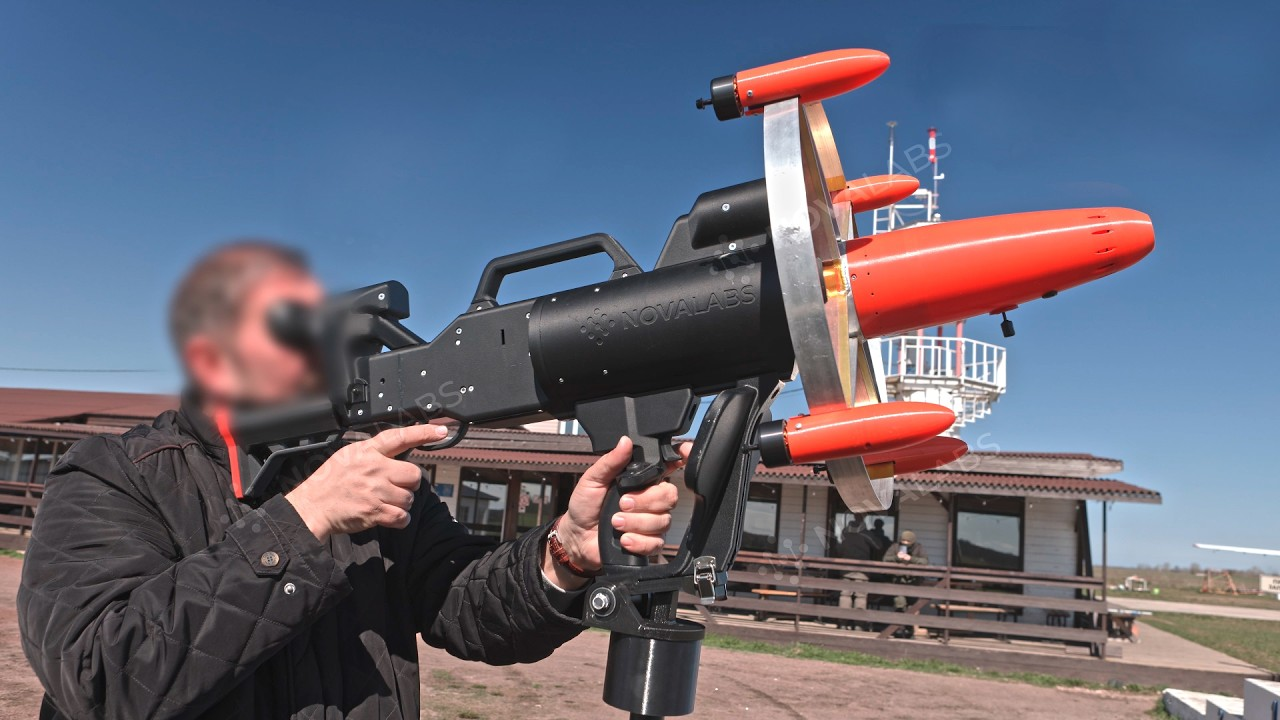
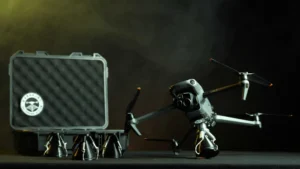
Complex for intercepting drones Molot-Britva
Russia is forming regiments of maritime unmanned systems and has also announced the creation of the world’s first modular drone. This week, the Russians also showcased new developments in UAVs, cruise missiles, and counter-drone technologies.
More on this in Black Mirror №7. Defender compiles this weekly digest to help Ukrainian innovators and their allies stay informed about the enemy’s plans.
“First universal modular drone in the world”
Engineers from the Moscow Aviation Institute (MAI) have created a universal modular UAV with vertical takeoff and landing. The developers claim that the created device has no analogues in the world due to the function of interchangeable modules. This allows you to adapt its dimensions and characteristics to a wide range of tasks, including cargo transportation, monitoring, search and rescue operations, etc.
Modularity makes it possible to quickly reconfigure the device to perform various missions by quickly replacing blocks. This approach is a fundamentally new solution in the design of copter-type aircraft. The drone was named F1 and is currently undergoing testing and is ready for mass production.
Among the key features of the F1 is its ability to operate at low temperatures down to -40 degrees. The design of the drone also provides for the possibility of using both a hybrid and a fully electric engine. The use of a hybrid power significantly increases the duration of active flight to four hours and provides a range of up to 120 km. The vehicle’s own weight is about 14 kg, and the maximum take-off weight reaches 29 kg. The maximum flight speed of the F1 is 80 km/h, and the cruising speed is 65 km/h.
Unmanned aircraft carrier for transporting small UAVs
Scientists from the Russian South Ural State University have created a prototype of a drone that can carry other UAVs up to 80 km, launch them directly in the air and return them. The drone was given the code name Kangaroo. Its mass is 3 kg, the total wingspan is 2 meters; the mass of the payload that it can carry is up to 2 kg. The maximum range of cargo delivery is 80 km.
While the small UAVs are performing their mission, the transport UAV can recharge before returning, or it can immediately and automatically return to the launch base.
Cruise missile Banderol
The Main Intelligence Directorate of the Ministry of Defence of Ukraine has revealed the technical characteristics of the new Russian cruise missile S8000 Banderol on the War&Sanctions portal.
According to them, the missile is manufactured by the sanctioned enterprise Kronstadt. Its main carrier is the reconnaissance drone Orion manufactured by the same company. In the future, the Russians plan to adapt the missile for use from Mi-28N attack helicopters.
Banderol is equipped with a warhead weighing up to 150 kg and is capable of covering a distance of up to 500 km at a speed of over 500 km/h.
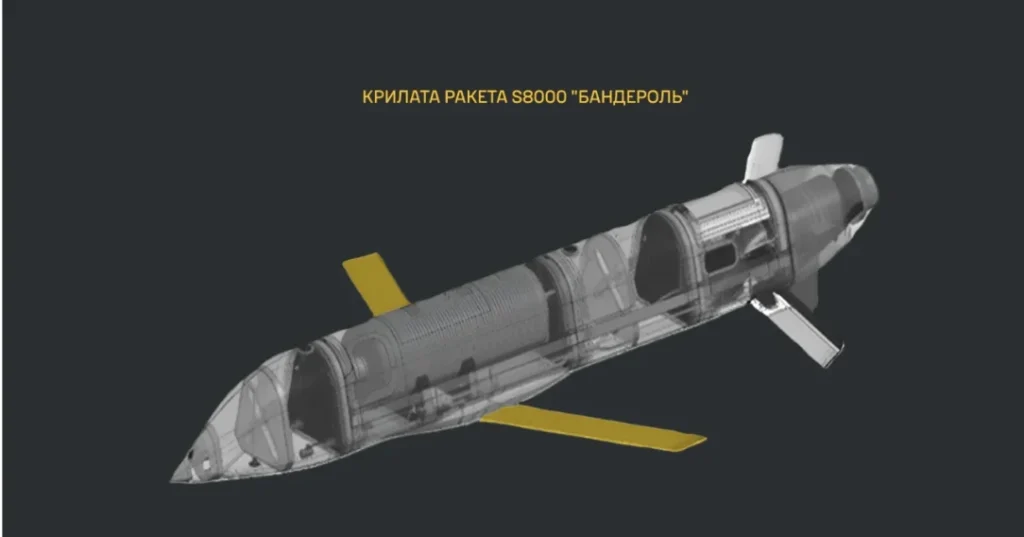
A feature of the missile is its ability to perform turns with a smaller radius than typical Russian-made cruise missiles (X-101, 3M-14, 9M727, X-69), while maintaining the characteristic flight trajectory of a cruise missile.
Import-substitute controller with artificial intelligence for UAVs
The aforementioned MAI has developed and has already launched a controller for controlling UAVs.
The device has a built-in artificial intelligence module. It can be used on unmanned aircraft of airplane, helicopter and multicopter types, as well as other autonomous systems, including ground-based ones. Thanks to a wide range of interfaces, the controller is easily integrated into existing systems and adapted to the specific tasks of unmanned and robotic platforms.
The flight controller acts as the central control unit of the UAV, performing tasks of autonomous navigation, stabilization and video signal processing.
The controller continuously processes large data streams from onboard sensors and sensors in real time. In addition to classic navigation, it performs intelligent flight control and adapts to external conditions and task changes.
Modifications of the Molot-Britva
Nova Labs has modified its complex for intercepting drones Molot-Britva. With its help, you can fight large copters and aircraft UAVs with a wingspan of 2-5 meters. The interceptor can reach the target at an altitude of up to 2 km at a speed of up to 200 km/h.
There are two versions of the complex, portable and stationary. The portable version has a thermal imaging homing head and 3.4-kilogram kinetic ammunition of 100 mm caliber, developing a speed of up to 265 km/h. The stationary one has radio command or laser guidance, the range is 3.5 km, and the projectile speed reaches 360 km/h.
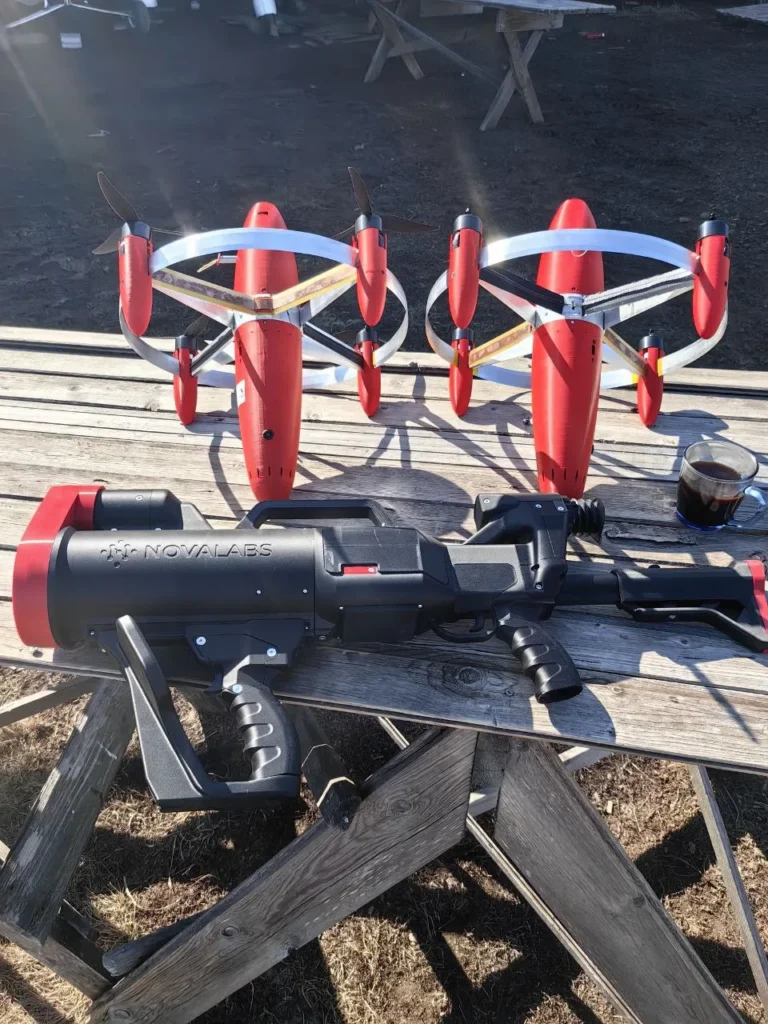
Oduvanchiki drones
The HeliRussia-2025 exhibition presented the family of multi-purpose drones Oduvanchiks. The drones work with a transport-launch complex, which is used as a charging and heating station at low temperatures.
Oduvanchik is designed to monitor the earth’s surface or sea surface, in single flight mode or as part of a group of launched UAVs. Payload – 1.2 kg, flight radius – up to 7 km, time – up to 48 minutes, height – up to 3 km.
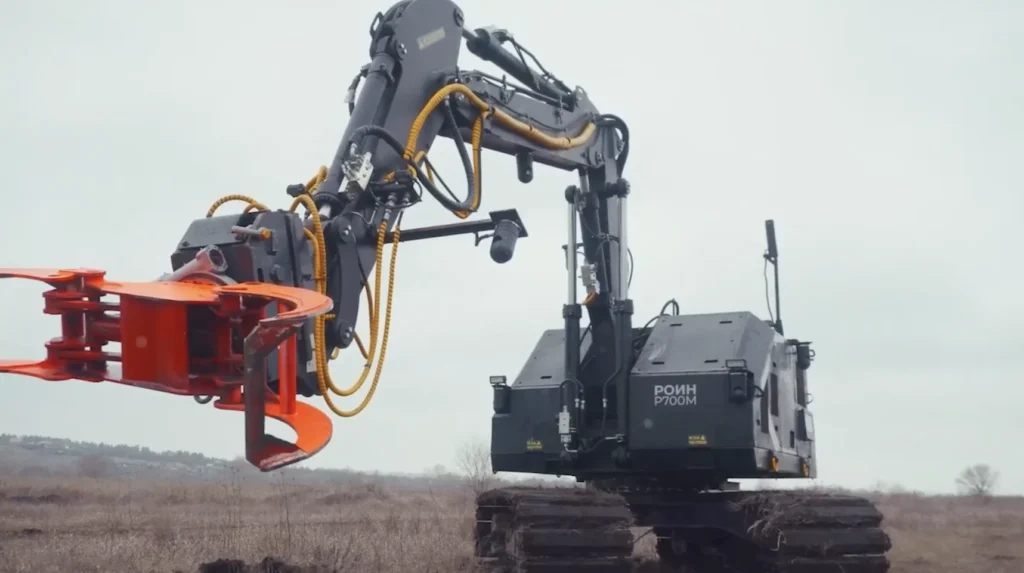
A robot for nuclear disasters was created in Russia
The Voronezh company Intekhros has developed a robotic complex ROIN P700M, capable of operating in zones with a lethal level of radiation – over 60 Gray per hour (this is thousands of times higher than the permissible dose for a person). ROIN R700M is tested at Novovoronezh NPP.
Drone, invulnerable to electronic warfare
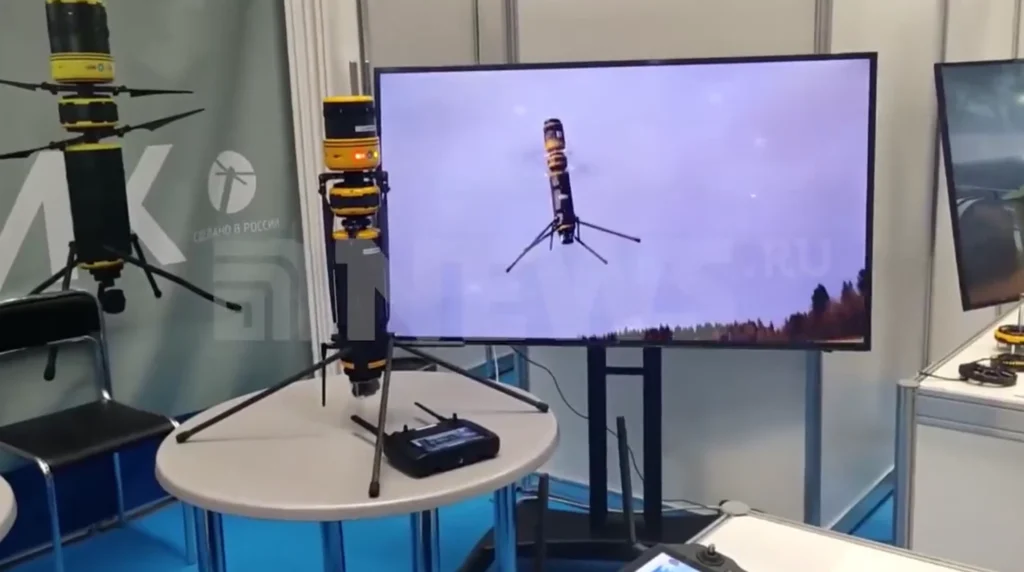
The new UAV Tyuvik from Stratim, according to the company, is practically impossible to jam with electronic warfare thanks to its own communication system Zemlya. The device is able to independently approach the target.
Judging by the data from the company’s website, there is an electric and gasoline version of the device:
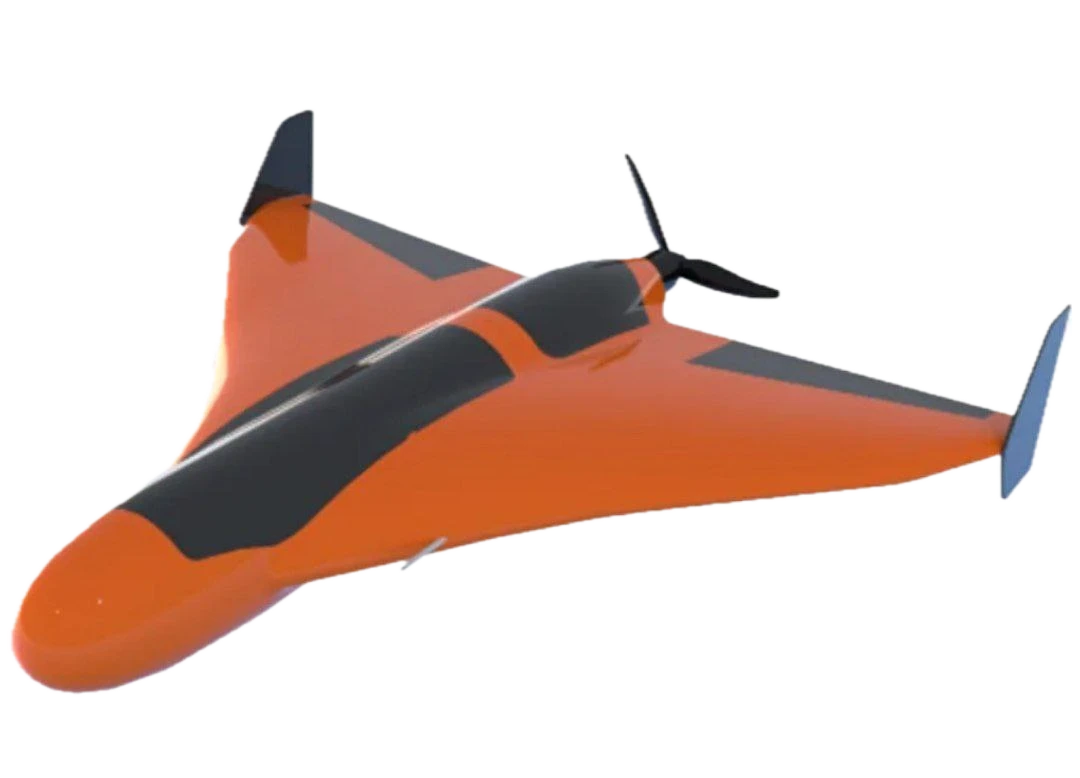
- The speed of the first version is 150-180 km/h, the second – 300-350 km/h;
- Range – 40 km and 100 km, respectively;
- Payload of the electric version is 3 kg, of the gasoline version – 1 kg more;
- Flight time – from 15 to 20 minutes.
Naval regiments of unmanned systems are looming on the horizon
The Russian Navy has begun forming specialised naval regiments of unmanned systems, which will be part of all fleets. These units will be equipped with various robotic equipment: air and ground drones, unmanned boats and underwater vehicles.
The main tasks of the new formations will be reconnaissance, strikes, ship protection, combat with enemy drones and neutralisation of sea mines.
This step corresponds to the general development of the Russian Armed Forces, where separate troops of unmanned systems are already being created.
Reading now
1
SkyFall officially unveils Thor Hammer mid-strike and announces 1,000+ km version
2

260+ vacancies in Ukrainian defence technology at BlueBird Tech, Sine Engineering, Buntar Aerospace and more
3
British-Ukrainian Occam Industries raises €3.8m. The funds will go towards scaling drone autonomy software
4
Terra Drone acquires 50% of Ukrainian Kurin Technologies for $3.5 million
5

Autonomous interceptor drones need radars to work. Why is there still a lack of them
By submitting this form, you give Defender Media consent to the processing of personal data.
Надсилаючи цю форму, ви надаєте Defender Media згоду на обробку персональних даних.

Latest news
1
Phantom Defense acquires net-launcher developer KARAKURT to integrate its technology into its UAVs
2

Acoustic sensor developer Zvook raises investment from new Czech fund managed by DEPO Ventures
3

Denmark to hold first-ever Danish Defense Tech Week in four cities: what to expect
4
Forbes: Airlogix plans to raise $100m at a $2bn valuation
5