Leleka, Bulava, Sokyra. How Deviro is developing its product ecosystem – and what’s new in it
The company has developed a remote control system for its UAVs and is testing an autonomous interceptor drone
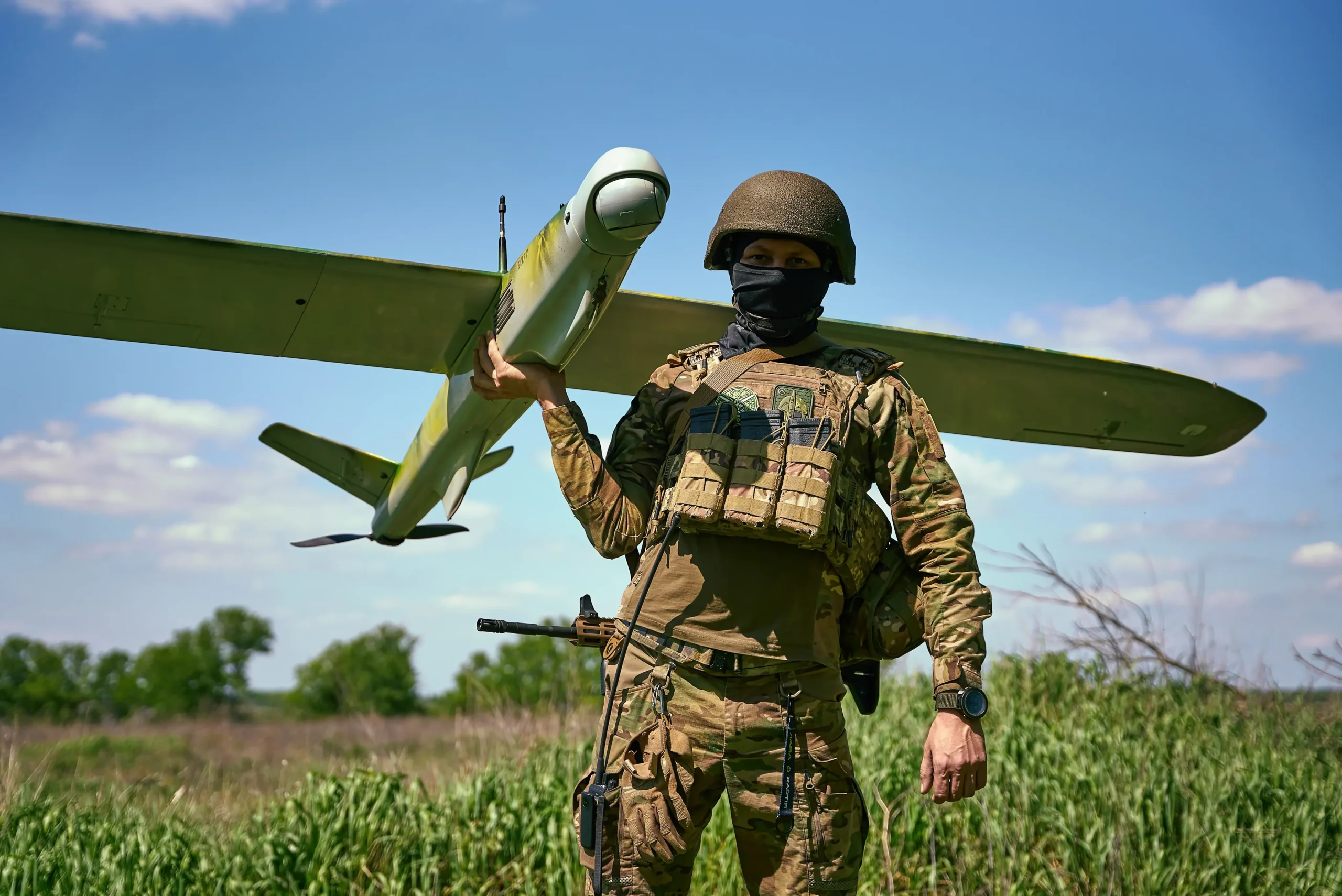
Norman with a Leleka drone (Photo: Lava Regiment)
Leleka-100 is one of the most widely used reconnaissance UAVs in Ukraine’s Armed Forces. Deviro developed it in 2017, and since then, the military has been using the drone to locate enemy pilot positions, equipment, logistics routes and more.
Targets found are then struck by another of the manufacturer’s UAVs – the Bulava mid-strike drone, which media have dubbed “Ukraine’s Lancet”. The drone strikes at ranges of 100+ km, and some units have managed to fly it 120+ km to a target.
Both drones have received several changes and improvements over the course of their service, and in the future, they are to be joined by Sokyra, an autonomous interceptor drone. Defender Media spoke with Deviro’s marketing director Roman about the evolution of the company’s products, and also talked with military personnel who work with Leleka and Bulava.
What you should know about Deviro
Deviro began operations in 2014 – according to Roman, the project was founded by “a group of enthusiasts interested in aircraft modelling”. Deviro’s first product was the Leleka-100 reconnaissance UAV. It entered service in 2017, with the State Border Service and the Ukrainian Defence Intelligence as its first users. Border guards periodically publish footage of the drone in operation.
Between 2018 and 2020, the company secured nine contracts with state structures, including the Ministry of Defence, the police and the border service. In 2021, the Ministry of Defence officially adopted the Leleka-100 into service.
However, ahead of the full-scale invasion, the company was left without state contracts and with a staff of 30, Forbes writes. After 24 February 2022, Deviro began actively scaling up, expanding and dispersing its production. The team also grew significantly – by October 2025, the company employed up to 600 people, the publication writes. Roman does not disclose the current headcount.
Leleka accounts for the largest share of revenue, though it is being caught up by Bulava – the company’s strike drone. Deviro’s website states that it has manufactured 10,000 UAVs since the start of the war, with 93–95% of drone components currently produced in Ukraine.
What is known about Leleka – Deviro’s reconnaissance drone
Leleka-100 is the company’s first drone, with a tactical range of 60+ km and an endurance of up to three hours. Maximum flight altitude is 3.5 km.
The primary tasks of Leleka operators are to detect the enemy while still on approach, locate their positions and logistics routes, explains Kinoloh, commander of the strike unmanned aviation systems company of the 238th Separate Unmanned Systems Battalion Black Falcon.
Kapelan, a Leleka crew commander in the same battalion, adds that enemy pilots are their primary focus. For instance, the drone helped Kapelan locate the landing pad of a Russian Molniya. According to the serviceman, Leleka’s camera allows operators to clearly observe treelines from an altitude of 1.2–1.4 km.
Kapelan says that EW systems have almost no effect on Leleka. Since 2017, the UAV has received a number of upgrades, including the ability to operate fully without GPS thanks to an inertial navigation system. In addition, the drone has been fitted with an interceptor drone evasion system that detects enemy drones and automatically issues an evasion command.
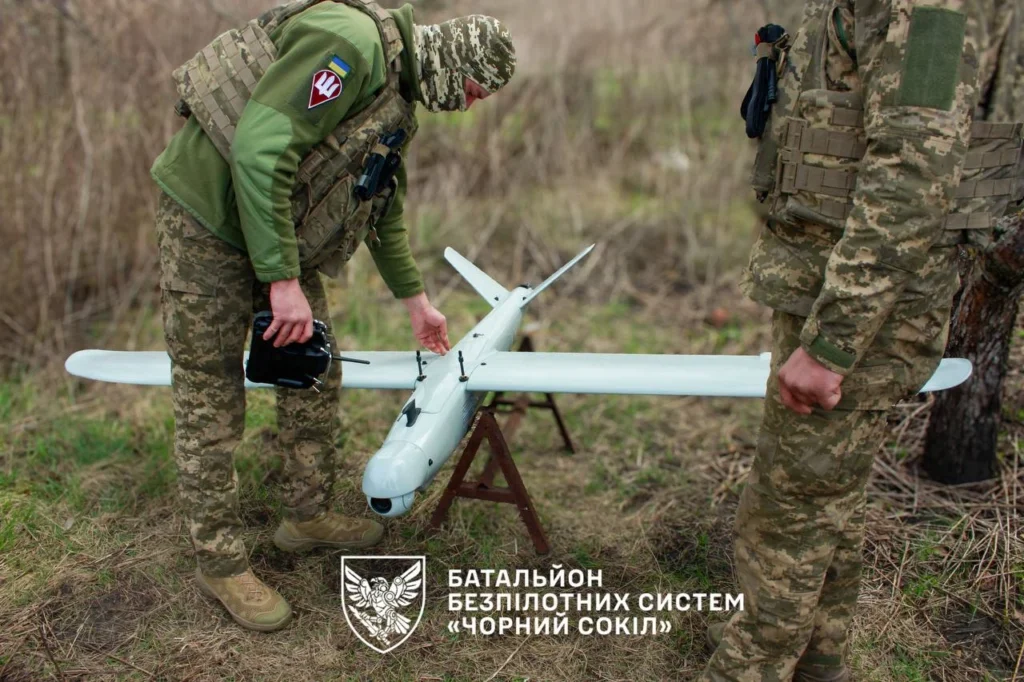
The system underwent beta testing in 2025 and entered mass production in 2026. Drones currently coming off the production line are equipped with it as standard. Norman, a pilot with the 21st Unmanned Systems Regiment Lava, tested this system with his crew. According to him, it does genuinely help evade interceptor drones under certain conditions.
The latest version of Leleka is fitted with the in-house-developed R322 camera, which features improved stabilisation, a redesigned architecture, and added switching between day and night modes. It has already completed beta testing and is being prepared for introduction across all new aircraft. One drawback of the camera previously used on Leleka is its vulnerability during landing in combat conditions, says Norman. After five or six landings on uneven surfaces with stones, branches and similar obstacles, cracks can appear on the housing through which moisture and dirt penetrate.
Norman adds, however, that cameras are the first to suffer on many reconnaissance drones. In Lava, 80% of damage is repaired by the unit itself; cameras are sent to the service centre only in cases of destruction or electronic component failure.
Both Norman and Kapelan speak highly of the company’s service. The latter says that damaged aircraft are repaired and returned on time. The Lava pilot notes the company’s accommodating attitude – it does not shift blame for damage onto the military and does not refuse repairs.
The Leleka range is currently available on Brave1 Market and can also be purchased using ePoints. Kinoloh from the Black Falcon says that while Leleka is not the most expensive system, every loss is still felt. As the enemy actively hunts reconnaissance UAVs, the military would benefit from cheaper, more mass-produced platforms. The manufacturer considers its products competitively priced within their class, given the available level of communications, range, technological solutions and service. A potential price reduction is therefore viewed as the loss of some significant component; instead, the focus is on minimising losses.
Modifications Leleka has received
The Deviro range also includes the Leleka-100 M2 variant, which sustains five hours of flight. It was developed for crews working with Bulava who have increased endurance requirements for their reconnaissance wing in the air. Thanks to a new battery, the tactical radius has also increased alongside flight time – reaching 55 km.
“You need to fly out 100 km, find the target, wait for Bulava to arrive, record the strike, and return home”, Deviro’s marketing director explains the operational logic.
In April, the manufacturer announced another feature for its UAVs – remote control. It has already been tested and is available to crews that wish to use it. Thanks to a stable internet connection, operators can control drones from any location in Ukraine.
However, the launch still takes place mostly 15–20 km from the front line. A field team connects the communications station to the internet, launches the UAV and moves to a safe location.
The evolution of the in-house mid-strike drone
In addition to spotting and reconnaissance, Leleka performs one more role – as a relay for the mid-strike Bulava drone. In this way, the company is building its own ecosystem in which one drone locates a target, and another strikes it. Bulava’s targets include logistics assets, strike systems such as artillery pieces or MLRS, radar systems and more.
Bulava took two years to develop. The drone was first used in 2024 with individual crews, and in 2025, the number of crews was scaled up. The UAV currently has two versions. The first carries a 3.6 kg warhead and is guaranteed to fly for 50 minutes over 80+ km.
The updated Bulava carries up to 5 kg of payload and has a guaranteed range of 100+ km. This version is currently undergoing combat testing.
Some crews are striking Russians at even greater distances. For example, a standard Bulava managed to fly 128 km from its launch point under the control of the 422nd Luftwaffe Regiment. However, such records are influenced by weather, crew skill, headwinds, interceptor drone avoidance and other factors.
Norman’s crew struck a stationary target with a Deviro mid-strike drone at a distance of 110–120 km. The serviceman says that the core skill to develop with Bulava is the final seconds of terminal guidance, when the pilot is hampered by wind, EW and other factors. To ease this, Deviro added a terminal guidance system to the drone.
The launch method also changed over the course of development. Initially, the drone launched from a rail catapult, the assembly time for which ultimately proved too long. This was eventually replaced by a pneumatic catapult weighing up to 10 kg, which can be carried into the field by hand and concealed after launch, or mounted on a pickup truck.
“There is a dedicated case for the catapult, spare equipment, canisters, funnels for refuelling the compressor – the full range of what is needed at a position,” the Lava pilot adds.
What is known about the interceptor’s alpha test
The company unveiled its fixed-wing interceptor drone Sokyra in March 2026. At the time, it was stated that the drone reaches speeds of 240 km/h, has a range of 45 km and can remain airborne for up to 30 minutes. The warhead weighs 750 grams.
The drone is undergoing alpha testing, and Deviro says it is “not their primary product”. It is not intended to compete with Sting or P1-Sun, as it will cost more and is being developed to support those interceptors: “During a mass drone attack, our UAVs will attempt to thin out Shahed swarms, with the remaining ones then finished off by the likes of Sting”, the company explains the operational logic.
Sokyra’s price will be higher due to certain components, such as the ground control station and the inertial navigation system. However, it has not yet been finalised, as components may change.
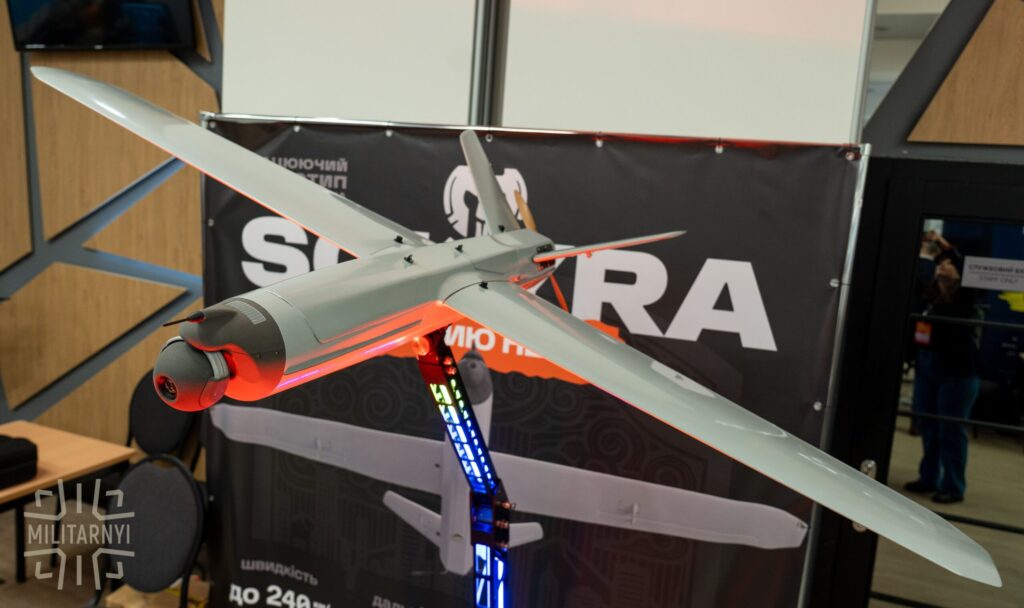
The company already states that its interceptor will be autonomous. The drone’s software is integrated with a radar, so after an enemy UAV is detected, the operator presses a button and waits for Sokyra to close in on the target. After visual confirmation, the pilot presses another button, and the interceptor begins its attack.
The developers also plan to implement an auto-detonation function using the radar. Sokyra will detonate upon approaching the target within a defined distance.
Reading now
1
Ukrainian Skyeton secures $10.6M US army contract
2
The Pentagon has announced the results of Drone Dominance Gauntlet II – announced Ukrainian companies did not make the top 5
3
Korven Systems project: How Teletactica co-founder is building an autopilot for interceptor drones
4
Ukrainian SkyFall again among winners of US Drone Dominance Program
5

Frontline Robotics CBDO Mykyta Rozhkov: Ukraine and Norway are working on an autonomous system to protect maritime infrastructure
By submitting this form, you give Defender Media consent to the processing of personal data.
Надсилаючи цю форму, ви надаєте Defender Media згоду на обробку персональних даних.

Latest news
1
Sights, radar systems and UAV components now available to the military through Prozorro Market
2
SkyFall officially unveils Thor Hammer mid-strike and announces 1,000+ km version
3

Ukrainian developer of AI tools for detecting information threats Osavul raises $10 million
4
TAF Industries plans joint UAV development with Luxembourg’s LUXUAV
5