September 28, 2026
Selected projects will receive invitations to upcoming conferences featuring investment funds

Last week, Kyiv hosted the Invest in Bravery conference, which focused on innovations in defence and dual-use technologies. One of the key events was a pitch competition featuring around 20 startups, who presented their ideas to representatives of Tillia Impact Ventures, Double Tap Investments, Defence Builder, and Nezlamni. This article presents the projects that received recognition from the jury.
Startup Pai Defence has developed the Redline system—an autonomous shield against drones already operational on the front lines. Founders engineer Tonia Zakorchemna and combat unit commander Dmytro Pulmanovskyi presented a stationary installation capable of autonomously detecting and suppressing enemy drones.
Redline comprises stationary passive antenna detectors and robotic jamming modules designed to disrupt drone control, enabling the neutralisation of enemy FPV drones before they reach their targets.
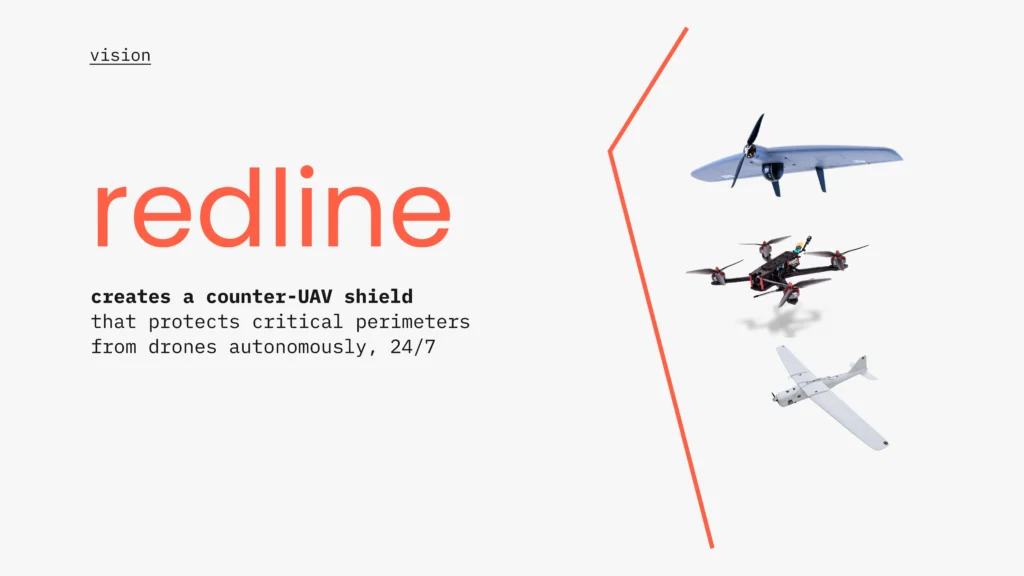
“We jam FPV drones not when they are overhead, but at the moment of their launch by the enemy. We create a kind of ‘shield against dementors’,” explains Zakorchemna. She says Redline’s current MVP — tested in active combat in Donetsk — was able to counter up to 90% of FPV drone threats within a test battalion’s area of responsibility. The system boasts a range of up to 18 km towards enemy positions.
The project was initiated without external investments and, within seven months, underwent successful frontline testing. The team now aims to scale up, develop drone classification based on combat datasets, and reduce reliance on imported components. Future plans include protecting critical infrastructure and diplomatic facilities, as well as exporting the technology.
Koalas::Systems is developing Nadra, a new communication system for drones. Designed for stable and secure control of drones and other unmanned platforms at medium distances (50–200 km), Nadra addresses the current “blind spot” between tactical and strategic communication means.
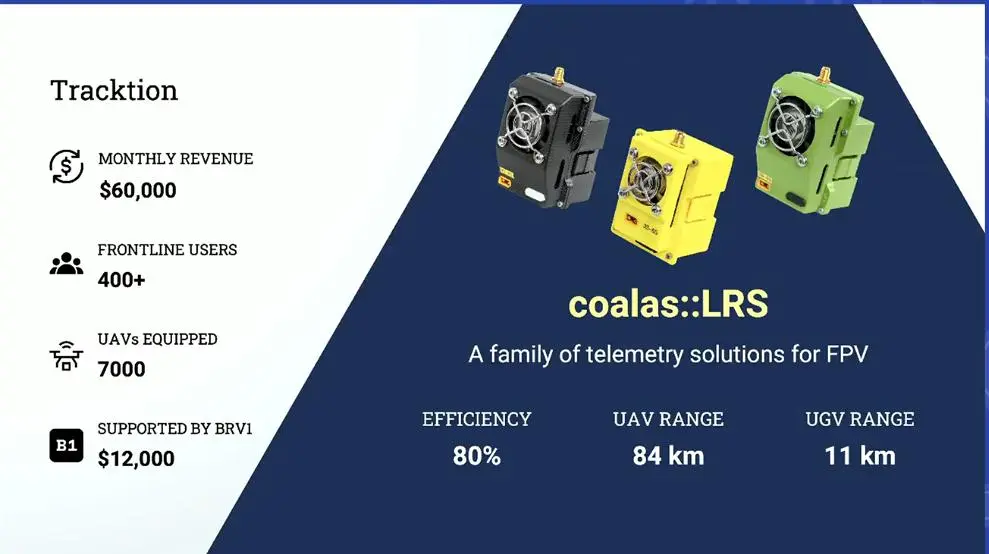
According to co-founder Yevhenii, modern telemetry systems are outdated and unreliable, leading to significant equipment losses due to communication issues. Nadra aims to be a universal solution for various drone types, including combat, civilian and ground-based systems. It is a hybrid network system featuring encryption, GPS/3G positioning and high resistance to interference.
Nadra’s development is planned in three stages: launching a basic version for FPV drones; implementing GPS/3G navigation; and deploying a full-fledged mesh network. Koalas::Systems has already released three telemetry systems currently used on the front lines—approximately 7,000 drones are equipped with them, with some units reporting efficiency increases of up to 80%.
The company positions itself as a B2B project for unmanned system developers, where Nadra will enable unified control of aerial and ground systems. The startup seeks to attract $600,000 in investment, primarily for R&D.
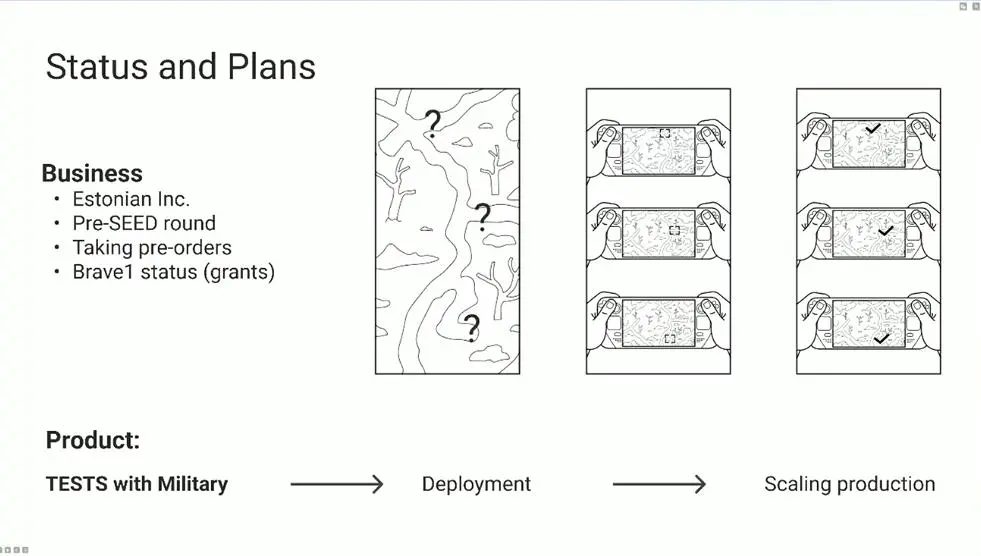
Ukrainian-Estonian startup Black Forest Systems is working on a new technological platform for the army—a simple, safe and scalable control system for combat drones, including kamikaze drones. According to co-founder and CEO Oleksandr, their goal is to equip every infantryman on the front line with a reliable drone that effectively assists in combat missions.
“We asked the military what they needed and received clear requirements: the drone should be safe, easy to use, reliable, mission-appropriate and affordable,” says the founder.
The project team is developing critical components on domestic platforms, including combat systems and power control modules, as well as proprietary communication and security architecture. In the future, this development is intended to serve as a technological foundation for a wide range of military solutions.
The company is registered in Estonia, has secured a pre-seed investment round, and is a resident of the RayOne accelerator. It is preparing to receive grants and is already testing the first version of the system with selected units of the Armed Forces of Ukraine.
Ukrainian startup Griselda has created a flexible platform for the rapid development of customised solutions in defence, security and crisis response. Griselda enables the integration and analysis of large volumes of information from intelligence, sensors, open sources and social networks, facilitating effective solutions for specific tasks.

According to founder Oleksii, “universal products simply do not work—you need tools that consider the specifics of each case.” Implemented solutions include a system for monitoring social media requests for help following the terrorist attack at the Kakhovka hydroelectric power station, developed in just 10 hours and instrumental in saving hundreds of lives, as well as a secure communication platform for engaging with vulnerable groups and those in temporarily occupied territories.
Griselda also collaborates with NATO and French defence companies, and its solutions have outperformed developments from major firms such as Google, Amazon and Oracle during exercises in Poland.
The startup has transitioned from a volunteer initiative to a commercial enterprise. Operating on a subscription model (SaaS), it already has contracts in Ukraine and is actively entering the European market. Its primary objective now is to identify partner integrators to access intelligence processing systems in NATO and EU countries.
Ukrainian startup Frontyr is developing a strike unmanned complex designed to deliver precise strikes on targets up to 60 km behind enemy lines—areas where expensive and critically important assets, including electronic warfare systems, logistics equipment and other heavy machinery, are concentrated.
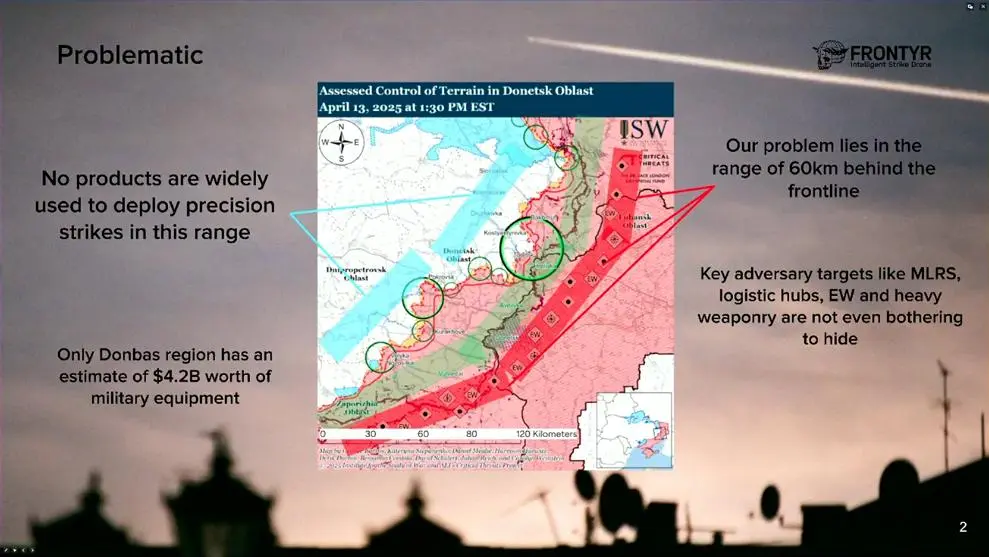
Team representative Pavlo explains that many such targets remain uncamouflaged, as “the defence forces lack sufficient solutions to accurately strike within this radius.” To address this issue, Frontyr offers a strike UAV complex comprising a drone, an antenna mast, a control unit and a catapult. Its key advantage is a digital-analogue transmitter that ensures stable operation even under intense electronic warfare interference. The drones can operate in radio silence mode and synchronously reach the target zone, enhancing battlefield effectiveness.
The team is already testing the technology in combat conditions and plans to commence sales by the end of 2025, anticipating revenue of $40 million. The cost of one complex will not exceed $4,000. Frontyr is currently seeking $1.5 million in investment to initiate mass production.
Ukrainian company Combat Vision has introduced Combat Vision 4, a decentralised combat situational awareness system already in use by military units. Developed as a contingency for a potential “technological apocalypse,” the system operates without the need for the internet or Starlink, instead utilising standard tactical radios to facilitate real-time coordination between infantry, drones and headquarters.

Combat Vision 4 is built on a proprietary 3D engine supporting augmented reality and is compatible with NATO systems. The product features a modular architecture with an open SDK, allowing third-party developers to create their own solutions. The project is seeking funding to establish a European implementation team, as the product requires user training and on-site configuration.
“We are preparing for scenarios where the internet will be unavailable—our system must function even in post-apocalyptic conditions. Today, it is already saving lives on the front lines,” emphasised Combat Vision founder and CTO Yevhen.
Invest in Bravery is a non-profit organisation that assists startups in connecting with international investors. The organisation has previously held several Pitch Days in Kyiv, Prague, Berlin and Dresden, attracting over 900 participants, including more than 100 startups and over 70 investors.

By submitting this form, you give Defender Media consent to the processing of personal data.
Надсилаючи цю форму, ви надаєте Defender Media згоду на обробку персональних даних.