
Why the Lessons Learned system is our most underrated weapon. An Op-Ed by Pavlo Musiienko, Head of Analytics at Boryviter
In a modern war where tactics and technologies evolve weekly, combat experience remains both the most valuable and the most vulnerable asset

In modern warfare, the speed of institutional learning is just as critical as the volume of weaponry. Ukraine has accumulated an unprecedented wealth of combat experience on the front lines, yet it has not yet fully weaponised this data into a systemic advantage.
In this column for Defender Media, Pavlo Musiienko, Head of Analytical Department at Boryviter Centre of Excellence, outlines why the Lessons Learned system should become a cornerstone of national defence capability, transforming hard-won insights into a strategic force multiplier.
In a war of attrition, victory belongs not simply to the side with greater raw resources, but to the one that learns and adapts faster. We can endlessly calculate the tally of artillery shells delivered by partners, missiles launched by the adversary, or the volume of domestic drone production. Yet there is one critical asset that remains surprisingly overlooked in the public discourse, despite directly dictating the efficacy of every other weapon system on the battlefield. This asset is Ukraine’s unique, combat-tested experience.
In a modern war where tactics and technologies evolve weekly, combat experience remains both the most valuable and the most vulnerable asset. If an army fails to accumulate this knowledge, secure it institutionally, and instantly convert it into actionable solutions, it loses its operational edge. The lack of institutional memory extracts the highest possible cost: the lives of soldiers. This is precisely why every modern NATO military operates a comprehensive Lessons Learned (LL) system. Far from a mere bureaucratic procedure, it is a fundamental paradigm for survival.
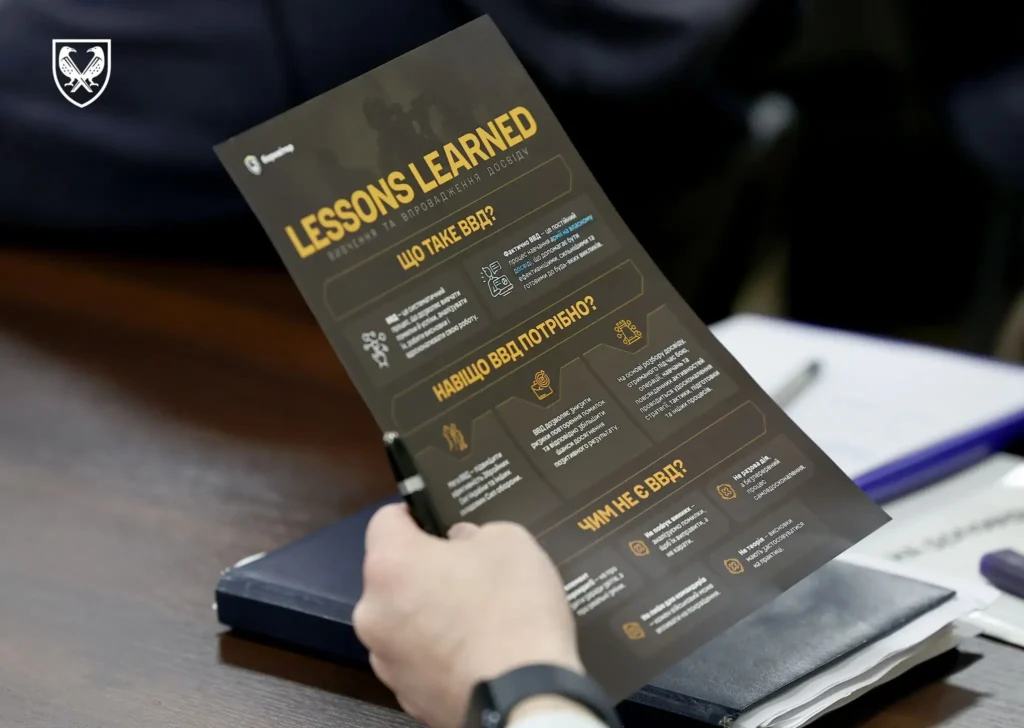
How should this system function in an ideal scenario?
The mechanism behind a robust LL capability is straightforward, operating as a continuous loop of operational adaptation. The moment a frontline unit completes a combat mission – regardless of its outcome – the command immediately initiates an After Action Review (AAR) to gather direct feedback from personnel. Soldiers document every tactical nuance on the ground: what worked well, where the adversary introduced a new tactic, and exactly how electronic warfare (EW) systems performed under pressure.
This raw data flows directly to dedicated military analysts who synthesise these battlefield observations, draw systemic conclusions and engineer targeted solutions. These insights do not sit in archives; they are rapidly weaponised and pushed back to the front lines as updated tactical instructions while being seamlessly integrated into institutional training programmes. As a result, the entire armed forces evolve simultaneously, transforming isolated frontline insights into a shared, institutionalised knowledge base that multiplies combat efficacy.
A paper structure versus trench reality
Through years of daily collaboration with the Armed Forces of Ukraine—spanning from frontline soldiers and non-commissioned officers (NCOs) to the General Staff—the Boryviter team has observed a stark contrast. On paper, Ukraine possesses a functioning Lessons Learned capability. The doctrine is approved, dedicated units exist, and specific roles are clearly defined. Yet, a massive chasm separates polished regulations from the brutal reality of the trenches. This mechanism fails to operate as a fully fledged weapon due to several deep-rooted systemic flaws.
“Islands of knowledge” and messenger chaos
Currently, the exchange of combat experience within the Armed Forces remains largely spontaneous. Commanders call one another, establishing closed groups on encrypted applications like Signal or WhatsApp to share tactical breakthroughs. On one hand, this ad hoc approach mitigates immediate crisis points in the “here and now.”. On the other, it severely compromises operational security (OPSEC) and elevates the risk of critical data leaks to the adversary.
Moreover, the experience remains dangerously isolated. If one brigade fighting on the Kupiansk axis pioneers a successful innovation, an adjacent unit deployed near Robotyne may never learn of it. Worst of all, this knowledge is heavily personalised: if a key knowledge bearer is wounded or killed in action (KIA), their unique expertise vanishes with them forever.
The fear of punishment and the Soviet legacy
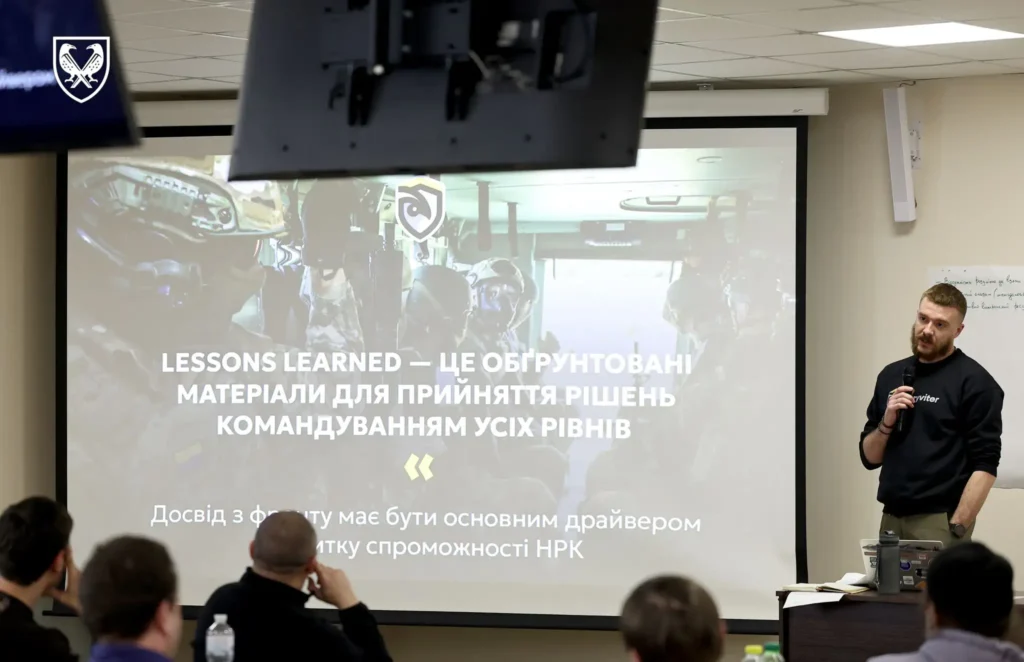
The most formidable obstacle to an effective Lessons Learned capability is not technological, but cultural: the deep-seated fear of reporting failures. In NATO militaries, the After Action Review procedure operates on a strict “leave your rank at the door” principle. The objective is never to hunt for a scapegoat, but to diagnose the root cause of an error and engineer a solution
In Ukraine, however, a deeply ingrained Soviet punitive command culture still predominates. For many headquarters, a battlefield mistake serves as an automatic trigger for an official investigation and the punishment of the “guilty.” When the constant threat of reprimands hangs over a commander, the natural human instinct for self-preservation kicks in. Consequently, operational failures are routinely masked as “successful mission execution,” practically guaranteeing that adjacent units will subsequently step on the exact same landmines.
The black hole of paper reporting
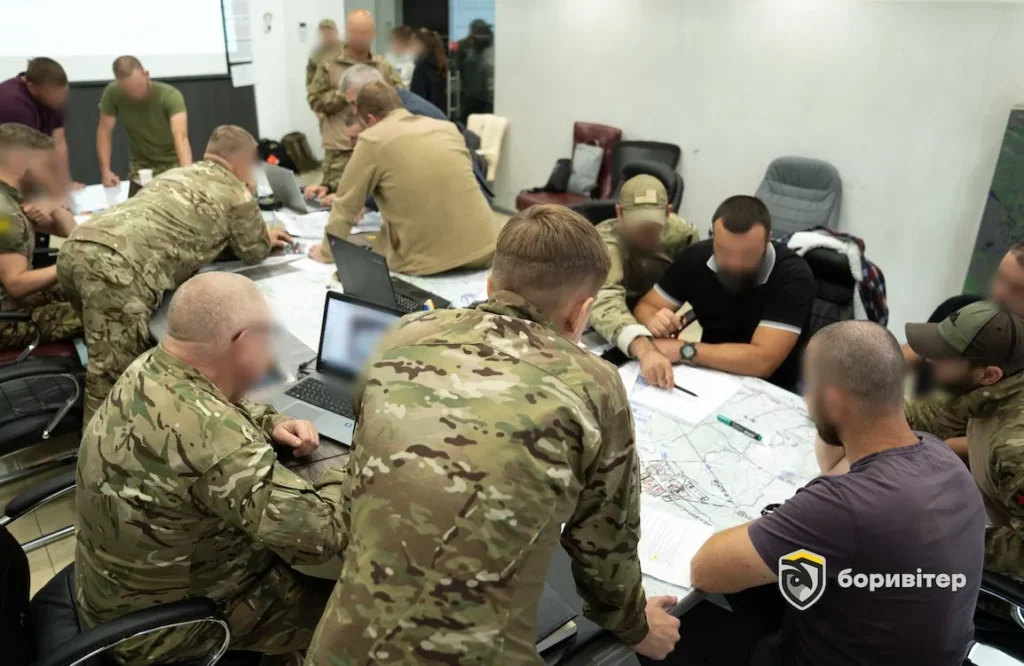
Even when operational data is collected through official channels, officers often compile reports merely as a box-ticking exercise to satisfy the chain of command. These mountains of paperwork and gigabytes of files flow up to higher headquarters, only to vanish into a black hole.
There remains a critical shortage of dedicated analytical centres capable of professionally processing this massive influx of raw data, identifying systemic trends, and transforming dry reports into updated combat manuals or training courses. Consequently, because frontline personnel experience no tangible feedback loop, they ultimately lose all motivation to share future battlefield insights.
The illusion of stability: why immediate change is essential
Resistance to change is a natural but dangerous response during high-intensity conflict. Amid relentless fighting, military leaders often adopt a pragmatic but flawed mindset: “We’re fighting, we’re holding the enemy back. Why disrupt existing processes and expend critical resources on reforms now?”
However, attempting to maintain the status quo in a technology-driven war merely masks the underlying institutional crisis.. Conserving inefficient approaches guarantees systemic stagnation, allowing an inherently adaptable adversary to outpace us on the battlefield.
Our ultimate objective must be to move from a punitive culture of blame to a dynamic system that learns. This paradigm shift demands colossal effort and structural overhaul. Yet, every resource invested today in building an effective Lessons Learned capabilitywill yield exponential operational returns tomorrow: preserving the lives of our personnel and securing a decisive tactical and strategic advantage.
Boryviter’s Analytical Department is actively collaborating with the Ministry of Defence and the General Staff to drive this this process forward. We urgev fellow defence analysts and international partners to join this effort, persistently chipping away at the bureaucratic monolith to forge a modern, universally adaptable military force.

Pavlo Musiienko
Head of Analytical Department
Boryviter Centre of Excellence
Reading now
1
Ukrainian Skyeton secures $10.6M US army contract
2
The Pentagon has announced the results of Drone Dominance Gauntlet II – announced Ukrainian companies did not make the top 5
3
Korven Systems project: How Teletactica co-founder is building an autopilot for interceptor drones
4

Ukrainian SkyFall again among winners of US Drone Dominance Program
5

Frontline Robotics CBDO Mykyta Rozhkov: Ukraine and Norway are working on an autonomous system to protect maritime infrastructure
By submitting this form, you give Defender Media consent to the processing of personal data.
Надсилаючи цю форму, ви надаєте Defender Media згоду на обробку персональних даних.

Latest insights
1
Everything about the RAM-2X mid-strike drone: interview with Ukrspecsystems deputy director Andrii Rymaruk
2

A demo is not demand: How to prove the value of a defence tech product. Column by Tekever Ukraine Director Kateryna Bezsudna
3

How to choose the right video link for an FPV drone: analogue, digital, or fibre-optic?
4

How a frontline signal becomes an engineering task. A column by Defence Builder Accelerator Director Yana Shkvarovska
5