Vluchnyk develops interceptor planned for production in Sweden and other countries: what attracted investors and what the team is working on
Company preparing several products in the small air defence sector. ‘Nothing like this exists in Ukraine yet’, hints co-founder

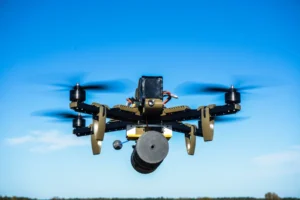
Zorelit v4 interceptor drone (Photo: Vluchnyk)
Ukrainian company Vluchnyk has gone from assembling FPV drones to supplying the army with its own Zorelit v4 interceptor. The team does not share stats on its performance, however, Scandinavian investors from Hede Capital and Skylen have already put their trust in it and invested money in its development.
The company’s founders, Platon Presich and Stepan Radiboh, are currently preparing to launch several joint ventures with foreign partners. At the same time, they are responding to the threat of jet-powered drones by improving their interceptor and preparing to unveil a new version.
Defender Media spoke with the founders of Vluchnyk and its investors and tells the manufacturer’s story and plans.
How Vluchnyk started out
Vluchnyk’s story, like that of many other companies, began with volunteering. Presich delivered various forms of aid to the Armed Forces from abroad while working in land management, law, and construction. Radiboh also helped him while working at his own IT company.
In 2023, the founders began work on their own terminal guidance system for drones. ‘We came to realise that volunteering is good, but you can do more’, Presich recalls.
However, after a year of work, development of the ‘last mile’ system was moving too slowly, so the team switched to assembling drones – something that could bring benefit here and now. By then, it already had assembly experience, having built drones to test its terminal guidance system.
In 2024, Presich and Radiboh registered the company, which currently employs up to 15 people. The enterprise supplied the military with kamikaze drones of several sizes, as well as a bomber.

The shift into air defence
Over time, the company stopped assembling conventional FPV drones. They explained this by saying the market had become too saturated with major players.
Instead, the air defence direction was ‘moving along quite well’, and scaling up against Shaheds was relevant.
‘We were making interceptors in a ten-inch drone form factor. They worked well, so we decided to try ourselves against more complex targets’, says Radiboh.
This is how the Zorelit v4 interceptor drone appeared – currently the company’s core product, designed to shoot down Shaheds. It was first tested in September 2025, and the first supply contract was closed in December of that year.

The interceptor has six modifications, differing in cameras, communications and the presence of artificial intelligence. Each version can have either a standard flight range of 46 km or an extended range of 65–70 km.
Prices also vary, ranging from UAH 35,100 to UAH 95,900.
The interceptor’s maximum speed is 348 km/h, and at a cruising speed of 135 km/h it can fly for around 25 minutes. Its warhead weighs 300–600 g.
What attracted investors’ attention
At the outset, each founder invested $30,000–40,000 of their own funds in the project. In 2025, the company received grants from Brave1 and Lviv City Council. According to data from the YouControl analytical platform, the latter provided Vluchnyk with UAH 2.5m. That same year, the startup attracted investment from the Scandinavians at Hede Capital and Skylen.
The Swedish investment company Hede Capital Partners AB is an active player in the Ukrainian defence tech investment market. Over the past two years, it has invested in domestic defence startups Sky Hunter, Black Forest Systems, MaXon Systems, Bravo Dynamics, Aeromotors and Trinity Robotics.
Its founder, Patrik Olson, says they were drawn to the combination of Vluchnyk’s team, engineering approach, and a product developed with the realities of war in mind.
‘We saw a team that understands that an effective interceptor has to be more than technically impressive. It needs to be cost-efficient, scalable, rapidly deployable and capable of evolving as the threat changes’, the investor explains.
The Danish platform Skylen invested in Vluchnyk for two reasons, says senior advisor Alexander Nielsen. First, they want to help expand Ukrainian air defence. Ukraine currently needs large volumes of counter-drone systems, and Denmark and the rest of Europe need them too.
The second reason is the team, which they met at last year’s DALO Industry Days and ‘felt an instant connection’. The investor received a minority stake in the company, but ‘big enough to matter’.
Nielsen does not disclose the investment amount, but adds that they are contributing more than money. The startup uses ComplyTrain – a Danish platform created to help small and medium-sized businesses obtain certification to ISO and AQAP standards. These are necessary to sell products to Western procurement agencies.
A response to jet-powered Shaheds
The company’s product is currently used by up to 10 combat units. They do not disclose kill statistics, however, the most widely used version is the interceptor with a 384-pixel night camera. It has shot down the most targets.
At the same time, developers say there are now fewer targets for standard interceptors – the Russians are not using as many petrol-engine Shaheds as before.
Instead, jet-powered drones have become a pressing problem: Banderol or modifications of Geran.
To counter them, Vluchnyk is developing a new product – the Zorelit v6, which will reach speeds over 400 km/h and climb to an altitude of 5 km.
The new specifications are achieved through more expensive components, so the interceptor’s price will also be higher than current versions – around UAH 85,000.

Plans for full autonomy
The artificial intelligence used by Zorelit is the same terminal guidance system the developers started with, which they have since adapted for aerial targets. It detects enemy drones at a distance of around 800 m, after which it can automatically strike the target.
At the same time, for Ukrainian interceptor manufacturers, detection and terminal guidance are only an intermediate stage on the way to full autonomy. Under this scenario, the drone takes off independently, moves onto the optimal trajectory, and automatically locks onto and strikes the target.
Such a project has already been implemented by F-Drones; defence tech startup MaXon Systems has created technology that automates 95% of the entire Shahed interception process. The Fourth Law is also working on autonomy, having earlier presented the Zerov-8 interceptor.
Vluchnyk’s founders say they are already testing an autonomous control and target-area approach system at a testing range.
‘The drone takes off by itself, switches into high-speed mode and reaches the target thanks to integration with SkyMap’, the developers say. SkyMap is a system that collects data on aerial targets from radars and sensors.
After visually confirming the target, the terminal guidance system engages. The team is currently improving its detection and ‘last mile’ systems, after which it will move on to combat tests of autonomous navigation.
Awaiting an export permit
In addition to Zorelit, the company is preparing several other products in the small air defence sector. Its details are not currently disclosed. ‘Nothing like this exists in Ukraine yet’, Presich only hints.
At the same time, the team is negotiating to set up several joint ventures with European companies.
One of these is Scandinavian X, founded by the Swedish investment company Front Ventures, Skygaard, Hede Capital and Vluchnyk. Under the plan, Scandinavian X will produce interceptor drones under licence from the Ukrainian manufacturer.
However, although the venture was announced in 2025, it has not started operating because it lacks an export permit. The manufacturer and the investors involved in the project say they are still waiting for it, although the Swedish government supported the application.
Vluchnyk adds that the steps being taken towards export are unequivocally positive. However, the process remains complicated and, in some respects, unclear.
As for other partners, the company had planned to sign its next joint venture agreement by the end of summer, but the process is still ongoing. Vluchnyk has not yet disclosed who exactly has become a partner.
Reading now
1

380+ vacancies in Ukrainian defence tech from Fire Point, DevDroid, UFORCE and others
2

A new Ukrainian fund, WildField Ventures, plans to invest $10-15 million in 20 dual-use startups. What areas is it interested in
3

230+ vacancies in Ukrainian defence tech from Tencore, Zvook, Airlogix and others
4
SkyFall unveils new StarGate hexacopter for casualty evacuation
5
Ukrainian units conduct “world’s first airborne evacuation from the frontline” using Audag-6 drone
By submitting this form, you give Defender Media consent to the processing of personal data.
Надсилаючи цю форму, ви надаєте Defender Media згоду на обробку персональних даних.

Latest news
1
Black Mirror #82: Filin cruise missile, Geran upgrades, new interceptor drones and other Russian miltech developments
2
Ukrainian defence firms sign 54 subsidised leasing agreements worth UAH 244.5 million
3
Himera and Danish GomSpace launch OBRIA NANO – a test satellite for the future Ukrainian communications network
4
TAF Industries and DoD Solution have integrated the Aura autonomy module into the Kolibri 10 Advance FPV drone
5