What is working and what isn’t with modern Ukrainian munitions: Key takeaways from the Brave1 Advantage discussion
A panel discussion featuring military personnel, UAV operators, engineers, and manufacturers
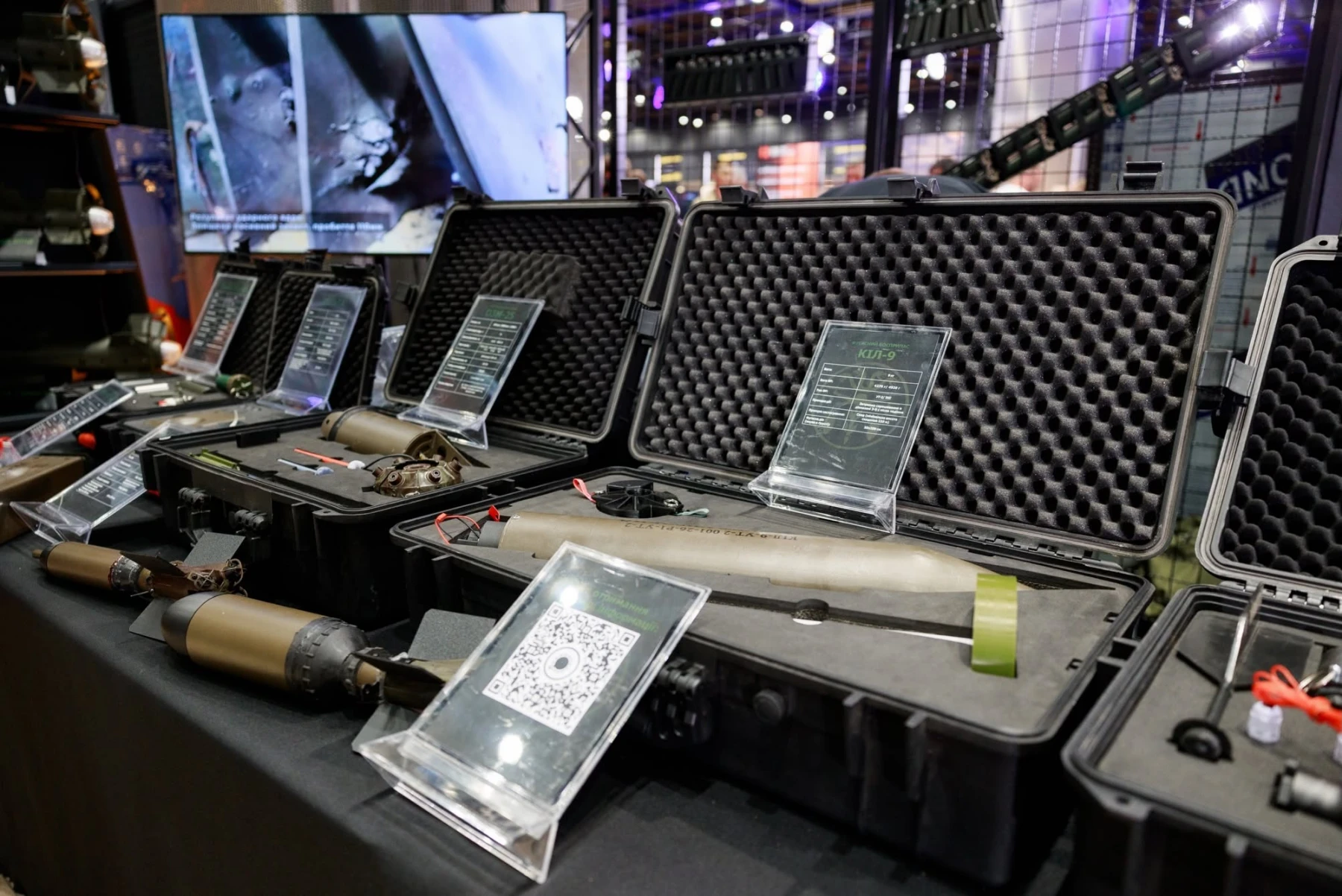
Explosives on Brave1 Advantage exhibition
Since 2025, Ukraine has been investing heavily in the production of domestic explosives, and military representatives note the emergence of a number of successful developments. At the same time, many problems remain unresolved: improvised production, the “cult of the explosively formed penetrator,” and the lack of replacements for certain popular Soviet-era munitions.
The industry’s main challenges, practical solutions for improving explosive devices, and pathways toward more effective cooperation between frontline units and industry were discussed by participants at a panel session during the recent Brave1 Advantage conference in Kyiv. The discussion brought together military personnel, UAV operators, engineers, and manufacturers.
Defender Media summarized the key takeaways from the discussion.
The depletion of Soviet stockpiles and improvised production
During the discussion, military practitioners noted that Soviet munition stockpiles at the front have effectively been exhausted. In particular, this applies to HEAT shells of the PG-7ML type, which had a mass of about 2.4 kg and provided armour penetration of up to half a metre. Currently, no Ukrainian manufacturer produces a serial equivalent with similar characteristics.
Faced with a shortage of ready-made factory solutions, strike reconnaissance units and UAV operators have been forced to manufacture munitions in-house — procuring empty warhead casings and filling them with explosive compounds in field conditions. Service members stressed that such improvised production poses extreme hazards to personnel, compromises aircraft aerodynamics and balance, and relies on ammonium nitrate or industrial explosive mixtures that render the munitions largely ineffective.
Military personnel see the solution in a strict requirement for manufacturers: all loitering munitions and mid-strike class drones must be delivered to the Armed Forces equipped with factory-fitted, fully codified warheads available in all necessary operational variants. Industry must fully take on the task of equipping munitions with high-quality military-grade components so that UAV operators receive ready-made devices from storage and do not risk their lives in field workshops.
Abandoning the universal munition
As Ukraine scales up mass production, domestic developers must move away from the concept of a “universal munition.” Attempts to combine explosive filler and an explosively formed penetrator (EFP) into a single warhead intended “for every target” have proven equally ineffective against buildings, armored vehicles, and field fortifications. The Armed Forces require specialized munitions tailored to distinct mission profiles: dedicated warheads for antipersonnel, anti-armour, and anti-fortification roles.
Service members also pointed out the operational limits of the “EFP cult.” Such warheads are effective primarily on FPV drones equipped with contact probes. When a drone strikes walls or structures at high speed, the penetrator detonates on initial impact, failing to inflict the intended internal damage.
“To achieve real results, industry must move away from improvised technologies — 3D printing, which cracks and crumbles in freezing temperatures, tape, cable ties, and glue. It is time for Ukraine’s defence industry to master machine tools for serial metalworking,” says “Barista,” a serviceman with the 1st Separate Centre of Unmanned Systems of the Unmanned Systems Forces.
Experts also noted that “Soviet engineering flaws” still persist in munition production. For example, fragmentation grooves are mistakenly machined on the outside of the casing by many manufacturers for ease of holding, even though to guarantee metal rupture and fragment formation, they must be located exclusively on the inside.
Quality control: from remote mining to terminal guidance modules
The panel also highlighted successful Ukrainian developments that have demonstrated high combat effectiveness without requiring field modifications. Specialized remote mining munitions have yielded strong results — particularly the OZM-25 mine, engineered for deployment from heavy bomber UAVs. These systems enable the creation of complex, combined minefields that completely halt enemy movement. Military personnel expect this product line to expand and are calling for the rapid fielding of Ukrainian mines equipped with seismic target sensors — systems capable of filtering out animal movement or incoming artillery impacts to trigger strictly on approaching vehicles or infantry.
Another standout development is a terminal guidance module for munitions weighing up to 9 kg, engineered by the Ministry of Defence’s Innovation Department. Priced at approximately UAH 10,000–11,000, the module enables heavy UAVs to adjust their flight path using a thermal signature, achieving target accuracy between 0.5 and 1.5 metres.
In closing, participants underscored that direct, transparent feedback remains the key to scaling successful technologies. As a case in point, they cited an instance where official military reviews identified defects in a batch of 2,500 drones that would have required over UAH 8 million in field modifications. Following this feedback, the manufacturer promptly rectified the flaws across all subsequent deliveries for the Armed Forces. The ultimate goal remains unchanged: ensuring military units receive fully codified, combat-ready weapons that perform reliably right “out of the box.”
Reading now
1

400+ jobs in Ukrainian defence tech from BlueBird, Vyriy, The Fourth Law, Odd Systems and other sector leaders
2
20 Ukrainian companies are working on jet-powered interceptor drones. Firebolt Engineering is among them
3

Former defence minister Mykhailo Fedorov launches fund to invest in defence tech
4

Swarmer co-founder Serhii Kupriienko steps down as CEO, Alex Fink takes over
5
Unwave’s Stepovyi Viter mid-strike drone passes codification: what we know about this UAV
By submitting this form, you give Defender Media consent to the processing of personal data.
Надсилаючи цю форму, ви надаєте Defender Media згоду на обробку персональних даних.

Latest news
1

70+ vacancies in Ukrainian defence tech at Ukrspecsystems, Strix Air, DoD Solution and other industry leaders
2

Manufacturers are not being paid under the ePoints programme due to new budget approval requirements, —Fedirko
3

Tencore unveils TRAX Utility firefighting UGV
4

Ukraine and Canada sign a declaration on defence cooperation, Drone Deal expected by end of September
5