An investment round and a new product line. What Oko Camera – one of Ukraine’s largest thermal imager manufacturers – is working on
The company has already signed more than 15 foreign contracts and is in talks to create joint ventures abroad

Oko Camera CEO Denys Nikolayenko (Photo provided by the company)
In 2022, entrepreneurs and volunteers Denys Nikolayenko and Yevhen Syvachenko decided to create their own drone for the Ukrainian army. But officially purchasing and importing the thermal imaging camera they needed into Ukraine was difficult and slow. At the time, no serial solutions were produced in Ukraine.
The problem the co-founders faced in 2022 defined the development trajectory of their future company. Instead of drones, they focused on the cameras used by Ukrainian and foreign drone manufacturers.
Oko Camera concentrated on specific segments, including optical navigation, UGVs, turrets, and various types of UAVs – from bombers to interceptors. In addition to the basic Oko Core line, the company is launching the advanced Oko Pro line with powerful capabilities. In parallel, the team is preparing for a new investment round and expanding sales abroad. Defender Media spoke with Oko Camera CEO Denys Nikolayenko about the manufacturer’s history and ambitious plans.
“Several new partnership requests appear every week”
After volunteering during the defence of Kyiv in February-March 2022, Nikolayenko and Syvachenko decided to work for the country’s security. “At first we planned to make a drone with a thermal imaging camera,” says Denys, who became the company’s CEO. “But at that time, it was difficult and slow to officially purchase such a camera in Ukraine.”
Nikolayenko had an engineering background and, at that time, was developing the software company Temy with partners. Syvachenko was a scientist working on quantum-chemical calculations of molecules. He later worked at an IT company dealing with software and hardware, and in particular had experience working with cameras. He became CTO of Oko Camera.
The company was launched with their own money and funds from two investors: entrepreneurs from Ukraine and Germany. The first to believe in the idea of a Ukrainian thermal imaging camera was one of the large drone manufacturers, whose name is not disclosed. Later, new clients joined, and the cameras are now actively carrying out combat missions.
“Several new partnership requests appear every week,” says Denys Nikolayenko. Among them are UAVs, UGVs, turrets, and armoured vehicles. Overall, these are relatively expensive systems – FPV drones are not currently the company’s focus.
One of the few public integrations is the Predator remotely controlled combat module by UGV Robotics, which is equipped with the company’s thermal imaging cameras. The system is integrated onto UGVs, pickups, boats, and helicopters, can shoot down aerial targets, and uses AI and a ballistic calculator for detection, automatic tracking, and engagement. UGV Robotics notes that they consider Oko cameras a good product and are currently testing them. After trials, the turrets equipped with them will be transferred to combat duty.
The company’s products are also used by the Termit 2.0 UGV from Tencore – the most widely deployed ground drone in the Armed Forces. Tencore CEO Maksym Vasylchenko says the camera on the system is the operator’s eyes, so it is extremely important that it be of high quality and that the developer provide service and round-the-clock online support. It also matters to Tencore that Oko Camera does not use Chinese components in its products, and that the team accepts criticism and technical requirements, and devotes time to the product.
Oko Camera operates on a B2B model. Its largest clients are drone manufacturers fulfilling state contracts. The developer fulfilled its first order from the state in 2024 – these were cameras for large bomber drones.
Compared to 2024, in 2025 the company grew both in production and in revenue. Its income amounted to UAH 89 million, compared to UAH 39 million in 2024, according to the YouControl analytics system. This year, the management plans to grow even more, but notes that the company is not yet profitable, as it is actively reinvesting in its development.
What is known about investment in Oko Camera
Throughout its existence, the company has raised external funds in various forms: loans, credits, and investments. Brave1 awarded it a grant in 2023, the team won $15,000 at a competition during the IT Arena event, and the MITS fund also invested in it.
Denys Gurak, co-founder and COO/CIO of MITS Capital, calls the company a typical case for their accelerator: “The founders assembled a good team that makes a needed product and has a clear vision of where to move next.” According to him, Oko Camera was among the first players on the market and has made considerable progress in recent years: it has established a full development cycle, built up production, and is actively expanding partnerships.
The demand for high-quality cameras, especially with minimal dependence on Chinese components, is not declining, Gurak adds. At the same time, the market is moving to a new stage of development, where standard venture pre-seed or seed cheques are not enough for scaling, and manufacturers need to look for institutional investors.
Oko Camera currently has projects that require investment, so it plans to close an investment round by the end of the year. Nikolayenko adds that the amount depends on the investors, and the money is needed to increase production capacity and expand its presence abroad.
How the company entered foreign markets
Oko Camera’s products are already present abroad. The company took part in an experimental project by the State Service for Export Control, which concerned the launch of an electronic system for obtaining permits and conclusions.
The cameras are included in the list of dual-use goods. To export them, the manufacturer must conduct an assessment, demonstrate that the product genuinely has a dual-use purpose according to formal criteria, and obtain a supply permit.
Documents are usually submitted to the export control service physically, and a response takes up to 30 days. Nikolayenko says that with the electronic system, documents can be submitted and conclusions and export licences obtained more quickly. Experts were able to respond within a day.
The experiment has ended, but during its operation, Oko Camera signed more than 15 foreign contracts. The CEO adds that he sees strong demand from foreign companies that are either present in Ukraine or interested in Ukrainian components. At the same time, the manufacturer’s production capacity is greater than domestic demand. However, the company does not disclose exact figures.
It also does not name its foreign customers, but it is known that these are companies from the European Union, the United States, and Canada. “Among the customers are leading world-class companies,” Nikolayenko recalls.
What is known about Oko Pro – the company’s new camera line
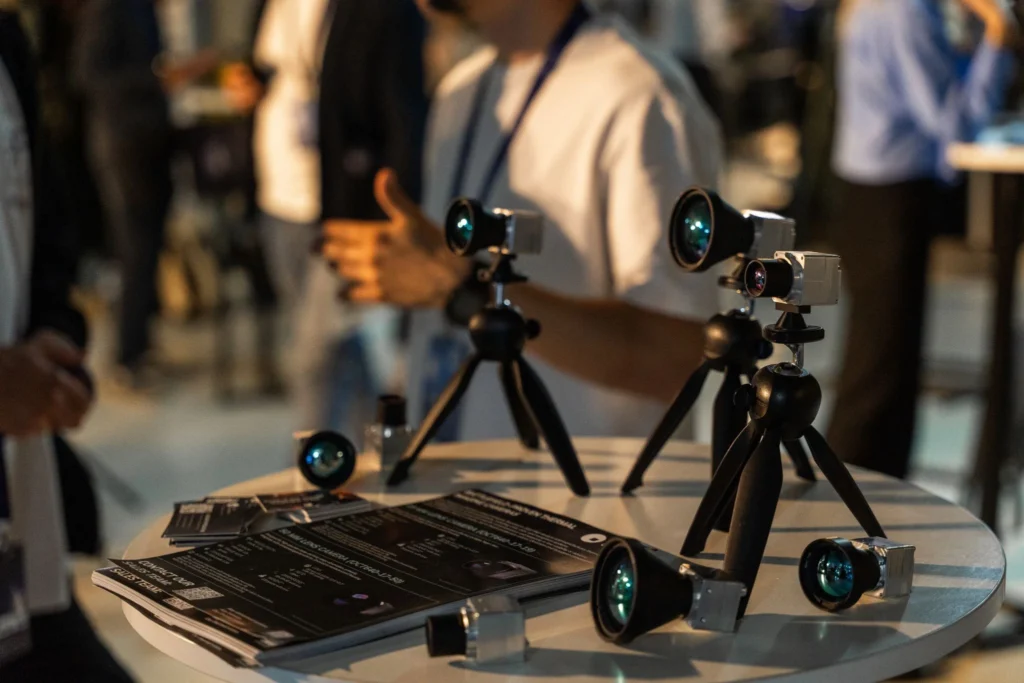
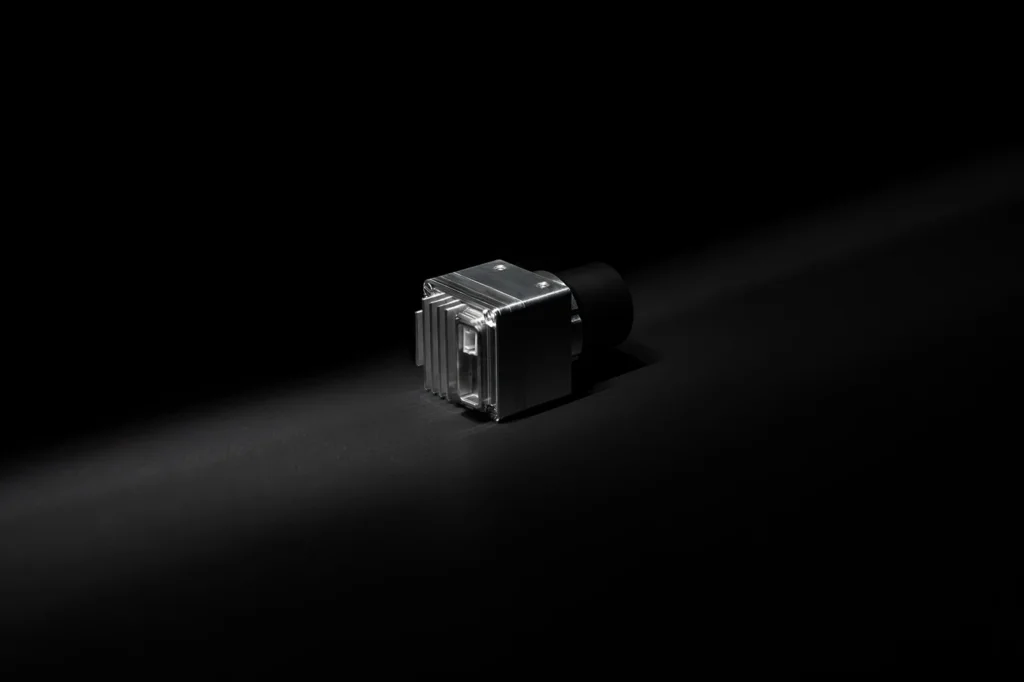
The company showed the first camera prototypes in 2023 and now has two product lines. Oko Core is already mass-produced and contains seven models that differ in optics. At the same time, all of them have a USB interface for connecting to microcomputers.
The new Oko Pro line is designed specifically for computer vision tasks. The cameras are now available for pre-order, and mass production is due to begin in the third quarter of 2026. Like the previous ones, these models have a 17-micron sensor with a resolution of 640×480 pixels, which delivers high image quality.
The team optimised the line specifically for unmanned and robotic systems based on machine vision algorithms. Oko Pro has a dual MIPI CSI-2® + USB 2.0 interface, built-in video processing, ultra-low latency of up to 17 or 34 milliseconds (depending on the frame rate), and is capable of transmitting a raw 16-bit video stream. The post-processing algorithms in the Pro have also been improved, as a result of which the image has become better as well.
The processing speed the company refers to is important for interceptors or anti-aircraft turrets, which need to detect and track a target at high speeds. Several interceptor drone manufacturers are currently testing the company’s cameras, but by the end of the year, it plans to release models that are even better suited to this type of UAV.
WinFly, which develops interceptor drones, says that for a daytime interceptor, the key parameter is the field of view. The operator must see the target far away and clearly. At the same time, they add that the drawback of Ukrainian manufacturers in general is price and availability: “Production capacities are overloaded, they have a queue months ahead.”
That is why the company currently uses Chinese products, and in order to build up levels of autonomy, it has begun creating its own video system and camera.
How localised is the production of these cameras
70 people work on development and production at Oko Camera. All specialities remain in short supply, but the most critical are product managers who have worked with high-tech products.
At the same time, Oko Camera states that it manages to develop the equipment needed for production itself. This allows it to solve complex engineering tasks quickly and cheaply – for example, the company developed its own camera calibration technology. It also developed the electronics in the Pro cameras.
Components for the cameras are bought in Ukraine and Europe, with a 50/50 split. Optics and sensors, in particular, remain imported. To eliminate this bottleneck, another camera manufacturer, Odd Systems, has begun building a plant in Ukraine for the serial production of sensors.
Nikolayenko calls the project ambitious and one that requires time: “Producing a sensor means 10 enterprises, each of which has more than a thousand square metres of clean rooms. If it is only about assembly, that is simpler.” At the same time, the European sensor manufacturer partners are also aiming to scale up to cover their clients’ needs.
In Nikolayenko’s view, what can realistically be localised in Ukraine is the production of optics, wires, and microelectronic products. “The simplest, in my opinion, is the production of printed circuit boards. There are rumours on the market that this is being planned and that it can realistically be done in a fairly short timeframe,” says the company’s CEO.
The company’s next steps on the Ukrainian market – and beyond
The total volume of the thermal imaging camera market in Ukraine is 1.5-2 million units per year, according to research by Oko Camera. 90% of them are for FPV drones, but this segment is mostly covered by Chinese thermal imagers.
Among the best-known Ukrainian camera manufacturers are Oko Camera and Odd Systems. Yaroslav Azhnyuk’s company previously focused on thermal imaging cameras – it is known that their Kurbas is used on Sting interceptor drones by Wild Hornets. But recently, the company presented its first daytime camera, Svitlych-662. Seek UAV, Ochi Nochi, and several other projects also work with cameras.
Oko Camera’s focus this year is to diversify its portfolio and expand production. In parallel, it is considering work abroad – this is more about selling its products than about a manufacturing presence there. However, Oko Camera is currently in talks with several companies regarding joint ventures.
At present, most of the joint ventures that Ukrainian companies are creating with foreign partners concern finished products. The pioneers here were Frontline Robotics and Quantum Systems, which jointly produce the Zoom and Linza drones at German facilities. The launch was announced in December 2025, and in April 2026, the first batch of UAVs was sent to the Armed Forces of Ukraine.
In total, Defender Media has written about more than ten joint ventures announced by Ukrainian companies. These are mostly deals in the Build with Ukraine format – a model under which production is set up in a partner country using the Ukrainian technological base, experience, and competencies, while the intellectual property rights remain in Ukraine. The products of such ventures are sent to the Armed Forces of Ukraine.
However, not everyone focuses on finished products. General Cherry and Croatia’s ORQA are building an underground plant in Ukraine that will focus on producing components for drones. The partnership will be the first under the Build in Ukraine programme – a model in which foreign defence companies set up production directly in Ukraine.
Oko Camera is not currently disclosing many details beyond the fact of the negotiations themselves. It adds only that the partners already have the level of technology that will allow them to manufacture products under the Ukrainian brand. However, the success of the deals depends on state decisions, the company’s CEO believes.
Reading now
1

260+ vacancies in Ukrainian defence technology at BlueBird Tech, Sine Engineering, Buntar Aerospace and more
2
Forbes: Airlogix plans to raise $100m at a $2bn valuation
3
Japan signs contract with Ukrainian company SkyFall to procure interceptor drones
4

A new Ukrainian fund, WildField Ventures, plans to invest $10-15 million in 20 dual-use startups. What areas is it interested in
5

230+ vacancies in Ukrainian defence tech from Tencore, Zvook, Airlogix and others
By submitting this form, you give Defender Media consent to the processing of personal data.
Надсилаючи цю форму, ви надаєте Defender Media згоду на обробку персональних даних.

Latest news
1
Ukraine approves simplified mechanism for building underground facilities for defence industry
2
Vyriy Industries reveals price and configuration of Slavic reconnaissance drone
3
For the underground operation Veles, the Khartiia Corps used its own technological solutions for communication and navigation
4
Denmark to guarantee €100m EIFO loan for Fire Point’s Danish subsidiary
5