How a defence venture studio works: Interview with Bifrost Defence’s Nicholas McGowan von Holstein
On the company’s details, collaboration with Ukrainian military, and the role of EDTH in developing defence innovations in Europe
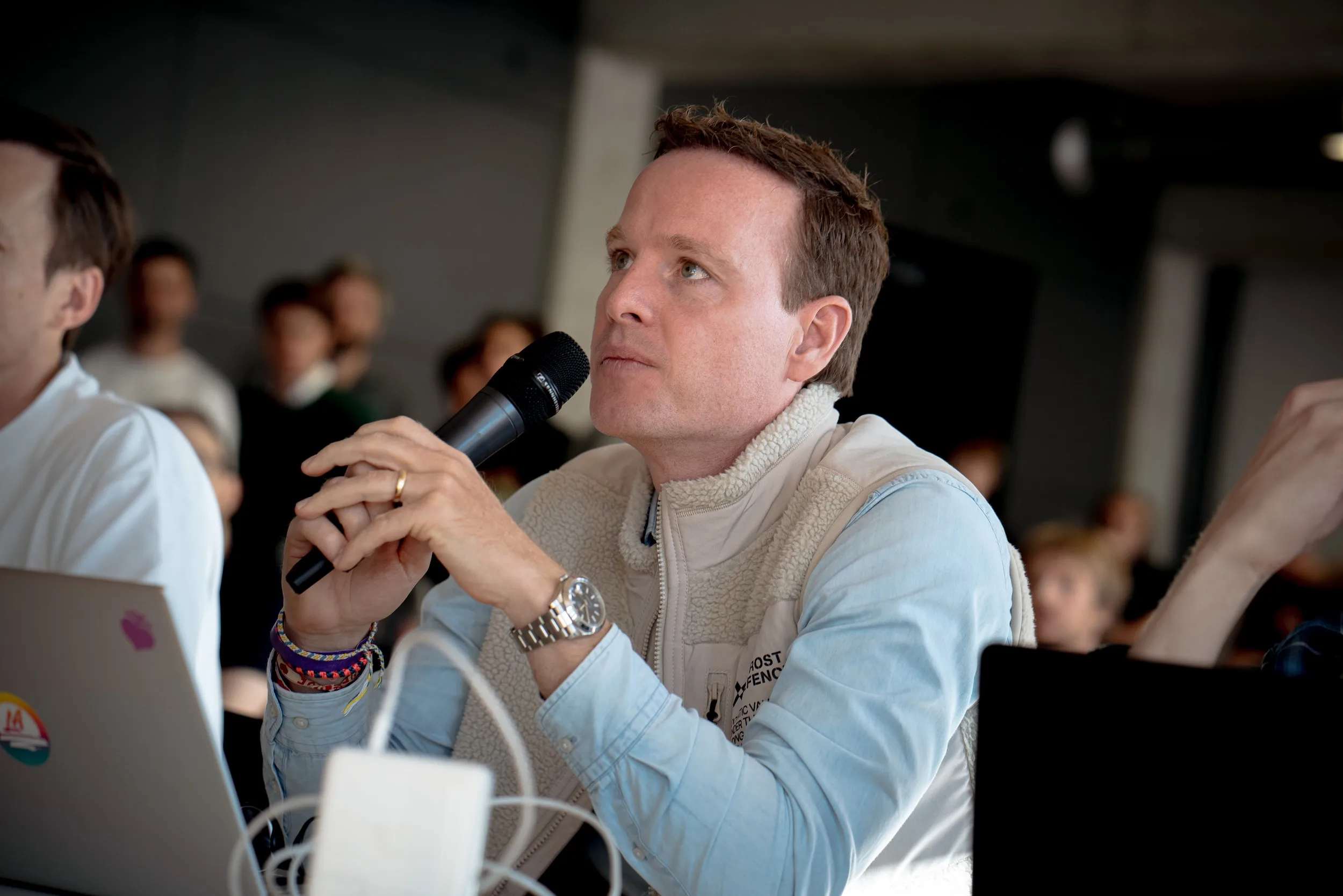
Nicholas McGowan von Holstein at the EDTH hackathon / Photo: Akim Karpach
A conversation with Nicholas MacGowan von Holstein — the first interview in the special project Rewiring European Defense Tech, which Defender Media is conducting in partnership with European Defense Tech Hub.
In 2025 EDTH finally held its first event in Ukraine – bringing together the largest defence hackathon in Europe and the country where defence innovations are developing the fastest on the continent (though not by choice). The May event in Lviv made a big splash and established EDTH as a leading ecosystem player connecting market participants from various countries and segments.
The joint project kicks off ahead of the second Ukrainian hackathon by EDTH, which will be held in the Ukrainian capital for the first time. Before, during and after the event, we will publish interviews with hub partners, founders from their ecosystem and other speakers who clearly understand EDTH’s value for the development of defence technologies in Europe.
Copenhagen-based Bifrost Defence, founded in 2025, has quickly established itself as a new kind of player in Europe’s defence innovation ecosystem — a venture studio that builds startups from the ground up rather than just funding them.
With €2 million in initial funding and three ventures already in motion, the studio partners with founders, engineers, service personnel, and hackers to transform early ideas into scalable, mission-ready technologies.
In an interview with Defender Media, Nicholas MacGowan von Holstein, founding partner and managing director at Bifrost Defence, explains how the company’s model differs from traditional VC funds or accelerators.
By combining venture-building expertise with direct engagement on the front lines — from Ukraine to European hackathons — Bifrost aims to turn raw innovation into real impact.
MacGowan von Holstein, who plans to gain firsthand experience on the front line in November, shares how wartime ingenuity is fueling Europe’s defence tech revolution, why Ukraine’s battlefield innovations are vital for the continent’s security, and how Bifrost is working to build a resilient, pan-European defence ecosystem.
Defender Media: Bifrost Defence positions itself as a “defence venture studio.” How does that model differ from a traditional VC fund or accelerator in the defence space?
Nicholas MacGowan von Holstein: Bifrost Studios is essentially the parent company, and under it we operate several venture studios focused on different verticals — such as finance, crypto, eSports, and marketing. The newest among them is Bifrost Defence, which, as the name suggests, focuses specifically on defence-related startups, ideas, and technologies.
At the moment, our work is centred purely on defence, but we plan to expand into dual-use technologies as well, with a focus on intelligence gathering and surveillance. My role is to take my experience from founding and scaling several companies and use that to help new founders grow theirs. My background spans both investment and venture building.

Within Bifrost Defence, we’ve brought together a team that combines expertise from both the military and entrepreneurial worlds. For instance, the founder of Bifrost Studios served in the Danish Army, and we recently welcomed another colleague, who comes from the U.S. Army Futures Command and serves as a U.S. Army reserve infantry soldier.
Our mission is to merge defence knowledge with venture-building practices. We work closely, for example, with frontline soldiers, members of the Ukrainian Armed Forces, and university researchers – people who encounter real-world problems firsthand. Together, we identify those problems, develop practical solutions, and transform them into viable startups.
Working on the front lines itself is one of the defining traits of the business, correct?
Yes, absolutely. There’s currently an urgent need to help Ukraine win the war — not only because it’s the right thing to do, but also because, if Ukraine were to lose, it would have serious consequences for all of Europe. Supporting Ukraine is both a moral responsibility and a matter of shared security.
At Bifrost Defence, we’re channelling that purpose into tangible support by investing in technology and startups that can make a real difference on the ground. For instance, we’re working with a company developing micro trauma centres and mobile medical facilities. Infrastructure-focused solutions like these are a key area of interest for us.
What we typically avoid are FPV drone and counter-drone projects, which use drones — unless there’s an exceptional founder with a truly groundbreaking idea. Generally, we prefer to focus on other areas of defence and resilience, such as UGVs, USVs, rockets & missiles and everything to do with keeping the armed forces running; such as infrastructure, energy, communications, but also object recognition, defence AI, surveillance, and so forth.
Many of the people we collaborate with are brilliant technical minds or experienced soldiers who understand the problems firsthand but may lack the business know-how to launch and scale a company. That’s where we come in. We provide them with the full venture-building infrastructure — from marketing, branding, and legal support to finance, scaling strategies, and fundraising.
We also act as a fund ourselves, backed by private investors and venture capital firms. Additionally, we partner with excellent VCs in Ukraine who specialise in supporting local startups. They often provide the follow-on funding once our initial support and development phase is complete.
For the first year, you’re working on three ventures, right?
It looks like it will actually be a bit more than that. Right now, we’re involved in several projects – a UGV (unmanned ground vehicle) startup, a USV (unmanned surface vehicle) startup, a micro-factory startup, and one focused on underground acoustic and sound technologies. So yes, it’s shaping up to be more than three.
We’re also participating in various defence hackathons. These kinds of events are a great fit for us because we invest at a very early stage — we’re looking for raw, technical innovation and fresh ideas, even if it is just an idea in the founder’s head. Hackathons are perfect for that. They attract students and young engineers who come up with creative solutions to real problems.
We also support initiatives like Women in Defence’s Combat Innovation Showcase, where soldiers present innovations they’ve developed in the field. These events are exactly where we find the kind of early, unpolished talent and ideas that match our mission.
Recently, I attended an event organised by the European Defense Tech Hub (EDTH) in Munich. It was fantastic — nearly 300 people participated, and 50 teams presented their concepts. For us, that’s the ideal environment to scout for promising founders and groundbreaking ideas.
How would you describe what you’ve seen from Ukrainian startups and engineers – their level of innovation and motivation?
I’m genuinely impressed by what Ukrainian soldiers, founders, and hackers have created. In Europe, there’s often a perception that hardware – especially hardware combined with software – is extremely difficult to develop. But in Ukraine, you see people identifying problems on the battlefield and just creating solutions. They don’t wait for permission or guidance; they simply build what’s needed and get it done.
Many of the UGV and USV projects, for example, didn’t even start as formal startups. Often, they’re soldiers coming up with ideas to solve immediate problems – sea drones are a good example. These solutions are highly effective because they’re born out of real needs.

That level of innovation and the sheer drive to execute is incredible. It’s the mindset we look for: instead of months spent on NDAs, research, and bureaucratic processes, these teams understand that in a war, solutions are needed immediately – today or tomorrow, not in four or five months. That urgency and practical ingenuity is what makes Ukrainian startups so impressive.
Over the past few years, Europe has increasingly seen how wartime innovation is shaping defence tech, from AI and surveillance to autonomous systems. How do you see this influencing Europe and the broader defence sector?
I think it’s highly underrated, and we’re now seeing innovation unfold in waves. Early on, the technology was extremely raw – there was an immediate demand for drones, which initially were used for ISR missions and then evolved into kamikaze-style applications, albeit in a crude form. Over time, this technology became increasingly professional.
You had private individuals in their living rooms improving drones, and then highly skilled software developers – an area where Ukraine has long excelled – applying their expertise to defence challenges. They’ve been working on advanced problems like autonomy and GPS-denied environments.
Now we’re seeing the emergence of fully developed companies, such as Farsight Vision, which focus on AI, object recognition or Swarmer, developing scalable and AI-driven drone collaboration autonomy and other sophisticated technologies. The Ukrainian defence ecosystem has matured rapidly.
I genuinely believe that Ukrainian companies, having received international support and funding, are now positioned to leverage their battlefield expertise and bring these innovations to Europe. Many of these companies have a real chance to provide advanced solutions to NATO forces.
Ukraine is indeed serving as a testing ground for emerging technologies. How do you see Bifrost working with Ukrainian defence startups or institutions in the near future?
Typical VCs follow a standard due diligence process: they meet founders, examine the technology, and make sure everything checks out. That’s necessary and correct because they usually invest larger sums. We operate differently. We don’t require polished pitch decks or even prototypes. Sometimes we invest in just an idea, providing €10,000–15,000 to develop a first prototype and help the founder to go from prototype to product and production.
Our focus is on being very close to the founders and the technology we believe in, keeping the process uncomplicated. If someone has a fantastic idea – especially one already tested on the battlefield – we’ll support them in spinning it out. We also aim to work directly with frontline units, helping them turn solutions they’ve developed into startups. The legal framework for spinouts from military units isn’t fully established yet, but when it is, we want to be ready to support and scale those companies, of course, always in close discussions with Brave1, whom we are a big fan of.
It’s probably too early to predict what will happen after the war, but a critical part of recovery will be building companies, creating jobs, and scaling innovations. Ukraine has incredible technology and products, similar to what we see in German startups like Helsing, Quantum Systems, or ARX Robotics in Munich, but often without the same visibility or valuation. Our goal is to help Ukrainian founders tell their stories, improve their marketing, achieve higher valuations and enter European markets, and sell their products – all of which will be crucial for Ukraine’s post-war recovery.
Regarding your activities with the EDTH, how do you see the hub contributing to the growth of the European defence ecosystem, and what has your experience been so far?
The hub has been active for about 16 months, and in that time, they’ve already helped develop two or three companies that have received funding, which is a tangible impact. Beyond that, they’ve contributed to a broader understanding and acceptance that universities have a crucial role in the defence sector. They can take research and innovation and translate it into practical solutions for defence.
In Europe, not everyone fully recognises the hybrid nature of modern warfare. We’re talking about sabotage in the Baltic Sea, drone attacks, and ISR missions conducted by adversaries. There’s often a sense of denial about these threats. The EDTH helps bridge that gap, bringing these issues closer to society while channelling great minds and research into defence applications. For us, their work is fantastic, and that’s why we’re proud to support them.
In this sense, how important is Pan-European cooperation, including Ukraine and countries on the Eastern Front?
It’s extremely important. In Europe, we tend to forget or underestimate the sheer talent, especially in IT, in Eastern Europe. But countries like Poland and Latvia have recognized that the threat is at their doorstep, and they understand the need to develop their own defence ecosystems. Poland, in particular, has made great strides in this area.
We’d love to see more hackathons and innovation initiatives in these countries, especially in partnership with universities and the local Armed Forces. There’s a wealth of talent among students and researchers that shouldn’t be overlooked. Innovation doesn’t have to come only from Germany, the UK, or Denmark – great minds exist all across Europe, and they need the right platforms to develop their ideas.
If universities or companies want to sponsor hackathons or similar initiatives, we would absolutely encourage them to reach out to the European Defense Tech Hub, and we would be happy to support those efforts.
How would you describe the spirit behind Bifrost, in one phrase?
I’d probably say: turning pure innovation into scalable defence startups…quickly.
Our approach is very hands-on and straightforward. We don’t need fancy pitch decks – we just focus on getting things done, and we like to get our hands dirty. We’re easy to reach, highly present at events, active in Ukraine, and constantly looking to tap into brilliant minds. The goal is simple: support those ideas and turn them into real, scalable startups for the benefit of us all.

Bojan Stojkovski
Bojan Stojkovski is a freelance journalist. Based in Skopje, North Macedonia, he reports on technology, science, and environmental issues, as well as post-war societies in the Western Balkan countries. His work has been featured in Foreign Policy, WSJ, ZDNET, New Eastern Europe, and Interesting Engineering.
Reading now
1
SkyFall officially unveils Thor Hammer mid-strike and announces 1,000+ km version
2
Pentagon to hold Drone Dominance trials for bomber drones, with UFORCE, Gurzuf Defence, Grim Tech and others taking part
3
British-Ukrainian Occam Industries raises €3.8m. The funds will go towards scaling drone autonomy software
4
Terra Drone acquires 50% of Ukrainian Kurin Technologies for $3.5 million
5

Frontline Robotics CBDO Mykyta Rozhkov: Ukraine and Norway are working on an autonomous system to protect maritime infrastructure
By submitting this form, you give Defender Media consent to the processing of personal data.
Надсилаючи цю форму, ви надаєте Defender Media згоду на обробку персональних даних.

Latest news
1
Ukraine’s Defence Forces hit a record number of Russian air defence systems and radars in September
2

Nataliia Mykolska to become VP of Growth and Affairs at Sine Engineering
3
Black Mirror #79: What’s inside Geran-4, unmanned tanks, balloon barrages and more of a new russian miltech
4
6,000 lives saved by replacing people with robots. “Makar” on the ground strike drone unit NC13 and its role in Operation Vivaldi
5