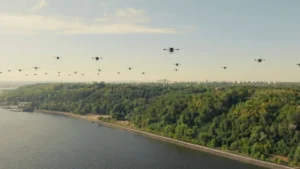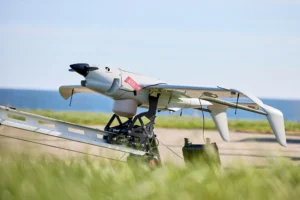
Ukrainian Osa drones were supposedly used to strike Russian strategic aviation
The Osa can carry up to 3.3 kg of payload, remain airborne for up to 15 minutes, and reach speeds of 42 m/s

Collage by Defense Express
The SBU strike on Russian strategic bombers — the Tu-95MS, Tu-22M3, and Tu-160 — at air bases deep within the Russian Federation was likely carried out using Osa (“Wasp”) FPV drones developed by the Ukrainian company First Contact, as reported by Defense Express.
Photographs published during the operation’s preparation show the drones stored in “hives” under the roofs of decoy buildings, which were transported by truck to Russian airfields. The Osa is one of the few FPV drones with a solid enclosed frame housing all electronics and wiring. The power port is fixed into the frame, and one antenna is positioned in the nose near the camera — unlike most other drones, which use open-frame designs with exposed cabling.
The enclosed and durable construction of the Osa was likely crucial for operation in all weather conditions and for surviving transportation by truck across Russian roads.

A detailed image published by Censor.net shows that the drone’s skids are shaped-charge warheads. Final launch preparations reportedly took place within the Russian Federation. A bottom view reveals distinctive ventilation holes, which support identification of the model.
According to the manufacturer, the Osa can carry up to 3.3 kg of payload, fly for up to 15 minutes, and accelerate to 42 m/s (approximately 150 km/h), allowing it to perform reliably even in stormy conditions.
It has also been reported that the drones used in this operation were equipped with artificial intelligence features to detect, identify, and target vulnerable components of enemy aircraft. First Contact was known to be testing AI-enabled drones as early as January 2024.
On 1 June, Ukrainian drones attacked four airfields in Russia housing strategic bombers. The Osas were transported to the sites in trucks, hidden inside specially designed containers disguised as fake houses. The drones were stored in compartments under the roofs of these containers. Upon arrival, the roofs were opened remotely, and the drones launched to strike Russian aircraft, including the Tu-95MS, Tu-160, and Tu-22M3.
According to the General Staff, 41 aircraft were hit, and Russian losses may amount to $7 billion. Up to 34% of all cruise missile carriers in the Russian air force were reportedly damaged.
Reading now
1
F-Drones launches FPV drone simulator, Ukrainians to get free access on August 24
2

British platform Grenadyr has invested in five Ukrainian defence tech startups. Defender is telling its story for the first time
3

60+ new job openings in Ukrainian defence tech: offers from Vyriy, TENCORE, Ukrspecsystems and others
4
Ukrainian company has developed a jet-powered interceptor drone that reaches speeds of over 600 km/h
5
Rise Technologies unveils Nakande digital communications system for drones
By submitting this form, you give Defender Media consent to the processing of personal data.
Надсилаючи цю форму, ви надаєте Defender Media згоду на обробку персональних даних.

Latest news
1
Tencore developed a flamethrower combat module for its TerMIT 2.0 UGV
2
Skyeton has acquired a plot of land in Germany, local media report
3
Norda Dynamics announces partnership with American company Palladyne AI
4
Dutch Tulip Tech developed batteries that can double the flight time of Matrice and Mavic drones
5