CEO of Neros Soren Monroe-Anderson – on scaling Ukrainian office, D3 as investor, Archer FPV drone, and many more
The first interview of the co-founder and CEO of an American FPV drone manufacturer in Ukrainian media

Two weeks ago, Defender Media reported that the American FPV-drone manufacturer Neros Technologies is opening an office in Kyiv. Company co-founder and CEO Soren Monroe‑Anderson clarifies that the representative office actually opened in spring, but is now being significantly scaled up.
The company has long-standing ties to Ukraine: since 2023, it has been cooperating with Ukrainian military forces, and in 2025, delivered 6,000 Archer FPV-drones here after winning the International Drone Capabilities Coalition tender. In addition, one of Neros’ investors is D3 Fund — a Ukraine-based fund whose portfolio is half comprised of Ukrainian projects.
The company is currently actively recruiting for its Ukrainian office. Defender Media spoke with Soren Monroe-Anderson about this and much more in his first interview with a Ukrainian media.
How Neros started
I was a professional drone racing pilot, flying for Team USA in high school and later founding a company in the drone racing space. That experience naturally drew me toward defence tech.
I noticed that no one in the U.S. was producing low-cost drones at scale. Around the same time, Russia’s full-scale invasion of Ukraine began — and when FPV drone footage from the battlefield appeared months later, it confirmed ideas I’d been thinking about for years.
I spent several months researching and prototyping different drone designs, eventually connecting with Ukrainian drone units to understand their real combat challenges. Those conversations directly inspired our first product.
Together with my co-founder Olaf, also a racer and electrical engineer, we built 30 prototypes of the Archer and brought them to Ukraine in September 2023 for field testing and feedback. Seeing FPVs already used at scale convinced us of the need for mass production — so we returned home determined to build a larger team and factory.
The rise of the Archer
After returning from Ukraine, we decided to raise a seed round. Seeing the scale of FPV drone use there made it clear we needed to move fast — and to design all our components in-house to avoid reliance on Chinese supply chains, which dominate the market.
That became our focus for the next 18 months: developing and manufacturing critical components in the U.S. to ensure full domestic production and secure supply.

I’ve been back to Ukraine several times since then. Every version of the Archer has been tested there, with drones sent directly to frontline units. Our long-term goal has always been to secure a production contract to deliver drones to Ukraine at scale.
So when the International Drone Capabilities Coalition launched its tender in June 2024 — funded by Western governments and favouring non-Chinese components and higher performance — it was a perfect fit. We put all company resources into winning it.
In February 2025, Neros officially announced the contract: 6,000 drones for Ukraine under the Coalition programme. We’ve produced and delivered about 1,000 units per month, with deployments across nearly all sectors of the frontline. The diverse feedback we have received from Ukrainian operators has continued to shape each new iteration.
What’s great about Archer, and which Ukrainian manufacturers are worth mentioning
We’ve learned a lot from Ukrainian companies – we’re friends with many of them – and I think they’re doing amazing work.
One of the areas where our drones stand out is jamming resistance. We do all of our own RF development and build our own radios – both the video transmitter and receiver, which is quite rare – as well as our command-and-control transmitters and receivers.
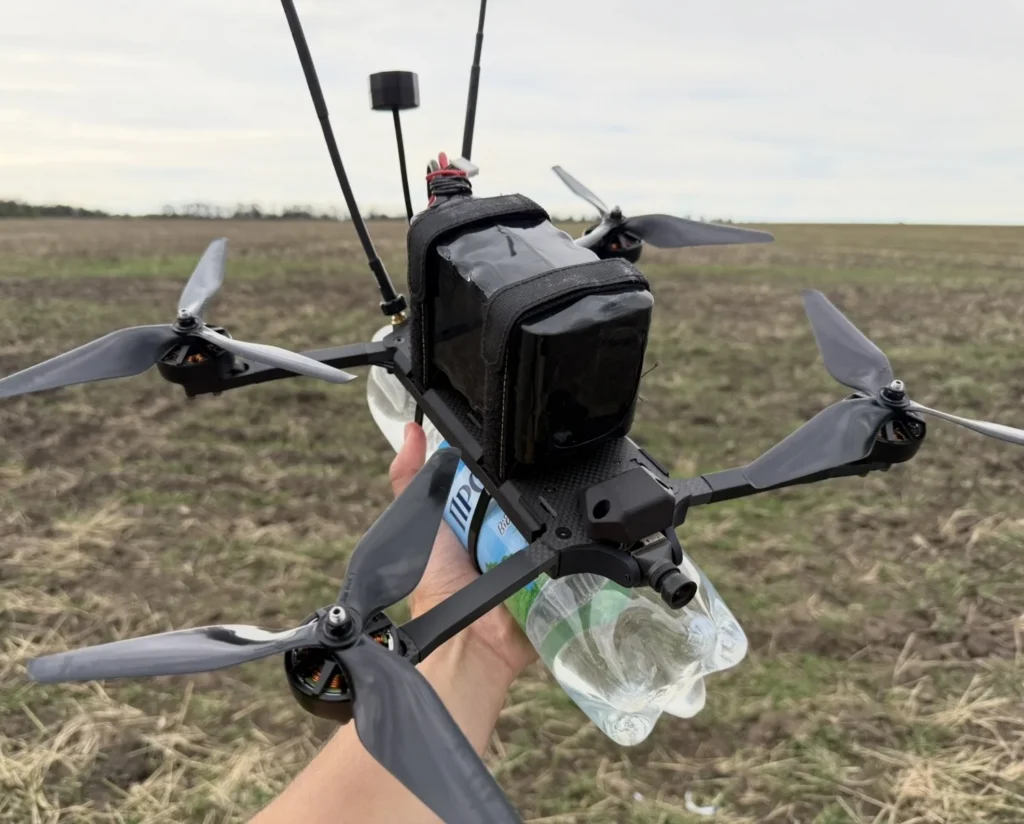
Our performance is strong in both long-range and high-interference environments. We also put a lot of effort into powertrain optimisation, which allows us to achieve impressive payload and range figures on relatively small platforms. Our 8-inch FPV drone can fly 25 kilometres carrying a 2-kilogram payload. Because of that, we’ve seen our drones used for longer-range missions – and by reducing the payload, they can go even further.
As for Ukrainian manufacturers, I think TAF Industries is doing great work. Vyriy as well. I also hear good things about Skyfall quite often. Those are definitely among the top names, and I know people in those companies who I think are doing an excellent job.
How the war in Ukraine has changed the industry
It’s caused a massive shift in the way the U.S. Department of War thinks about drones and unmanned systems in general. The war has sparked a rush — both within the DoW and among private companies — to build better systems and figure out how they can actually be used by U.S. forces.
When we started our company, interest in FPV drones within the DoW was basically zero. Now, across every service branch, we’re constantly being asked how units can spin up their own FPV programmes.
All of this comes directly from what Ukraine has pioneered with FPV drones. It’s been a complete mindset shift – realising that such inexpensive systems can go so far and hit such high-value targets. It’s already turning the industry upside down, but I think this is just the beginning. The Department of War now understands that the U.S. needs this capability.
On raising $35 million at Series A
With our seed funding, we have been able to build a mature, full FPV system – both the drone and the ground station – and scale production to around a thousand drones per month. With the Series A funding, our goal is to develop truly novel technology.
We have access to an incredible pool of engineers here in LA – many coming from Bay Area tech companies and local aerospace firms. There’s such a high concentration of talent, and we’re expanding the team rapidly. We’re also investing heavily in manufacturing capacity, aiming to produce tens of thousands of drones per month. Essentially, it’s about scaling what we’ve already built, while pushing FPV technology into areas that haven’t been explored before.
In terms of customer numbers, the U.S. Department of War is actually our largest client. But we’re absolutely committed to continuing our support for Ukraine as much as we possibly can — even as interest from the DoW keeps growing.
About using Chinese components
We’ve faced the same challenge everyone encounters when building FPV drones — making everything outside of China is really difficult. Components like motors have historically been hard to replace. But we’ve actually found a solution for motors, and now nearly every major part of our bill of materials is either already China-free or will be very soon.
I’m not criticising Ukrainian companies for using Chinese components — they offer the best quality-to-price ratio and can scale production quickly. In wartime, you do what you have to do. But our long-term vision is to build a fully independent drone supply chain.
It definitely costs more to produce everything in the U.S., and that cost difference will remain for some time. But if the cost gap were massive, it would mean we weren’t doing our job well enough. There are already examples of manufacturing in the U.S. that are actually more efficient — so while Neros manufacturing will be more expensive for now, the difference shouldn’t be so large that it stops us from staying competitive.
About the next step
One of the main areas we’re focusing on is continuing to evolve jamming-resistant radios and pushing forward with autonomy.
Our current product is a manually piloted FPV drone, but we’re strong believers in autonomy, and we’re already taking steps to integrate it into our systems. Eventually, we want to reach the stage of fully autonomous drone swarms – so we’re mapping out practical steps along the way to get there.

We’re also continuously increasing vertical integration. Any component we don’t currently design or manufacture ourselves, we plan to bring in-house. That allows us to control more of the supply chain and the ability to swiftly optimise design for higher performance. In short, anything that falls within the FPV ecosystem is something we’re probably working on.
About D3
D3 participated in both our seed round and Series A. On my first trip to Ukraine, we met Evelyn and the D3 team, and we were really impressed by them — not just as investors, but by how hands-on they are in supporting companies working in Ukraine. They’ve been incredibly helpful, assisting us in setting up our Ukrainian office, connecting us with end users, and supporting our local operations overall.
It’s been fantastic working with them — they have a deep practical understanding of the landscape and can help with any challenge. We’re very grateful to have them as investors.
Office in Kyiv
This past spring, we opened a small office in Kyiv focused on support and tech development. It was just a few people, but we saw it as essential to have technical support available in-country for our customers.
We’ve been deeply impressed by the technology being developed in Ukraine. Our chief engineer there is outstanding; he leads new tech development and works on integration projects with Ukrainian companies. So the office serves three main purposes: supporting end users, developing new technology, and collaborating with local innovators.
Now that we’re scaling up our operation in Ukraine, we’re actively looking for a Country Manager, Business Development Lead, Customer Support, and, of course, more engineers.
Reading now
1
SkyFall officially unveils Thor Hammer mid-strike and announces 1,000+ km version
2

260+ vacancies in Ukrainian defence technology at BlueBird Tech, Sine Engineering, Buntar Aerospace and more
3
British-Ukrainian Occam Industries raises €3.8m. The funds will go towards scaling drone autonomy software
4
Terra Drone acquires 50% of Ukrainian Kurin Technologies for $3.5 million
5

Autonomous interceptor drones need radars to work. Why is there still a lack of them
By submitting this form, you give Defender Media consent to the processing of personal data.
Надсилаючи цю форму, ви надаєте Defender Media згоду на обробку персональних даних.

Latest insights
1
Everything about the RAM-2X mid-strike drone: interview with Ukrspecsystems deputy director Andrii Rymaruk
2

A demo is not demand: How to prove the value of a defence tech product. Column by Tekever Ukraine Director Kateryna Bezsudna
3
How to choose the right video link for an FPV drone: analogue, digital, or fibre-optic?
4
How a frontline signal becomes an engineering task. A column by Defence Builder Accelerator Director Yana Shkvarovska
5