
Can Europe afford a war of expensive platforms? DevDroid co-founder on the cost of modern warfare
The cost of a weapon is becoming as important a characteristic as its range, accuracy and protection, argues the expert

Today, the two-day DALO Industry Days 2026 conference has kicked off in Denmark, with many Ukrainian defence companies taking part. One of them is DevDroid, a Ukrainian manufacturer of UGVs, robotic turrets and components.
Ahead of the conference, the company’s co-founder Oleh Prots prepared a column for Defender Media on cost efficiency in defence. He argues that cost is becoming just as important a characteristic of a weapon as range, accuracy or protection — and that it is in Europe’s interest to realise this as soon as possible.
For decades, the technological superiority of armies was determined primarily by large platforms — tanks, artillery systems, aircraft and air defence systems. Defence doctrines, government weapons programmes and production strategies of major defence companies were built around them. Today, this approach is changing under the influence of the war in Ukraine. It has shown that the high cost and technological sophistication of an individual platform no longer guarantee an advantage on the battlefield.
A modern tank costing millions of dollars can be damaged or destroyed by several relatively cheap FPV drones. At the same time, a dozen more affordable robotic systems performing routine combat and logistics tasks can deliver a greater overall effect than a single extremely expensive vehicle. This is especially true when tasks must be performed every day across multiple parts of the frontline and under conditions where equipment losses are inevitable.
That is why the concept of cost efficiency — the ratio of combat effect achieved to resources spent — is increasingly becoming part of the conversation. It expands the traditional understanding of weapons effectiveness, which for a long time was defined primarily by range, calibre, speed, protection and power.
Mass-produced systems as a separate level of capability
Clearly, armoured vehicles, artillery and aviation remain necessary and, in many cases, irreplaceable. At the same time, they cannot economically or physically cover the entire range of daily tasks on the battlefield.
Delivering ammunition, evacuating wounded soldiers, reconnaissance, mining, fire support and operations in the most dangerous areas require large numbers of systems. This is where compact aerial, ground and maritime robotic systems are becoming increasingly important. They can be mass-produced, deployed in large numbers, repaired quickly and replaced. They allow militaries to achieve significant combat effects at a lower cost, while the loss of a single system does not stop a mission.
That is why even manufacturers that have focused on complex and expensive weapons systems for decades are now expanding their portfolios with mass-produced solutions. For example, Rheinmetall, best known for its armoured vehicles and artillery, has launched serial production of HERO loitering munitions under licence from Israeli company UVision Air. In 2026, the German giant also unveiled its own FV-014 kamikaze drone.
The cost of a weapon should match the mission
The war in Ukraine has shown that an army’s ability to fight for years depends on a continuous supply of systems that match current battlefield conditions and needs. That is why, based on our painful experience, allies are increasing defence budgets to ensure they can maintain a high operational tempo in the event of escalation.
But increasing budgets alone does not guarantee the desired result. If additional funding is directed only towards very expensive systems that take years to produce and arrive in limited quantities, Europe risks ending up with technologically advanced but too-small capabilities that will not be sufficient for a prolonged and, crucially, asymmetric war.
The example of Patriot interceptor missiles is telling. In 2025, production of PAC-3 MSE missiles reached a record 620 units. At the same time, according to open-source estimates, during the first 96 hours of large-scale Iranian attacks, the US and its partners used more than 800 Patriot interceptors of various modifications against missiles and drones. The gap between the production rate of expensive interceptors and the potential scale of their use during intense combat is obvious.
This problem becomes particularly acute when scarce missiles are used against relatively cheap Shahed-type strike drones. The complexity and cost of countermeasures should correspond to the nature of the threat and the expected result: expensive interceptors should be reserved for targets for which there is no effective alternative, while mass attacks involving cheaper systems should be countered with more affordable solutions.
The question of whether a system’s cost matches the nature of the threat applies at every operational level. For example, delivering ammunition to the frontline does not always require a large protected vehicle with a crew. For medical evacuation, key factors include mobility, payload capacity, range and the ability to safely return from the engagement zone. In reconnaissance, mining, demining and fire support, the choice of platform should likewise be determined by the specific mission requirements — the necessary range, payload capacity, mobility, level of protection and acceptable cost of deployment.
Ukrainian cases: combat results at lower cost
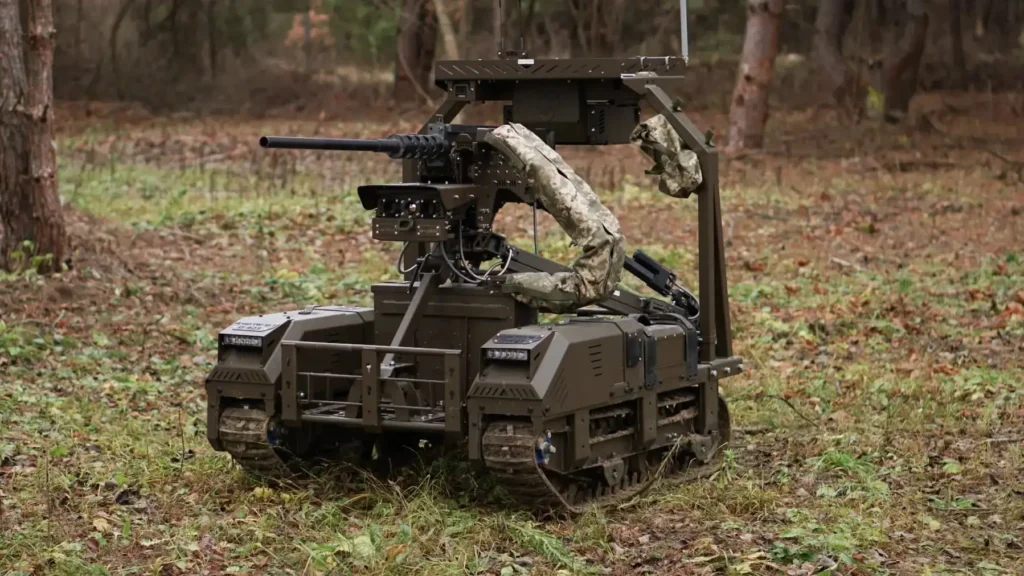
Real-world combat cases in Ukraine confirm this logic. During one operation, our Droid TW 12.7 UGV destroyed an enemy MT-LB along with its crew. The relatively compact robotic platform, equipped with a 12.7 mm M2 Browning machine gun, achieved a combat effect against a significantly heavier armoured target.
A similar cost asymmetry between the weapon and the target can be seen in the air. The Ukrainian Shrike 10 FPV drone hit a Russian Mi-28 attack helicopter. The subsequent fate of the Mi-28 has not been publicly confirmed, but the case itself clearly demonstrates the difference between the cost of the weapon and the potential value of the target.
This asymmetry is even more pronounced at sea. Ukrainian naval drones have been used to strike and destroy significantly larger Russian warships. There are already dozens of such cases. We can see how relatively compact unmanned systems can pose a threat to large and expensive naval platforms.
It is also worth highlighting cases where the effect is achieved through the interaction of different robotic systems. During an operation on the Kinburn Spit, an unmanned surface vessel delivered a ground robotic system equipped with a Wolly 7.62 combat module to the occupied coast. This combination made it possible to divide the mission into stages between platforms, each adapted to its own environment and specific function.
Another example is a robotic assault in which a Droid TW 12.7 UGV operated together with UAVs. The ground system delivered the initial fire strike against the enemy position, after which aerial drones completed the engagement.
These operations show that effectiveness also depends on how well different robotic systems are integrated. Ground, aerial and maritime platforms can perform different stages of the same mission, complementing each other’s capabilities while reducing overall costs and risks.
A new logic for defence procurement
Europe needs to assess future procurement based on how well its arsenal matches the real tempo and nature of modern warfare. A multi-layered model makes it possible to preserve complex platforms for missions where their capabilities are critical, while using mass-produced robotic systems for routine operations.
Cost is becoming just as important a characteristic of a weapon as range, accuracy or protection. Europe’s ability to withstand a prolonged confrontation will depend on how quickly this criterion is incorporated into procurement and defence planning.

Oleh Prots
DevDroid Co-founder
Reading now
1
SkyFall officially unveils Thor Hammer mid-strike and announces 1,000+ km version
2
Pentagon to hold Drone Dominance trials for bomber drones, with UFORCE, Gurzuf Defence, Grim Tech and others taking part
3

Terra Drone acquires 50% of Ukrainian Kurin Technologies for $3.5 million
4
British-Ukrainian Occam Industries raises €3.8m. The funds will go towards scaling drone autonomy software
5

Frontline Robotics CBDO Mykyta Rozhkov: Ukraine and Norway are working on an autonomous system to protect maritime infrastructure
By submitting this form, you give Defender Media consent to the processing of personal data.
Надсилаючи цю форму, ви надаєте Defender Media згоду на обробку персональних даних.

Latest insights
1
Everything about the RAM-2X mid-strike drone: interview with Ukrspecsystems deputy director Andrii Rymaruk
2

A demo is not demand: How to prove the value of a defence tech product. Column by Tekever Ukraine Director Kateryna Bezsudna
3
How to choose the right video link for an FPV drone: analogue, digital, or fibre-optic?
4

How a frontline signal becomes an engineering task. A column by Defence Builder Accelerator Director Yana Shkvarovska
5