
Fatigue as an engineering risk: why a workspace is infrastructure, not furniture
A column by Oleksandra Samokhinа, co-founder of Ukrainian manufacturer TEHNOTABLE, which equips workspaces for technology and defence tech teams
Photos courtesy of TEHNOTABLE
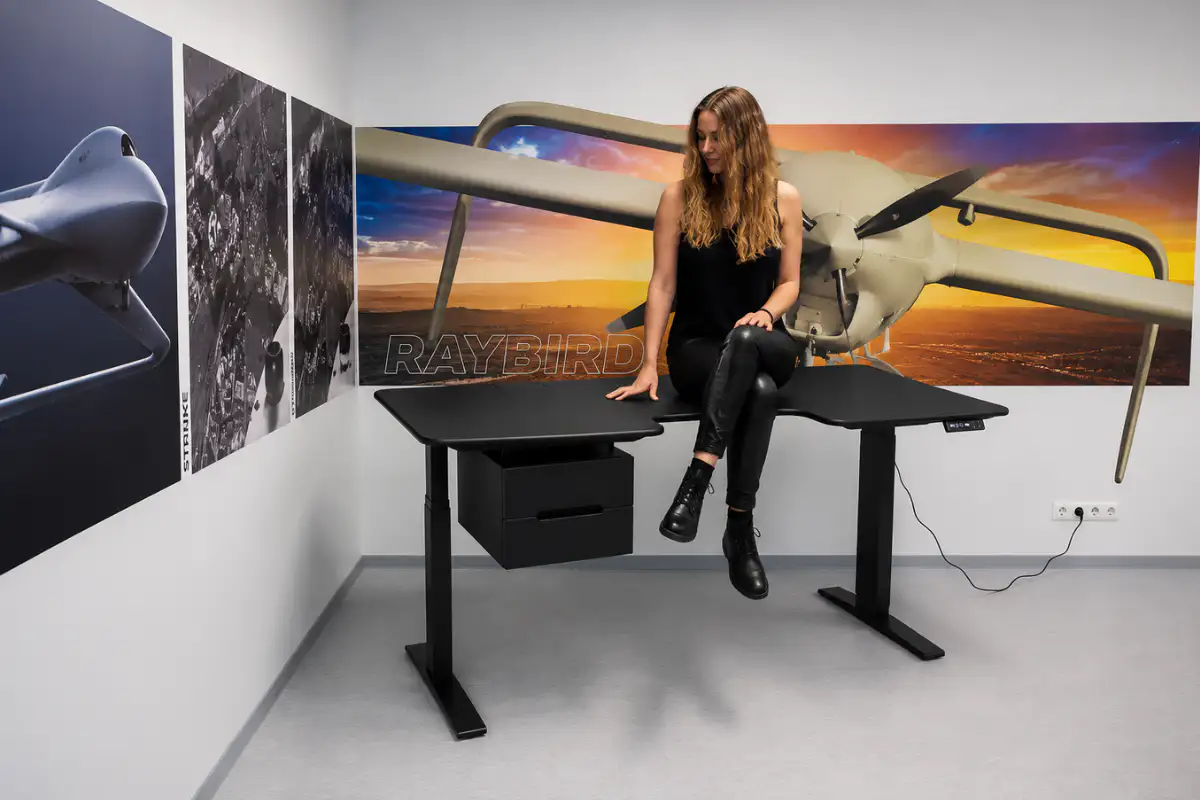
Ukrainian technology sector is operating at its limit right now. Engineers, developers, systems operators spend ten to twelve hours at their workstations — and this is not a temporary crunch, but a mode in which teams have lived for the fourth consecutive year. In these conditions, the question “how comfortable is it for a person to sit” ceases to be a question of comfort. It becomes a question of solution quality.
The price of fatigue that nobody counts
When we discuss risks in engineering teams, we usually mention burnout, deadlines, staff shortages. Physical fatigue from the workspace rarely makes it to this list — it accumulates quietly and has no dedicated line in any report. And that is a mistake: an uncomfortable workspace affects not just the back, but directly the ability to think. The mechanics are straightforward. The brain continuously processes signals not only from the task at hand, but also from the body. If a person has to compensate for an unsuitable desk height, strain their neck because the monitor sits too low, or hold their back without proper support, a portion of cognitive resources is spent on this continuously. Research in cognitive ergonomics shows a consistent result: the number of minor errors rises, decision-making speed drops, attention starts to “slip” from the task.
For a company where an engineer makes dozens of technical decisions a day, this is not abstract. It is a calculation error, a defect missed during testing, an unnecessary iteration where there could have been one.
Static exhaustion is more draining than strain
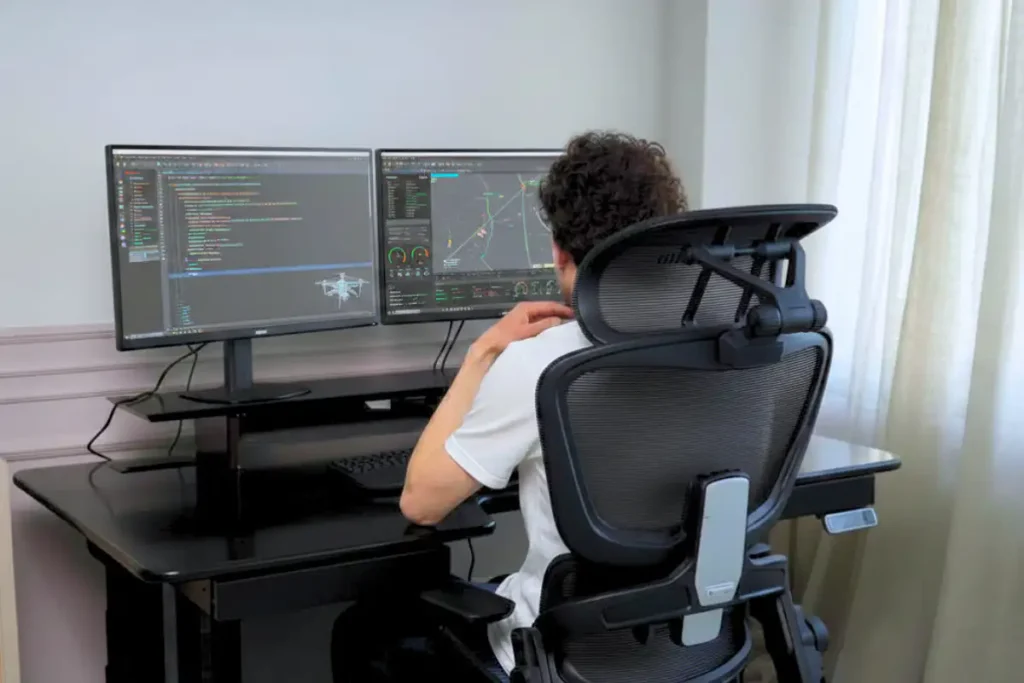
The paradox of sedentary work is that the most fatiguing part is not movement, but its absence. During hours of sitting, the muscles of the back, neck and shoulders work in a static mode — continuously, without recovery phases. This is why at the end of a day at the monitor a person can feel as exhausted as if they had done physical work.
A common misconception is to think the solution is to work standing. This is not so: standing for eight hours is no better than sitting for eight hours. What works is alternation. Ergonomists converge on an interval of approximately 40–45 minutes: by changing body position with this frequency, a person prevents static strain from accumulating. For this to work, the workspace must allow position changes within seconds, without the ritual of moving equipment around — which is precisely why demand for electrically height-adjustable desks has become standard, rather than a luxury, in engineering teams over recent years.
What we see in results-driven companies
Over seven years working at TEHNOTABLE, we have equipped workspaces for companies across different sectors — from product-focused IT teams to manufacturers of unmanned systems. And we have noticed a characteristic shift: whereas previously ergonomics was a bonus from the “perks for retention” category, technology companies now approach it as infrastructure — using the same criteria as for servers or development tools.
In practical terms, this is a handful of solutions that deliver the greatest effect per unit of investment.
Adjustable height as a baseline requirement. Not so people can “stand up occasionally,” but so the desk adapts to the anthropometry of the particular person. There is no universal correct desk height — the correct one is the height at which the elbows lie at an angle of approximately 90 degrees and the shoulders are relaxed.
Monitor at eye level. The cheapest ergonomic intervention with the largest effect for the cervical spine. A bracket or stand costs incomparably less than chronic strain on a key engineer.
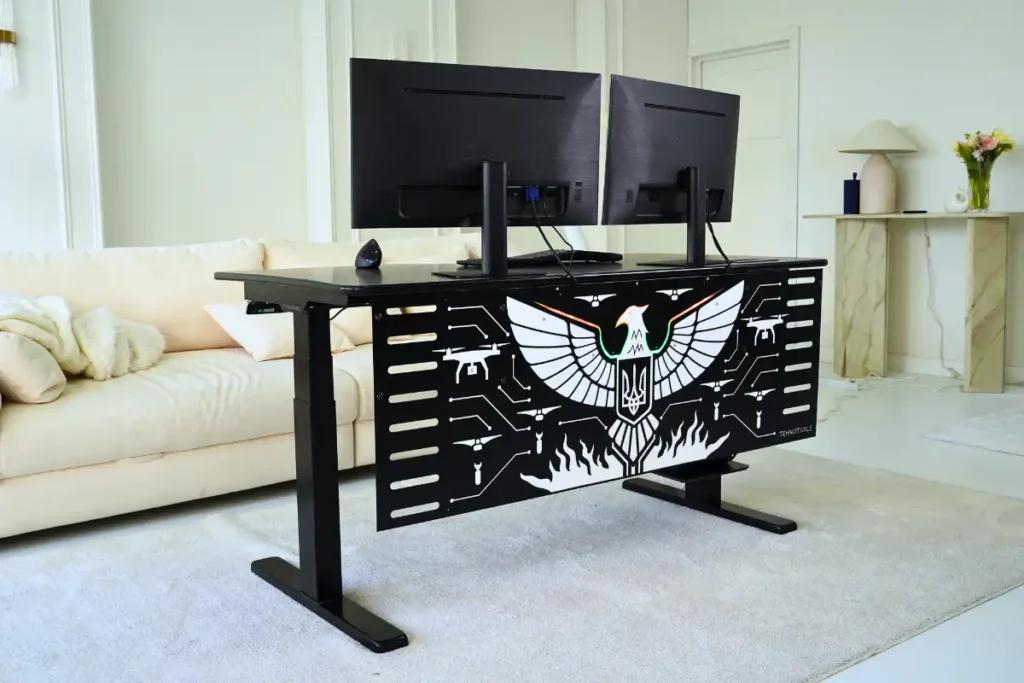
Order in cables and on the workspace surface. This is not aesthetics. Visual noise is a real irritant that the brain processes continuously. In operations and engineering spaces where a single desk has multiple monitors and peripherals, cable management directly affects the ability to concentrate.
A space that signals the working mode. The brain ties behaviour to context: a permanent, properly organised workspace reduces the time to achieve concentration. For teams working in hybrid format, this is an argument for equipping home workspaces for key people — a practice we increasingly see among Ukrainian technology companies.
Local production as a resilience factor
There is another dimension specific to our market. For companies in the security and defence sector, what matters is not only the product but also the supply chain: the ability to scale procurement quickly, adapt solutions to non-standard tasks — from operator stations to design offices — and receive service without multi-month logistics cycles. A full production cycle within the country transforms furniture from an import item into a managed infrastructure asset.
Instead of a conclusion
Team productivity rarely comes down to motivation — motivation is fine in Ukrainian tech. It much more often comes down to small details that daily take away several percentage points of attention: a desk that is not the right height, a monitor below eye level, cable chaos, light reflecting off the screen.
The good news is that this is one of the few risks that can be addressed once and predictably. Setting up a workspace correctly is an engineering problem with a known solution. And at a time when the country’s primary resource is people who think, this task is certainly worth putting on the backlog.
This material was created with the support of TEHNOTABLE 
TEHNOTABLE is a Ukrainian full-cycle manufacturer of ergonomic workspaces: in-house production in Kyiv Oblast, height-adjustable electric desks, bespoke B2B solutions. Clients include technology and defence tech companies in Ukraine.
Reading now
1
“His opponents’ victory could become a defeat for Ukraine”. How the defence tech market is reacting to Mykhailo Fedorov’s resignation
2

German Helsing raises $1.8bn in investment and appoints a new managing director in Ukraine
3

SkyFall, F-Drones and seven other Ukrainian manufacturers become founding members of EU-Ukraine drone alliance
4

SkyFall unveils new P1-SUN JetKiller interceptor drone against jet-powered Shaheds
5

Farsight Vision has developed a tool that determines a drone’s position from intercepted video
By submitting this form, you give Defender Media consent to the processing of personal data.
Надсилаючи цю форму, ви надаєте Defender Media згоду на обробку персональних даних.

Latest news
1

Court decides not to seize funds confiscated from Vyriy Industries during searches
2

General Lebedenko: Ukraine to receive domestic laser air defence systems within quarter
3
KAI and Fire Point launch bachelor’s programme for deftech engineers with €800 monthly scholarships
4

Deviro develops mid-strike drone Palytsia – cheaper alternative to Bulava
5